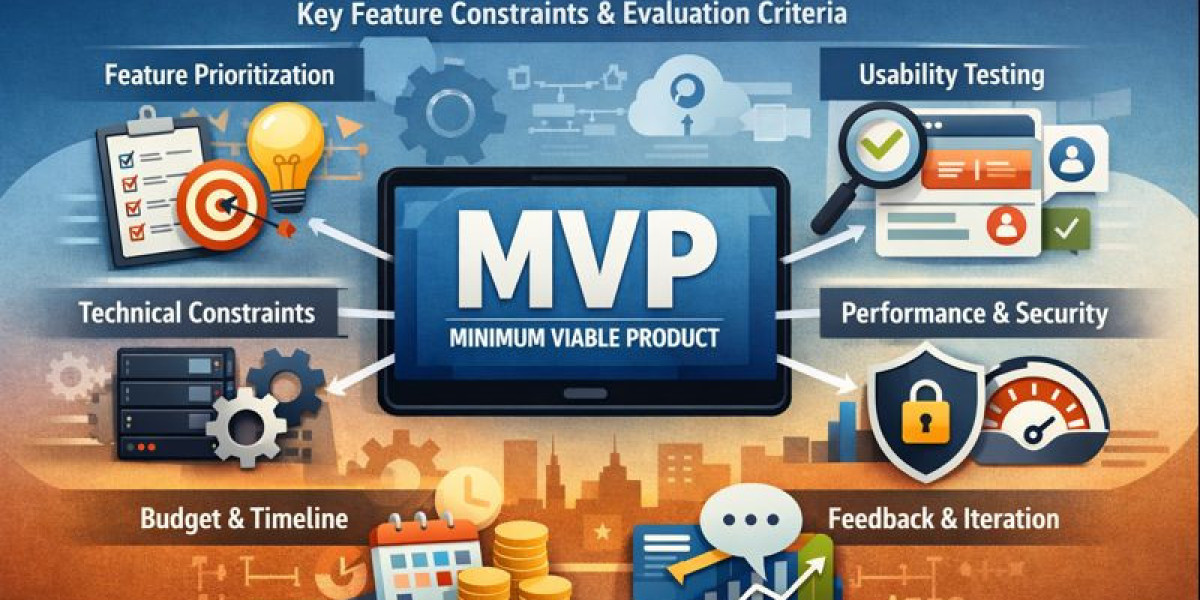

Building a successful minimum viable product requires disciplined decisions grounded in evidence, constraints, and clearly defined outcomes. At the MVP stage, teams must balance speed with learning while avoiding unnecessary complexity. This is where structured evaluation becomes essential. Organizations often rely on an MVP App Development Company to help translate user problems into testable assumptions, ensuring early releases remain focused. By defining scope around real user needs and measurable results, product teams can validate direction early, reduce uncertainty, and establish a foundation for informed iteration without overengineering or strategic drift.
A well-defined scope ensures the MVP does not attempt to solve every problem at once. Instead, it concentrates on the smallest set of capabilities required to test core hypotheses.
Key principles for defining scope include:
Identifying a single primary user problem worth solving first
Clarifying the desired behavioral or operational outcome
Documenting assumptions that must be validated early
Explicitly excluding features that do not support learning objectives
Clear scope definition creates alignment across design, engineering, and business stakeholders. It also provides a benchmark against which every feature decision can be evaluated, reducing the risk of feature creep during early development.
Prioritizing Features Using Data, Risk, and Value Signals Early
Feature prioritization at the MVP stage should be driven by evidence rather than intuition alone. Each proposed capability must be evaluated through the lens of learning value, implementation risk, and user impact. Features that offer the highest insight with the least complexity typically deserve priority.
Effective prioritization frameworks often consider:
User frequency and severity of the problem addressed
Risk reduction potential for technical or market assumptions
Dependencies that may block future iterations
Effort relative to the knowledge gained
Quantitative inputs such as analytics projections and qualitative inputs such as user interviews both contribute to balanced decisions. Prioritization is not static; it should be revisited as soon as new data emerges. This disciplined approach ensures the MVP remains a learning tool rather than a diluted version of a full product.
Technical Constraints That Shape Early Architecture Decisions
Technical constraints play a defining role in shaping MVP architecture. Early decisions should favor flexibility and speed over long term optimization. Overly complex architectures can slow delivery and obscure learning signals, while overly simplistic designs may limit the validity of results.
Common technical constraints to evaluate include:
Platform requirements and device compatibility
Integration needs with existing systems
Data storage, synchronization, and access patterns
Team skill sets and tooling familiarity
Architectural choices should support rapid iteration, observability, and controlled scalability. Decisions made at this stage are not permanent, but they should be intentional. Understanding constraints early helps teams avoid rework while still preserving the ability to evolve the system as validated needs emerge.
Evaluating Usability and Experience Metrics at MVP Stage Testing
Usability is often the most immediate signal of MVP effectiveness. If users cannot easily understand or complete core tasks, other metrics become irrelevant. Experience evaluation at this stage should focus on clarity, efficiency, and perceived value rather than visual polish.
Key usability evaluation criteria include:
Time required to complete primary tasks
Error frequency and recovery ease
User comprehension without external guidance
Consistency across key interaction flows
Lightweight testing methods such as moderated sessions and task based evaluations are often sufficient. The goal is to identify friction that prevents users from reaching the intended outcome. Usability findings should directly inform iteration priorities, ensuring improvements are guided by real user behavior rather than assumptions.
Performance, Security, and Scalability Evaluation Criteria Benchmarks
Even at the MVP stage, nonfunctional requirements cannot be ignored. Performance, security, and scalability establish trust and reliability, both of which influence user adoption and retention.
Evaluation benchmarks typically focus on:
Acceptable response times under expected load
Basic data protection and access control measures
System behavior under moderate growth scenarios
These criteria should be right sized to the MVP’s purpose. Excessive hardening can waste resources, while neglecting fundamentals can invalidate results or introduce risk. Thoughtful benchmarks help teams deliver a product that is credible and stable enough to support meaningful evaluation.
Balancing Development Effort, Time, and Budget Constraints Realities
Constraints related to effort, timeline, and cost are inseparable from MVP planning. Every feature and quality decision carries trade offs that must be evaluated transparently. Understanding MVP app development cost early enables realistic planning and prevents scope expansion from undermining learning goals.
To manage constraints effectively, teams often:
Break work into clearly estimable increments
Identify features with disproportionate effort relative to value
Reserve capacity for post launch adjustments
Track actual effort against initial assumptions
Constraint awareness supports better decision making throughout development. It also reinforces the discipline required to stop building once learning objectives are met, preserving resources for subsequent iterations or pivots.
Feedback Loops and Validation Methods for Iterative Improvement
The MVP’s value lies in its ability to generate actionable feedback. Without structured validation methods, even well built products can fail to produce insight. Feedback loops should be designed alongside features, not added later.
Common validation methods include:
Behavioral analytics tied to key actions
Qualitative feedback from targeted user groups
Comparative testing of alternative flows
Monitoring drop off and engagement patterns
These methods support continuous learning and guide refinement. When combined with broader mobile app development solutions, feedback insights help teams align technical adjustments with evolving user expectations, ensuring iterations remain purposeful and evidence based.
Conclusion
A disciplined approach to constraints and evaluation criteria transforms the MVP from a rushed deliverable into a strategic learning instrument. By clearly defining scope, prioritizing features through evidence, respecting technical and operational constraints, and establishing robust feedback loops, teams can make confident decisions grounded in real data. This structured mindset reduces waste, clarifies direction, and accelerates meaningful progress. Ultimately, success at the MVP stage depends less on how much is built and more on how thoughtfully each decision supports learning, validation, and informed evolution.