
Modern robotics, CNC rotary tables, and automation platforms require compact bearings with extreme rigidity. However, traditional bearing setups often increase assembly complexity and reduce positioning accuracy.
This is where the RU cross roller bearing becomes a reliable solution for engineers demanding stability and precision.
The Industry Problem – Complex Assembly and Low Rigidity
In high-precision machinery, common issues include:
Multiple bearings required for different load directions
Alignment errors during installation
Insufficient rigidity under moment loads
Increased vibration affecting accuracy
Limited installation space
Using separate inner and outer ring structures can complicate housing design and increase tolerance stacking errors.
The Solution – What Is an RU Cross Roller Bearing?
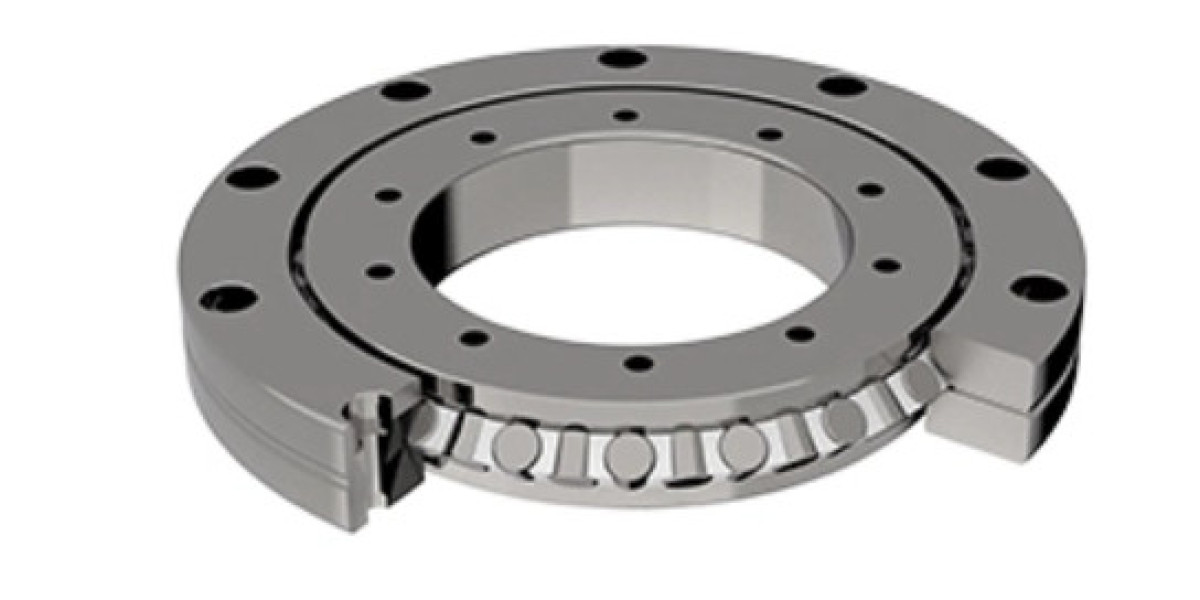
The RU cross roller bearing is an integrated inner and outer ring type cross roller bearing.
Unlike split ring designs, the RU type features a single-piece structure with mounting holes on both rings. This allows direct bolt mounting without additional flanges or housings.
It is designed for:
High rigidity
Compact structures
Easy installation
Multi-directional load support
How RU Cross Roller Bearings Work
The bearing contains cylindrical rollers arranged alternately at 90 degrees to each other.
This cross arrangement allows the bearing to handle:
Radial loads
Axial loads (both directions)
Moment loads
Because the inner and outer rings are integrated, structural rigidity improves significantly. The mounting holes simplify installation while maintaining high rotational accuracy.
This design reduces deformation and ensures smooth motion under heavy loads.
Problems with Traditional Cross Roller Bearings
Older or standard cross roller designs often include split rings or require additional fixing plates.
1. Complex Installation
Extra flanges and housings increase assembly time.
2. Alignment Sensitivity
Improper mounting affects rotational accuracy.
3. Reduced Structural Stiffness
Non-integrated designs may deform under load.
4. Higher Maintenance Risk
More components increase failure points.
These issues can compromise robotic and precision system performance.
How RU Cross Roller Bearings Solve These Issues
The integrated structure of RU type bearings provides:
High structural rigidity
Simplified direct bolt mounting
Reduced alignment errors
Lower assembly cost
Improved rotational accuracy
By combining load capacity and installation convenience into one design, the RU cross roller bearing enhances both performance and efficiency.
Key Features of RU Cross Roller Bearings
Integrated Inner & Outer Rings
Improves stiffness and reduces structural deformation.
Mounting Hole Design
Allows direct installation without additional flanges.
High Load Capacity
Supports radial, axial, and moment loads simultaneously.
High Rotational Accuracy
Suitable for precision positioning systems.
Compact Structure
Saves installation space in automation equipment.
These features make RU type bearings ideal for high-end industrial applications.
Comparison – RU Type vs Standard Cross Roller Bearings
| Feature | RU Cross Roller Bearing | Standard Cross Roller |
|---|---|---|
| Ring Structure | Integrated | Split or separate |
| Installation | Direct bolt mounting | Requires flange |
| Rigidity | Very High | High |
| Assembly Complexity | Low | Moderate |
| Alignment Accuracy | Improved | Sensitive |
| Ideal Application | Robotics, CNC tables | General precision systems |
For equipment where space, rigidity, and easy installation matter, RU type provides clear advantages.
Real Industrial Applications
RU cross roller bearings are widely used in:
Industrial robot joints
CNC rotary tables
Automation indexing platforms
Semiconductor manufacturing equipment
Precision inspection systems
Medical imaging devices
In these systems, stable rotation and accurate positioning are critical for productivity.
Why Manufacturers Prefer RU Cross Roller Bearings
Engineers and OEM buyers choose the RU cross roller bearing because it:
Reduces installation time
Improves structural rigidity
Minimizes vibration
Supports compact machine design
Enhances long-term reliability
For B2B manufacturers, simplified assembly also reduces labor costs and alignment errors during production.
How to Choose the Right RU Cross Roller Bearing
Selecting the correct bearing requires technical evaluation.
1. Load Analysis
Calculate radial, axial, and moment loads accurately.
2. Dimensional Compatibility
Confirm inner diameter, outer diameter, and mounting hole pattern.
3. Required Precision Level
High-accuracy equipment requires tighter tolerances.
4. Operating Environment
Consider temperature, lubrication, and contamination factors.
5. Speed Requirements
Ensure the bearing matches rotational speed demands.
Careful selection ensures optimal system performance and extended service life.
Conclusion
As automation and robotics continue to evolve, bearing performance directly influences machine accuracy and stability. Traditional multi-component designs increase complexity and alignment risks.
The RU cross roller bearing offers integrated structure, high rigidity, and simplified installation, making it ideal for precision equipment.
For manufacturers focused on compact design, stable motion, and long-term reliability, RU type cross roller bearings provide a practical and high-performance solution.