
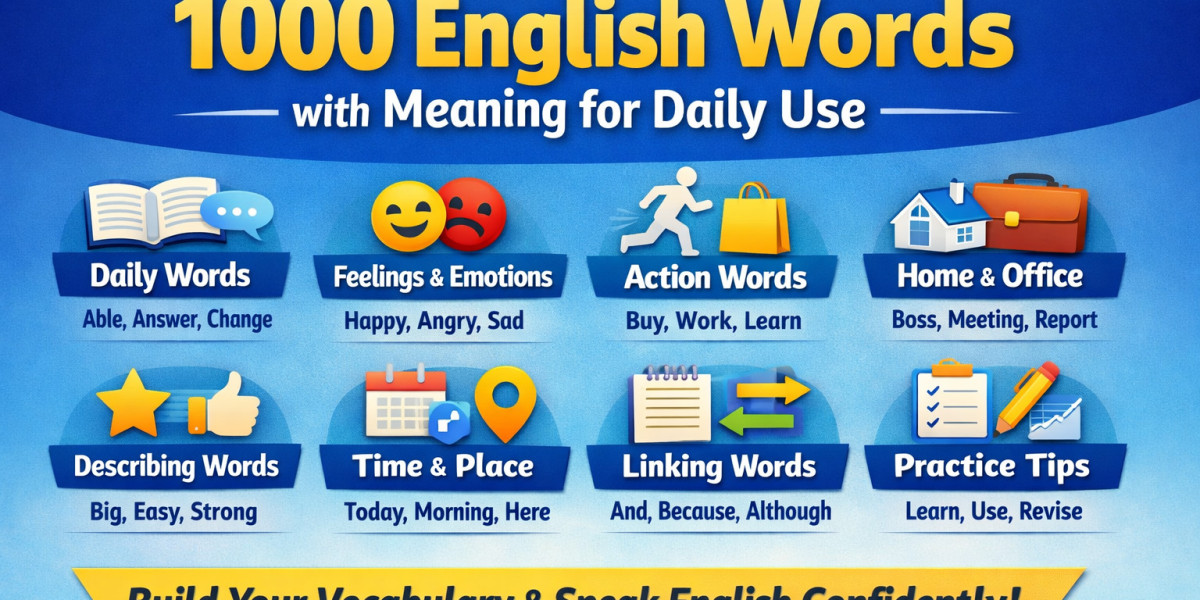

Building a strong vocabulary is the foundation of good English communication. Whether you want to speak fluently, write confidently, or score better in exams like IELTS, learning 1000 English words with meaning can dramatically improve your daily English usage. These commonly used words appear in conversations, news, emails, interviews, and everyday situations.
This blog will help you understand why learning the essential 1000 English words matters, how to use them daily, and how to master them effectively with meanings and examples.
Why Are 1000 English Words Important?
Research shows that knowing the most frequently used English words helps you understand nearly 80% of daily conversations. You don’t need complex or advanced vocabulary to speak good English—you need the right words, used correctly.
Learning 1000 English words with meaning helps you:
Speak English confidently in daily life
Understand movies, news, and conversations
Improve spoken and written English
Prepare for exams like IELTS, PTE, and TOEFL
Build a strong foundation for advanced vocabulary
How to Learn 1000 English Words Effectively
Instead of memorizing random words, learn them category-wise and use them in sentences. Practice daily, revise often, and apply words in real conversations.
Below are essential daily-use English words grouped into useful categories.
1. Common Daily Use English Words with Meaning
These words are used in everyday conversations at home, office, or with friends.
Able – having the skill or power to do something
Accept – to agree to receive something
Advice – a suggestion to help someone
Allow – to give permission
Answer – a reply to a question
Begin – to start
Believe – to think something is true
Bring – to take something with you
Change – to make something different
Choose – to select one option
2. English Words for Emotions and Feelings
These words help express thoughts and emotions clearly.
Angry – feeling mad
Happy – feeling pleased or joyful
Sad – feeling unhappy
Excited – very happy and interested
Fear – feeling afraid
Proud – feeling happy about an achievement
Relaxed – calm and stress-free
Nervous – feeling worried or anxious
Confident – believing in yourself
Surprised – feeling shocked
3. Action Words (Verbs) for Daily Use
Action words are essential for speaking and writing sentences.
Ask – to request information
Buy – to purchase something
Call – to talk on the phone
Clean – to make something neat
Cook – to prepare food
Drive – to operate a vehicle
Help – to assist someone
Learn – to gain knowledge
Meet – to see someone
Work – to do a job
4. English Words Used at Home and Office
These words are commonly used in professional and personal settings.
Boss – a person in charge
Client – a customer
Colleague – a co-worker
Deadline – the last date to complete work
Document – written information
Meeting – a formal discussion
Office – workplace
Project – planned work
Report – detailed information
Salary – monthly payment
5. Describing Words (Adjectives)
Adjectives make your English more clear and expressive.
Big – large in size
Small – little in size
Fast – quick
Slow – not fast
Easy – not difficult
Difficult – hard to do
Important – valuable or necessary
Interesting – enjoyable
Strong – having power
Weak – lacking strength
6. English Words for Time and Place
These words are used in daily schedules and conversations.
Today – the current day
Tomorrow – the next day
Yesterday – the day before today
Morning – early part of the day
Evening – late part of the day
Here – in this place
There – in that place
Near – close
Far – at a distance
Around – nearby
7. Common Linking Words
These words help connect sentences smoothly.
And – used to add information
But – shows contrast
Because – gives a reason
So – shows result
Although – shows contrast
If – shows condition
When – refers to time
While – during the time
Therefore – as a result
However – but
How to Practice 1000 English Words Daily
To truly master 1000 English words with meaning, follow these tips:
Learn 10–15 words daily
Make sentences using each word
Speak words loudly to improve pronunciation
Revise words every weekend
Use words in real conversations
Write short paragraphs using new words
Consistency is the key to vocabulary success.
Final Thoughts
Learning 1000 English words with meaning is one of the smartest ways to improve your daily English. These essential words help you speak clearly, understand better, and express ideas confidently. Instead of focusing on difficult vocabulary, master the most commonly used English words first.
If you practice daily and apply these words in real life, your English fluency will improve faster than you expect.