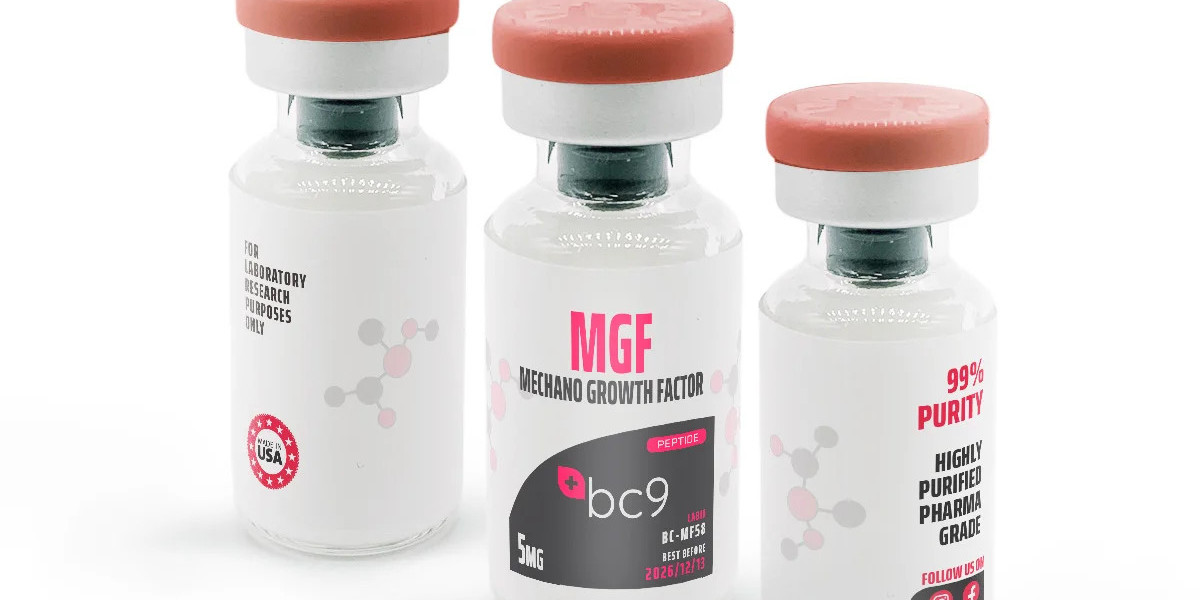

Mechano Growth Factor (MGF) is a splice variant of insulin-like growth factor-1 (IGF-1) expressed in response to mechanical overload and tissue injury. Structurally distinct due to its unique E-domain sequence, MGF demonstrates rapid local expression following skeletal muscle damage and is widely investigated in controlled laboratory environments for its regenerative signaling profile.
In preclinical research settings, MGF peptide is utilized exclusively for in vitro and in vivo experimental protocols. Investigators evaluate its influence on satellite cell activation, protein synthesis pathways, muscle fiber hypertrophy, and tissue remodeling. Structured dosing strategies are central to experimental reproducibility, making dosage protocols a critical variable in MGF research design.
Molecular Structure and Functional Profile of MGF Peptide
MGF differs from systemic IGF-1 isoforms due to alternative splicing of the IGF-1 gene. The most commonly studied synthetic research version is the C-terminal E-domain peptide, often referred to as MGF (24–amino acid sequence), distinct from full-length IGF-1.
Key molecular characteristics:
- Short half-life compared to systemic IGF-1
- Localized autocrine/paracrine activity
- Rapid degradation in circulation
- Activation of satellite cells via IGF-1 receptor pathways
Preclinical data suggests MGF expression peaks within hours of mechanical stimulus and declines rapidly, reinforcing the importance of controlled timing in experimental dosage protocols.
In Vitro MGF Peptide Dosage Protocols
In cellular research models, MGF peptide concentration is typically measured in micrograms per milliliter (µg/mL) or nanomolar (nM) ranges.
Common Experimental Concentration Ranges:
- 1–10 nM for satellite cell proliferation assays
- 10–100 nM for differentiation studies
- 5–50 µg/mL in culture media supplementation models
Researchers frequently administer MGF in pulsed exposure designs (24–72 hours) to mimic transient physiological expression.
Experimental Design Example:
Study Objective | Concentration Range | Exposure Duration |
Satellite Cell Activation | 5–20 nM | 24–48 hours |
Myoblast Proliferation | 10–50 nM | 48–72 hours |
Gene Expression Analysis | 25 nM | 6–24 hours |
Precision in reconstitution is critical. Lyophilized MGF peptide is typically reconstituted using sterile bacteriostatic water under aseptic laboratory conditions to maintain structural integrity.
In Vivo MGF Peptide Dosage Protocols in Animal Studies
Animal models including murine and rodent skeletal muscle injury models represent the most extensively documented preclinical MGF research category.
Common Research Dosage Parameters:
- 10–100 µg per injection (localized administration)
- 1–5 mg/kg body weight (systemic experimental studies)
- Administration frequency: Single post-injury dose or short-term daily injections for 3–7 days
Localized intramuscular injection remains the dominant protocol in muscle repair studies. Systemic administration is less common due to MGF’s rapid degradation.
Dose Escalation Models in Laboratory Research
Preclinical studies often utilize escalating-dose frameworks to evaluate dose-response relationships.
Standard Escalation Pattern:
- Low Dose: 10 µg
- Moderate Dose: 50 µg
- High Dose: 100 µg
Endpoints evaluated include:
- Myogenic regulatory factor expression
- Myonuclear accretion
- Fiber cross-sectional area increase
- Histological regeneration markers
Controlled comparison groups remain essential for statistically valid outcomes.
Stability, Handling, and Storage in Research Environments
MGF peptide demonstrates limited stability at room temperature. Laboratory best practices include:
- Storage at -20°C to -80°C
- Avoidance of repeated freeze-thaw cycles
- Use within defined stability windows after reconstitution
- Aliquot preparation to preserve activity
Peptide degradation directly impacts dosage accuracy, emphasizing strict adherence to laboratory handling standards.
Comparative Protocols: Native MGF vs PEGylated MGF
Some research institutions utilize PEGylated MGF variants to extend half-life.
Differences in Experimental Use:
Variant | Half-Life | Typical Dosage |
Native MGF | Minutes | 10–100 µg localized |
PEG-MGF | Extended | Lower frequency dosing |
PEGylation modifies pharmacokinetics and reduces injection frequency in long-term regenerative models.
Mechanistic Pathways Evaluated in Dosage Studies
Preclinical research consistently evaluates MGF peptide impact on:
- IGF-1 receptor activation
- PI3K/Akt pathway signaling
- mTOR cascade modulation
- MyoD and myogenin gene expression
Dose intensity directly correlates with activation magnitude in controlled laboratory settings.
Ethical and Regulatory Context in Research Use
MGF peptide remains categorized for research purposes only in laboratory settings. Institutional Animal Care and Use Committee (IACUC) guidelines govern in vivo experimental design to ensure ethical compliance.
All studies must adhere to controlled protocol approval processes prior to dosage implementation.
Optimizing Research Outcomes: Precision in MGF Peptide Protocols
Successful preclinical studies consistently demonstrate:
- Controlled dosing accuracy
- Strict timing relative to injury induction
- Short exposure windows mimicking physiological expression
- Reproducible injection localization
- Robust histological and molecular endpoints
Experimental clarity, not arbitrary high dosing, defines high-quality MGF peptide research outcomes.
Sourcing Research-Grade Material: Buy MGF Peptide for Laboratory Use
Researchers seeking to buy MGF peptide for controlled experimental studies should prioritize:
- Verified purity testing (≥98%)
- Certificate of Analysis (COA) documentation
- Independent third-party analytical validation
- Proper cold-chain shipping procedures
- Lyophilized stability confirmation
Selecting high-purity research-grade material ensures accurate dosing calibration and consistent experimental replication.
Conclusion: Evidence-Based Dosage Structuring in MGF Research
MGF peptide dosage protocols in preclinical research are defined by precision, timing, and localized administration strategies. Concentration ranges vary depending on model type, but structured dosing frameworks combined with rigorous laboratory handling determine reliable regenerative outcome measurements.
Optimized dosing design remains the cornerstone of reproducible MGF peptide research across in vitro and in vivo experimental platforms.