
The Food Delivery Revolution Is Already Here
Food delivery is no longer a bonus service. It is a core revenue channel — and in Lahore's competitive dining market, it is quickly becoming the difference between restaurants that grow and restaurants that struggle.
The global online food delivery market was valued at $316 billion in 2024 and is projected to reach $716 billion by 2034. That is more than a doubling in under a decade, driven by rising smartphone penetration, shifting consumer habits, and a generation of diners who expect their favourite meal at their doorstep within 45 minutes or less.
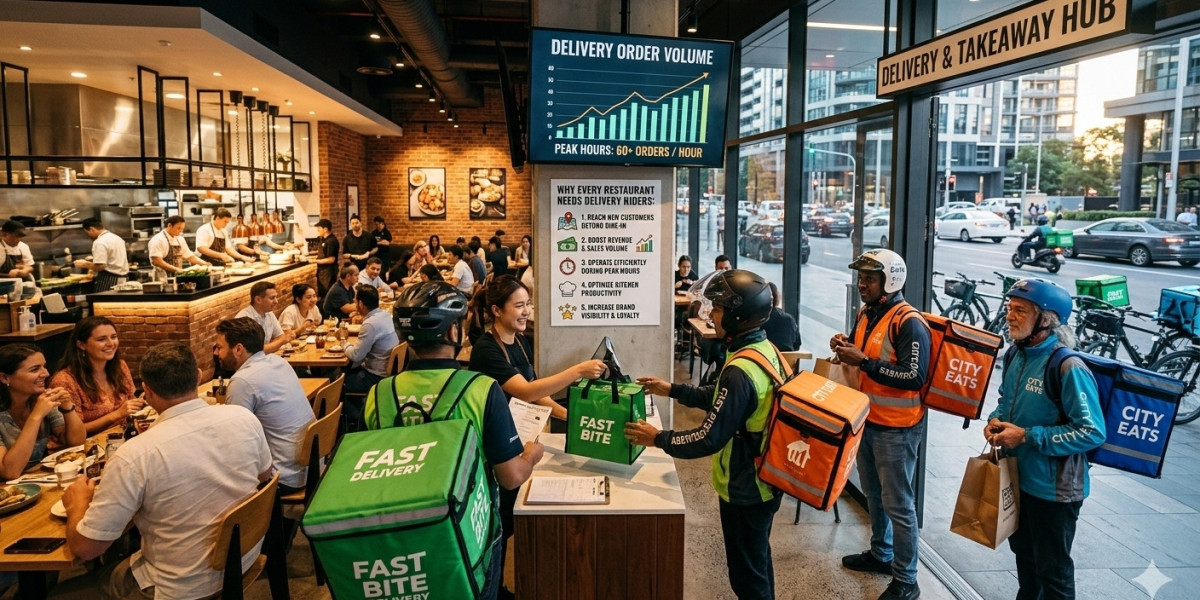
In Lahore specifically, the delivery culture has exploded. From upscale restaurants in DHA and Gulberg to fast-food spots in Johar Town and Model Town, nearly every serious food business now offers delivery. The question is no longer whether to deliver — it is how, and crucially, through whose platform.
This article breaks down exactly why restaurant owners in Lahore are moving away from third-party aggregators and investing in their own dedicated food delivery rider app.
How Food Delivery Works: Two Models Restaurants Must Understand
Before choosing a delivery strategy, it helps to understand the two fundamental models available to restaurant owners.
Model 1: Third-Party Aggregator Platforms. Platforms like Foodpanda connect you to an existing customer base and provide their own riders. The setup is fast, and the initial reach can be significant. However, every order comes with a commission cost, limited brand control, and no access to your own customer data.
Model 2: In-House Delivery with a Dedicated Rider App You manage your own riders, your own app, and your own customer relationships. This requires upfront investment — but the long-term returns in margins, loyalty, and brand equity are substantially higher.
For restaurants processing consistent delivery volumes in Lahore, in-house delivery is increasingly the smarter financial decision. The break-even point arrives faster than most owners expect, often within the first few months of switching.
Why Lahore's Diners Choose App-Based Ordering
To build a delivery system that works, you need to understand what customers actually want from it. Here are the key drivers behind food delivery adoption among Lahore's urban diners:
Convenience Above Everything Modern diners are time-pressed. Ordering food online takes under two minutes, requires no commute, no parking, and no waiting in line. Whether it is a weeknight family dinner or a late-night craving, the ability to order from a phone is simply too convenient to ignore.
Real-Time Order Tracking Uncertainty is the enemy of a good delivery experience. Customers want to know exactly where their food is at every stage — from the moment it leaves the kitchen to the second it arrives at the door. According to Statista, over 53% of consumers say delivery time estimates directly influence which restaurant they order from. Real-time tracking is no longer a premium feature — it is a baseline expectation.
Ratings, Reviews, and Social Proof. Before trying a new restaurant, most customers check ratings and read reviews. A restaurant with consistent five-star delivery feedback will always outperform one with a great menu but a poor delivery reputation. Your rider app is a direct extension of your brand's quality standards.
Flexible Fulfilment Options: Not every customer wants doorstep delivery. Many prefer to order ahead and pick up — skipping the queue while their food is freshly prepared. A good rider app supports both delivery and pickup workflows seamlessly.
Direct, Frictionless Communication. When a rider cannot find the address, the entire experience breaks down. A dedicated rider app allows riders to contact customers directly, resolve issues instantly, and complete deliveries without unnecessary delays. This is one area where restaurant-owned delivery consistently outperforms third-party services.
The True Cost of Third-Party Delivery Platforms
Third-party aggregators are not delivery partners — they are intermediaries who profit from your food while owning your customers. Before committing to or continuing with these platforms, every restaurant owner in Lahore should understand the full picture.
Commission Fees Are Eating Your Margins
Third-party platforms typically charge restaurants between 15% and 30% commission per order. On a Rs. 2,000 order, that is Rs. 300 to Rs. 600 per transaction — before you account for packaging, ingredients, or labour.
A restaurant processing just 80 delivery orders per day at an average order value of Rs. 1,500 could be losing over Rs. 1.4 million per month in commission fees alone. That is money that could fund a second location, a marketing campaign, or significant kitchen upgrades.
You Do Not Own Your Customers
This is the part most restaurant owners do not fully appreciate until it is too late. When customers order through a third-party platform, they are the platform's customers — not yours. You cannot contact them, reward them, or retarget them with promotions. If the platform changes its algorithm, raises commissions, or removes your listing, your delivery revenue can disappear overnight with no recourse.
Inconsistent Service Reflects on Your Brand
A third-party rider managing six different restaurant orders simultaneously is not representing your brand — they are a logistics contractor. Late deliveries, cold food, damaged packaging, and poor communication all come back to damage your restaurant's reputation, even when the fault lies with the platform.
Geographic and Operational Limitations
Some aggregator platforms have limited coverage in Lahore's newer or outer residential areas — Bahria Town, DHA Phase 8, Lake City, and parts of Raiwind Road are often underserved. With your own rider app, you define your delivery zones and expand them on your terms.
The Business Case for Your Own Rider App
Owning your delivery operation is not just about saving on commission. It is about building a sustainable, data-driven business that compounds in value over time.
Keep 100% of Every Order
With a white-label solution like CherryBerry RMS, there are zero per-order commission fees. The investment is in the platform itself — and the savings begin from your very first delivery. For most restaurants, the platform cost is recovered within the first two to three months of operation.
Own Your Customer Data
When customers order through your app, every data point belongs to you — order frequency, preferred items, average spend, location, and ordering patterns. This intelligence allows you to run targeted loyalty programmes, send personalised promotions, and identify your highest-value customers for retention campaigns.
Restaurants that own their customer data report retention rates up to 40% higher than those relying exclusively on third-party platforms, according to research by McKinsey & Company. (Full report)
Build a Brand, Not Just a Listing
On a third-party platform, your restaurant is one of hundreds of listings competing for the same customer's attention. With your own app, your brand is front and centre — your logo, your colours, your voice, your story. Every delivery becomes a brand touchpoint that reinforces recognition and loyalty.
Scale at Your Own Pace
As your order volume grows, your own delivery infrastructure scales with you. You can add riders, expand delivery zones, introduce new menu categories, or launch promotional campaigns — all without needing platform approval or paying higher commission tiers.
Real-World Example: What the Switch Looks Like
Consider a well-established casual dining restaurant in Gulberg, Lahore. After two years of relying on a third-party aggregator, the owner decided to invest in an in-house rider app through CherryBerry RMS.
In the first month after launch, commission costs dropped to zero. Within six weeks, the restaurant had identified its top 200 repeat customers by name and order history — and launched a loyalty programme offering a free item on every tenth order. Rider performance improved immediately because dedicated riders focused solely on that restaurant's orders rather than splitting attention across multiple brands.
By the end of the first quarter, delivery revenue had grown by 34%, average delivery time had improved by 11 minutes, and customer repeat order rate had increased by 28%. The restaurant had not changed its menu, its pricing, or its kitchen team. It had simply changed who controlled the delivery.
This is not exceptional — it is what consistently happens when restaurants stop renting access to their own customers and start owning the relationship.
Features That Make CherryBerry RMS's Rider App Different
CherryBerry RMS provides a complete three-layer delivery system: a customer-facing app, a dedicated rider app, and a full restaurant admin panel. All three are white-labelled to your brand identity and integrated natively with your existing operations.
For Your Delivery Riders
Simple onboarding — riders are operational within minutes, not days
Intelligent route optimisation — the fastest route is suggested automatically, reducing delivery times and fuel costs
Real-time status updates — riders update order progress at every stage (accepted → picked up → en route → delivered), keeping customers and managers fully informed
Direct customer contact — riders can reach customers instantly to resolve address issues without involving restaurant staff
For Your Customers
Seamless registration with saved profiles, delivery addresses, and order history
Live tracking with push notifications at every stage of the delivery journey
One-tap repeat ordering for frequent customers
Social sharing integrations to drive organic word-of-mouth promotion
For Your Restaurant Team
Centralised order management dashboard with real-time visibility across all active deliveries
Automated notifications for new, in-progress, cancelled, and completed orders
Cross-interface communication linking customer, rider, and kitchen in one system
Advanced performance analytics covering delivery times, peak hours, rider efficiency, and customer behaviour
The rider app also integrates natively with CherryBerry RMS's cloud-based POS system, order management software, and kitchen management system — eliminating the need for separate, disconnected tools and reducing order errors significantly.
Getting Started: Three Simple Steps
Step 1 — Consultation Share your restaurant's current setup, delivery zones, order volumes, and goals. The CherryBerry team will map the right configuration for your specific needs across Lahore's neighbourhoods.
Step 2 — Customisation The platform is configured to your brand identity — logo, colour palette, menu, pricing, and delivery radius. This is a fully white-label solution. Customers will interact with your app, not a generic platform.
Step 3 — Launch and Ongoing Support CherryBerry RMS provides launch marketing support, regular platform updates, performance reporting, and dedicated technical assistance. You are not just buying software — you are gaining an operational partner.
To explore the full feature set, visit the CherryBerry RMS Rider App page or contact the team directly.
Frequently Asked Questions
Q: How much do third-party food delivery apps charge restaurants in Lahore?
Most platforms charge between 15% and 30% commission per order. For restaurants with consistent delivery volume, this represents a substantial monthly cost that compounds significantly over a year.
Q: Is an in-house rider app affordable for small or single-location restaurants?
Yes. Platforms like CherryBerry RMS are structured so that commission savings begin immediately from the first delivery. Most restaurants recover the platform investment within two to three months purely through eliminated commission fees.
Q: What is the difference between a rider app and a customer app?
A rider app is used by delivery staff to receive orders, navigate routes, and update delivery status. A customer app is used by diners to place orders and track deliveries in real time. A complete system includes both, plus an admin panel for restaurant managers.
Q: How does real-time order tracking benefit my restaurant?
It reduces customer service inquiries, increases satisfaction scores, and builds trust with first-time customers. Research indicates that live tracking can reduce inbound customer support contacts related to delivery by up to 30% — freeing your staff to focus on food preparation.
Q: Does CherryBerry RMS cover all delivery areas in Lahore?
Yes. Delivery zones are fully customisable. You can configure coverage for DHA, Gulberg, Johar Town, Bahria Town, Model Town, Lake City, and any other area your restaurant serves — and expand zones as your business grows.
Q: How does owning customer data help a restaurant grow?
Owned customer data allows you to run loyalty programmes, personalise promotions, identify high-value repeat customers, and market directly to people who have already purchased from you — all without paying a third party for access to your own audience.
Q: Can the CherryBerry RMS rider app integrate with my existing POS system?
Yes. The rider app integrates natively with CherryBerry RMS's full suite of restaurant tools, including the cloud-based POS, kitchen management system, and order management software — creating a single connected operation.