
You have become an expert in avoidance. Declining the restaurant with harsh overhead lighting. Skipping the workout class that leaves you crimson for hours. Pretending you do not mind when acquaintances ask if you are sunburned or embarrassed. Your cheeks carry a permanent flush that no topical regimen has resolved. Your nose displays a web of fine vessels that seem to expand each year. You have eliminated beloved foods from your diet, limited alcohol to rare occasions, managed stress through meditation—and still the vascular network persists and proliferates. Prescription creams helped briefly, then reached a plateau that leaves you visibly different from everyone around you.
This clinical frustration drives patients toward procedural solutions. The dual yellow laser has accumulated substantial evidence for vascular-predominant rosacea. It demands realistic expectations—transformation requires multiple sessions over months. For appropriate candidates, however, it consistently delivers among the most reliable improvements in aesthetic dermatology. This guide explores the biological mechanism, procedural experience, and clinical outcomes that define this treatment pathway.
Understanding Rosacea's Vascular Foundation
Effective intervention requires comprehending the underlying disease process. Rosacea represents a chronic inflammatory condition with characteristic central facial distribution—cheeks, nasal bridge, chin, and forehead. Its visible signature includes persistent erythema and dilated superficial vessels called telangiectasia. These capillaries undergo structural compromise, becoming fragile and hyper-responsive to thermal stimuli, capsaicin exposure, emotional arousal, and alcoholic beverages.
When these compromised vessels rupture, blood escapes into surrounding dermal tissue. Chronic accumulation creates permanent discoloration ranging from violaceous to bright red. Anti-inflammatory topicals may reduce transient swelling but cannot repair damaged vessel walls or eliminate existing structural pathology. Once architectural integrity fails, physical removal becomes necessary. Laser technology provides this precision elimination.
The Science of Hemoglobin-Targeted Light Therapy
Laser operation depends upon selective photothermolysis—destruction of specific pigmented targets while sparing adjacent structures. Every biological chromophore exhibits wavelength-specific absorption preferences. Hemoglobin demonstrates peak absorption within the green-yellow spectrum.
Erythrocyte hemoglobin possesses exceptional photon-capture efficiency in this range. During yellow laser treatment, hemoglobin molecules absorb emitted energy and convert it immediately to heat. This heat conducts through vessel walls until reaching coagulation threshold. The vessel seals internally through controlled thrombosis. Your body gradually absorbs this sealed structure over subsequent weeks. Surface redness fades as the underlying blood source disappears.
Engineering Superiority of Dual-Wavelength Design
The device market offers various vascular laser categories. Pulsed dye systems emit specific yellow-orange wavelengths. Nd:YAG platforms provide deeper infrared penetration. The dual yellow laser configuration addresses rosacea's particular complexity.
These devices integrate 577 nanometer emission with complementary wavelengths. This strategy simultaneously addresses multiple tissue depths. Shorter wavelengths target superficial papillary dermal vessels. Longer components reach deeper reticular dermal structures. Single-wavelength systems risk therapeutic gaps or require excessive fluence with attendant complication risks.
The yellow laser treatment approach using dual capabilities enables comprehensive single-session targeting. Treatment efficiency improves, reducing total sessions needed for clearance. Distributed energy loading enhances comfort and minimizes bruising compared to concentrated single-wavelength delivery. This profile suits the reactive, sensitive skin characteristic of rosacea populations.
Your Treatment Journey: What to Expect
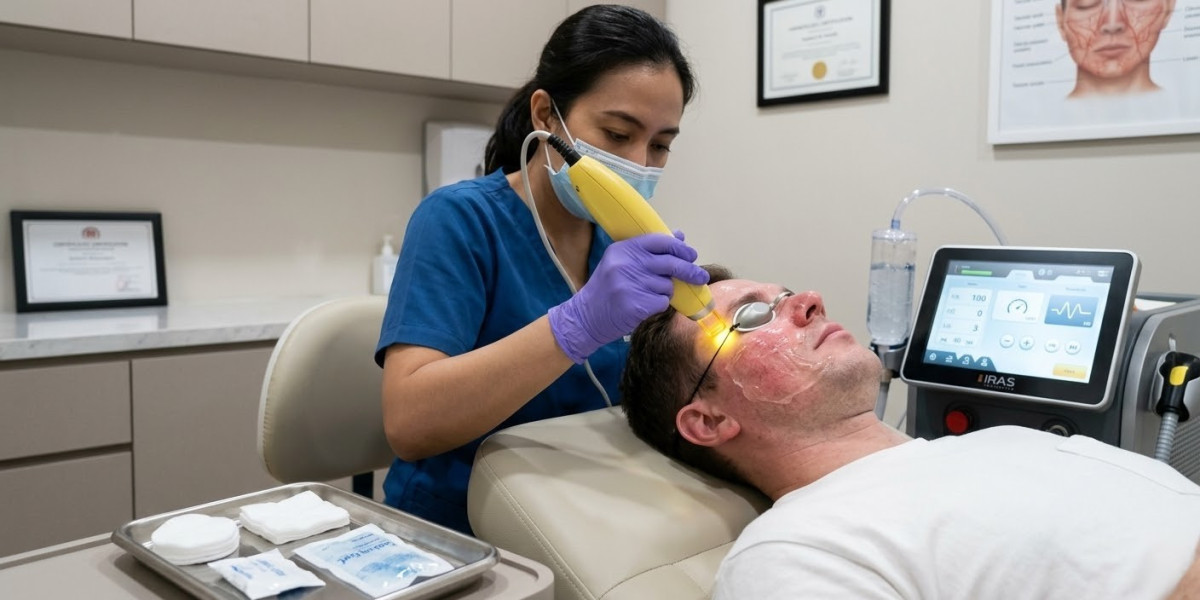
Discomfort anxiety prevents many from scheduling beneficial therapy. Detailed preparation information reduces this barrier. Standard practice involves chilled coupling gel application, providing epidermal protection and mild anesthesia. Controlled handpiece contact follows.
Pulse discharge produces characteristic audible clicking. Sensory experience resembles elastic band snapping for most patients. Integrated cooling technology renders warmth predominant over pain. Sharp or burning sensations indicate parameter adjustment needs. Immediate operator communication enables modification.
Treatment duration ranges 15-30 minutes based on facial involvement. Non-ablative nature eliminates wound care requirements. Post-procedural erythema and edema simulate sunburn intensity, typically resolving within hours without intervention.
Post-Treatment Recovery and Results Evolution
Recovery burden influences treatment decisions significantly. Yellow laser treatment imposes minimal lifestyle disruption. Expected inflammatory responses include transient erythema and edema resolving within 24-48 hours.
Certain protocols intentionally generate purpura—microscopic purple spots indicating robust coagulation. These resolve over 5-7 days naturally. Contemporary optimization often avoids this endpoint for schedule accommodation. Immediate return to professional activities is standard, with cosmetic coverage available if desired.
Vascular clearance demonstrates delayed onset. Final visible results require 3-4 weeks as mononuclear phagocyte systems complete thrombosed vessel elimination. Serial treatments produce additive effects, each session addressing residual pathology. Standard protocols specify 3-6 sessions at 4-week intervals. Annual maintenance preserves achieved clearance. Underlying inflammatory tendency may persist, but visible vascularity demonstrates substantial improvement.
Identifying Ideal Candidates and Safety Essentials
Optimal candidates present vascular-predominant features. Sebaceous or textural prominence without significant erythema suggests alternative modalities. However, substantial daily investment in redness concealment indicates dual yellow laser treatment may prove advantageous.
Subtype classification significantly influences planning. Active inflammatory lesions risk exacerbation with laser exposure. Competent screening distinguishes inflammatory from structural erythema. Only the latter responds predictably to photothermal targeting.
Mandatory safety measures include ocular protection through metal shields or appropriate goggles. Strict ultraviolet avoidance before and after treatment prevents melanin competition and dyschromia risk. Pre-procedural guideline adherence optimizes outcomes.
Final Perspectives on This Therapeutic Approach
Rosacea management requires longitudinal commitment, often multimodal approaches, and realistic expectation setting. The dual yellow laser does not constitute curative therapy. For recalcitrant vascular erythema and telangiectasia, however, it maintains strong evidence support and high satisfaction rates.
Technological evolution has substantially improved parameters over preceding decades. For individuals exhausted by concealment efforts and social limitation, qualified provider consultation represents appropriate progression. Professional assessment determines individual candidacy and aligns intervention with personal objectives. This therapeutic option offers confidence restoration grounded in established photophysical principles.
Ubicación del Autor
1 Grange Road, Orchard Building #12-02, (Located above H&M), Singapore 239693