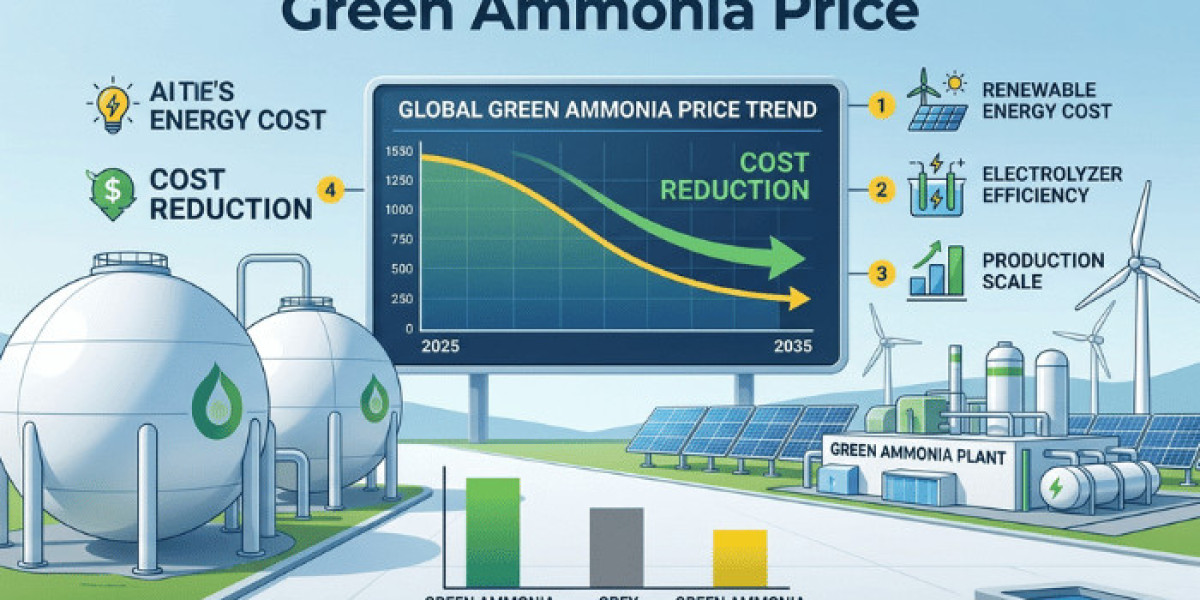

The green ammonia price trend in 2025 followed a clear downward trajectory through the first three quarters before stabilising toward the end of the year. Prices started at USD 0.53/KG in Q1 2025, dropped to USD 0.48/KG in Q2 (-9.4%), declined further to USD 0.45/KG in Q3 (-6.3%), and then remained flat at USD 0.45/KG in Q4. This pattern reflects a market transitioning from early-stage cost pressure toward gradual stabilisation as supply and demand dynamics began to rebalance.
Green ammonia, produced using renewable hydrogen, is still an emerging commodity compared to conventional ammonia. Its pricing is closely tied to renewable electricity costs, electrolyzer efficiency, hydrogen availability, and infrastructure readiness. In 2025, improvements in these areas played a key role in easing prices across the global market.
Global green ammonia price movement across 2025
The year began with relatively elevated pricing in Q1, reflecting the still-developing nature of green ammonia production. Limited capacity, high capital expenditure, and reliance on renewable energy inputs kept costs elevated. However, as the year progressed, prices began to decline steadily.
By Q2, the market saw a noticeable drop of nearly 10%. This decline was driven by improved renewable energy economics, particularly falling solar and wind generation costs, which directly impact hydrogen production expenses. Lower input costs started translating into more competitive green ammonia pricing.
In Q3, prices continued to soften, though at a slower pace. The market was adjusting to increasing supply from new pilot and early commercial-scale projects. At the same time, procurement remained cautious, as buyers were still evaluating long-term contracts and infrastructure readiness.
By Q4, the Green Ammonia Price stabilised at USD 0.45/KG. This indicates that the market had reached a temporary balance between supply expansion and demand growth. Prices no longer declined sharply, suggesting that cost reductions had begun to level off in the short term.
Key drivers behind the 2025 price decline
The most important factor behind the falling price trend was the decline in renewable energy costs. Since green ammonia production depends heavily on green hydrogen, and hydrogen production depends on electricity, any reduction in renewable power cost has a direct impact on final pricing.
Another major factor was increasing production capacity. As more green ammonia projects came online across regions like North America, Europe, and Asia-Pacific, supply constraints began to ease. Even though the industry is still in early stages, incremental capacity additions helped reduce pricing pressure.
Technology improvements also contributed. Advancements in electrolyzer efficiency and scaling of hydrogen production systems improved cost efficiency, allowing producers to operate at lower marginal costs.
At the same time, competitive bidding and project-based procurement played a role. Several large-scale tenders and pilot agreements pushed prices lower as producers competed to secure long-term contracts.
Get Real Time Price Analysis: https://www.expertmarketresearch.com/price-forecast/green-ammonia-price-trends/requestsample
Demand-side dynamics shaping the market
On the demand side, growth remained strong but uneven. Green ammonia is gaining traction across multiple sectors:
- Fertilizers
- Renewable energy storage
- Shipping fuels
- Hydrogen carrier applications
These sectors continued to support demand, but most adoption remained at pilot or early commercial stages. Large-scale demand ramp-up is still dependent on infrastructure development, policy clarity, and long-term contracts.
Because of this, buyers remained cautious in 2025. Procurement was often aligned with project timelines rather than bulk consumption, which limited aggressive price increases and supported the downward trend.
Why prices stabilised in Q4 2025
By the final quarter, the market stopped declining and moved into a stable phase. This stabilisation reflects a few key shifts.
Supply expansion slowed relative to earlier quarters, as many projects were still under development rather than fully operational. At the same time, demand from energy transition initiatives and industrial decarbonisation began to provide a steady base.
Market participants also adjusted procurement strategies, maintaining controlled inventory levels and avoiding overbuying. This helped maintain price stability despite ongoing structural changes.
Additionally, green ammonia pricing remained structurally higher than conventional ammonia due to higher production costs and infrastructure limitations. This created a natural floor for prices, preventing further sharp declines.
Broader market context
Even though prices declined in 2025, the green ammonia market is still in a growth phase. The industry is being shaped by:
- Decarbonisation policies
- Hydrogen economy development
- Investment in renewable infrastructure
- Expansion of export-oriented energy projects
These factors are expected to support long-term demand growth, even if short-term price movements remain volatile.
The market also remains sensitive to changes in renewable energy pricing, logistics costs, and project execution timelines. Since green ammonia is still not fully commoditised, regional variations and project-specific pricing continue to play a major role.
How Claight Corporation (Expert Market Research) Database Can Help
The latest report by Expert Market Research, "Green Ammonia Prices, Trends, Charts, Demand, and Market Analysis - 2026 Edition," offers a comprehensive overview of the global pricing landscape for green ammonia. Designed for industry stakeholders, the study provides detailed historical and forecast price data, highlighting key market shifts and emerging pricing trends.
Drawing from in-depth research, the report analyses the primary factors influencing green ammonia price, including fluctuations in raw material availability, changes in production capacity, and macroeconomic or geopolitical developments. Additionally, the report evaluates global and regional demand patterns, outlining how shifts in end-use industries such as construction, paper, and plastics are impacting market dynamics. By examining the supply-demand balance, Expert Market Research's report helps businesses understand the underlying forces shaping current and future pricing environments, offering valuable insights to guide procurement, pricing strategy, and investment planning.
About Us:
Expert Market Research is a global market intelligence and consulting platform by Claight delivering data-driven insights across commodities, chemicals, energy, and industrial markets. We design our research to support businesses, analysts, investors, and procurement teams in understanding price trends, supply-demand dynamics, competitive landscapes, gaining competitive intelligence, benchmarking best practices, and develo ping long-term market outlooks.
Our robust research methodologies, combined with validated primary and secondary data, ensure accuracy, consistency, and relevance. Our analysis is widely used not only for strategic planning, market-entry assessments, and sourcing decisions, but also for investment evaluation across international markets. Our strong emphasis on transparency, factual reporting, and regular data updates to reflect real-time market conditions always keeps you ahead of the curve.
Contact us:
Claight Corporation (Expert Market Research)
30 North Gould Street, Sheridan, WY 82801, USA
Email: [email protected]
Tel No: (D) +91-723-689-1189
United States:+1-415-325-5166