


A Cash Management Application is a financial automation tool that helps businesses monitor, control, and optimize cash inflows and outflows in real time. It enables organizations to improve liquidity, streamline cash flow processes, and enhance working capital efficiency.
In today’s fast-paced digital economy, companies rely on cash flow automation and intelligent financial systems to maintain stability, reduce risk, and make data-driven decisions.
What is a Cash Management Application?
A cash management application is software designed to manage a company’s cash position, track transactions, forecast future cash flow, and automate financial operations.
It acts as a centralized platform that integrates with banking systems, ERP platforms, and payment channels to provide real-time visibility into cash balances.
- Tracks cash inflows and outflows
- Provides real-time liquidity insights
- Automates reconciliation processes
- Supports working capital management strategies
How Cash Management Applications Work
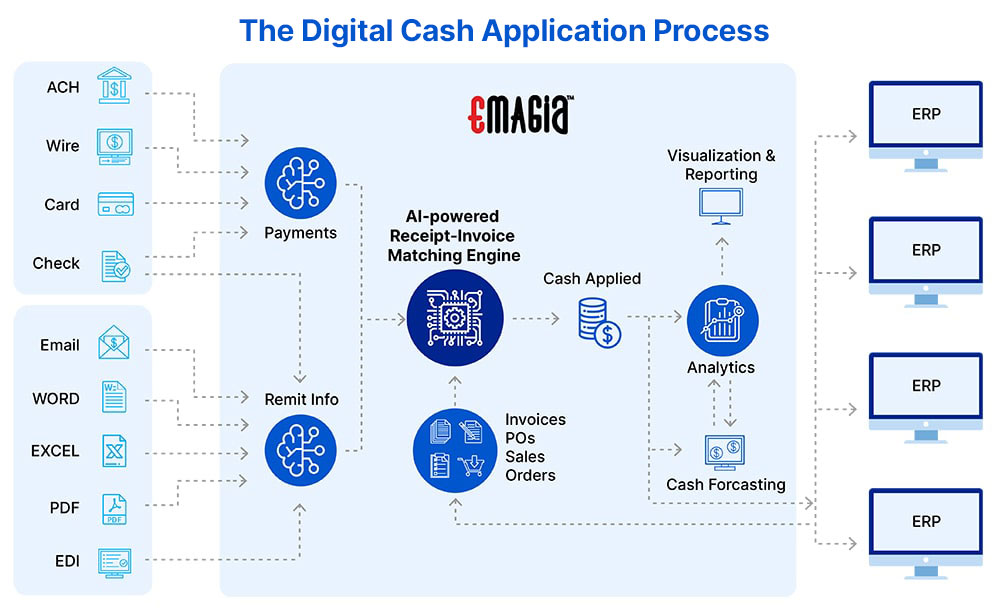
Cash management systems function by aggregating financial data from multiple sources and applying automation and analytics to streamline operations.
- Data Integration: Connects with banks, ERP systems, and payment gateways
- Transaction Monitoring: Tracks incoming and outgoing payments
- Cash Positioning: Provides real-time visibility into balances
- Forecasting: Uses historical data for predictive insights
- Automation: Reduces manual intervention in reconciliation and reporting
Key Features of Cash Management Software
- Real-Time Cash Visibility: Monitor liquidity across accounts instantly
- Cash Flow Forecasting: Predict short-term and long-term cash needs
- Bank Reconciliation Automation: Match transactions automatically
- Payment Processing: Manage disbursements and collections
- Fraud Detection: Identify anomalies and suspicious activities
- Reporting & Analytics: Generate financial insights for decision-making
- Multi-Currency Support: Handle global financial operations
Benefits for Businesses
Implementing a cash management application delivers measurable ROI and operational efficiency.
- Improved Cash Flow Control: Gain visibility into liquidity positions
- Reduced Manual Work: Automate repetitive financial tasks
- Better Decision Making: Use real-time data and analytics
- Enhanced Accuracy: Minimize human errors
- Stronger Compliance: Maintain audit trails and regulatory adherence
- Optimized Working Capital: Improve cash utilization
Use Cases Across Industries
Cash management applications are widely used across industries to streamline financial operations.
Banking & Financial Services
- Liquidity monitoring
- Risk management
- Transaction tracking
Manufacturing
- Supplier payments optimization
- Inventory-related cash flow planning
Retail & E-commerce
- Real-time payment tracking
- Revenue forecasting
Healthcare
- Billing and collections automation
- Cash flow visibility across departments
Cash Management vs Treasury Management
| Aspect | Cash Management | Treasury Management |
|---|---|---|
| Focus | Daily cash operations | Strategic financial planning |
| Scope | Short-term liquidity | Long-term financial strategy |
| Functions | Payments, collections, reconciliation | Risk management, investments, funding |
| Users | Finance teams | CFOs and treasury departments |
How to Choose the Best Cash Management Application
Selecting the right solution requires careful evaluation of business needs and system capabilities.
- Scalability: Supports business growth
- Integration: Connects with ERP and banking systems
- User Experience: Easy to use and intuitive
- Security: Strong data protection and compliance
- Automation Capabilities: Reduces manual processes
- AI Features: Enables predictive analytics and insights
Implementation Best Practices
- Define Objectives: Identify key financial goals
- Choose the Right Vendor: Evaluate based on features and support
- Data Migration Planning: Ensure accurate data transfer
- Employee Training: Educate teams on system usage
- Monitor Performance: Track KPIs and optimize continuously
Common Challenges and Solutions
Data Integration Issues
Solution: Use APIs and standardized connectors
Lack of Real-Time Visibility
Solution: Implement cloud-based financial automation software
Resistance to Change
Solution: Provide training and demonstrate ROI
Security Concerns
Solution: Adopt systems with advanced encryption and compliance standards
Future Trends in Cash Management
- AI in Cash Management: Predictive analytics for smarter decisions
- Automation Expansion: End-to-end financial process automation
- Real-Time Payments: Faster transaction processing
- Cloud Adoption: Scalable and flexible solutions
- Advanced Analytics: Data-driven insights for CFOs
Frequently Asked Questions (FAQs)
What does a cash management application do?
It helps businesses monitor, control, and optimize cash flow by automating financial processes and providing real-time visibility.
Why is cash management important?
Effective cash management ensures liquidity, reduces financial risk, and supports business growth.
How does automation improve cash management?
Automation reduces manual errors, speeds up processes, and enhances accuracy in financial operations.
What industries use cash management software?
Industries like banking, retail, manufacturing, and healthcare rely on these solutions for financial efficiency.
Is cash management software suitable for small businesses?
Yes, it helps small businesses manage cash flow efficiently and make better financial decisions.
What is the difference between cash flow and cash management?
Cash flow refers to the movement of money, while cash management focuses on optimizing and controlling it.
How does AI help in cash management?
AI enables predictive analytics, anomaly detection, and smarter decision-making.
Can cash management applications integrate with ERP systems?
Yes, most modern solutions integrate seamlessly with ERP and banking platforms.
What are the key metrics in cash management?
Key metrics include liquidity ratio, cash conversion cycle, and operating cash flow.
How to measure ROI of cash management software?
ROI can be measured through cost savings, efficiency gains, and improved cash flow visibility.
Read Related Articles :
https://www.scenario.press/blogs/351030/Cash-Application-Automation-Complete-Guide-for-AR-Teams
https://talvixo.com/cash-application-automation-transforming-accounts-receivable/
https://blogingrace.com/blogs/72203/Cash-Application-Automation-Driving-Efficiency-in-Receivables
https://www.monu.org/what-is-cash-application-automation/
Ubicación del Autor
USA