
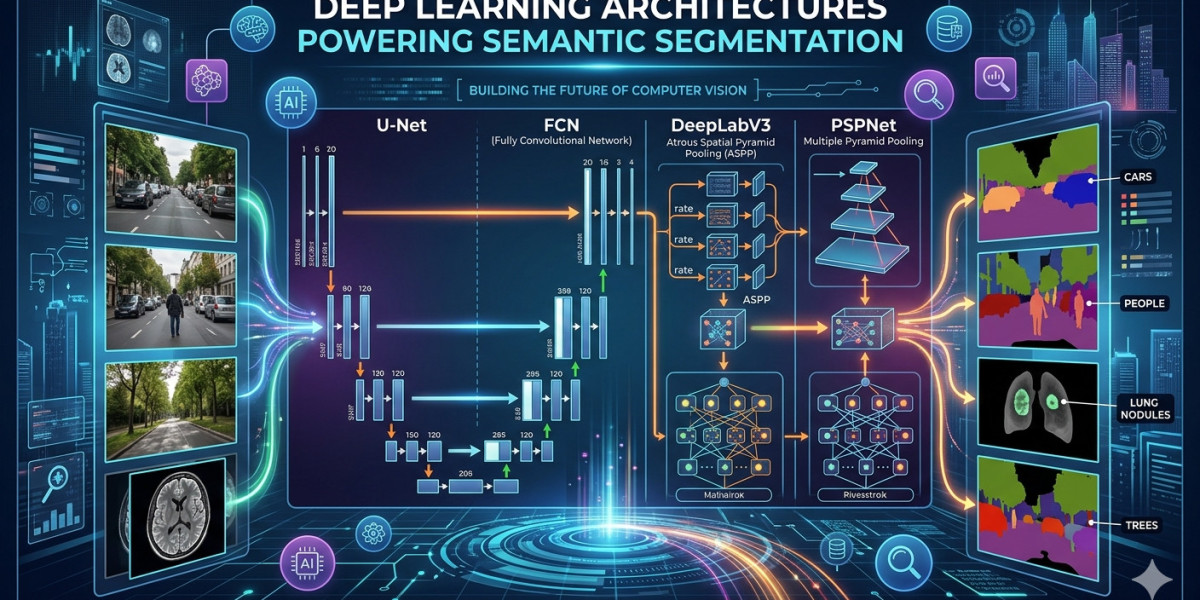

Semantic segmentation has emerged as a cornerstone of modern computer vision, enabling machines to interpret visual data at a pixel level. From autonomous vehicles to medical diagnostics and smart surveillance systems, this technology underpins applications that demand precise scene understanding. At the heart of these capabilities lie advanced deep learning architectures designed to extract, process, and classify intricate visual patterns.
At Annotera, we recognize that even the most sophisticated models rely heavily on high-quality labeled data. As a leading data annotation company and image annotation company, we support organizations in building robust semantic segmentation pipelines through scalable data annotation outsourcing and image annotation outsourcing solutions.
Understanding Semantic Segmentation in Context
Unlike image classification, which assigns a single label to an entire image, or object detection, which identifies bounding boxes, semantic segmentation assigns a class label to every pixel. This fine-grained approach enables systems to distinguish between objects and backgrounds with high precision.
For example, in autonomous driving, semantic segmentation helps differentiate roads, pedestrians, vehicles, and traffic signs in real time. Achieving this level of accuracy requires not only powerful algorithms but also meticulously annotated datasets—something an experienced image annotation outsourcing partner can provide at scale.
Evolution of Deep Learning Architectures
The progression of deep learning architectures for semantic segmentation reflects a broader shift in computer vision—from handcrafted features to end-to-end learning systems.
Fully Convolutional Networks (FCNs)
Fully Convolutional Networks marked a turning point by replacing fully connected layers with convolutional layers, allowing models to process images of arbitrary sizes. FCNs introduced the concept of upsampling through deconvolution (or transposed convolution), enabling pixel-wise predictions.
However, FCNs faced challenges in preserving spatial resolution, often producing coarse segmentation maps. This limitation led to the development of more refined architectures.
U-Net: Precision Through Symmetry
U-Net addressed the shortcomings of FCNs by introducing a symmetric encoder-decoder structure. The encoder captures contextual information, while the decoder reconstructs spatial details. Crucially, skip connections link corresponding layers in the encoder and decoder, ensuring that fine-grained information is retained.
Originally developed for biomedical image segmentation, U-Net has become a versatile architecture across industries. Its effectiveness, however, is closely tied to the quality of training data—reinforcing the importance of working with a reliable data annotation company.
SegNet: Efficient Memory Usage
SegNet builds on the encoder-decoder paradigm but introduces a more memory-efficient approach. Instead of learning upsampling weights, SegNet uses pooling indices from the encoder to guide the decoder. This reduces computational overhead while maintaining reasonable accuracy.
Such efficiency makes SegNet suitable for real-time applications, particularly when combined with optimized datasets produced through image annotation outsourcing.
Advanced Architectures Driving Performance
As applications demand higher accuracy and robustness, newer architectures have pushed the boundaries of semantic segmentation.
DeepLab Series: Atrous Convolution and Beyond
The DeepLab family of models introduced atrous (dilated) convolution, which expands the receptive field without increasing computational cost. This allows the model to capture multi-scale contextual information effectively.
DeepLab also incorporates Atrous Spatial Pyramid Pooling (ASPP), enabling the network to analyze features at multiple scales simultaneously. These innovations significantly improve segmentation accuracy, especially in complex scenes.
However, the performance of such architectures depends heavily on diverse and well-annotated datasets—highlighting the role of data annotation outsourcing in achieving production-grade results.
PSPNet: Global Context Awareness
Pyramid Scene Parsing Network (PSPNet) emphasizes global context by aggregating features from different regions of an image. By combining local and global information, PSPNet excels in understanding complex scenes where object relationships matter.
For instance, distinguishing between a road and a sidewalk may require contextual cues from surrounding areas. High-quality annotations provided by an image annotation company ensure that such contextual relationships are accurately represented during training.
Mask R-CNN: Bridging Detection and Segmentation
Although primarily an instance segmentation model, Mask R-CNN has influenced semantic segmentation workflows. It extends Faster R-CNN by adding a segmentation branch that predicts pixel-level masks for each detected object.
This hybrid approach demonstrates how segmentation can be integrated with detection tasks, offering flexibility for applications requiring both object localization and detailed segmentation.
Transformer-Based Models: The Next Frontier
Recent advancements have introduced transformer architectures into semantic segmentation. Models like Vision Transformers (ViTs) and hybrid CNN-transformer frameworks leverage self-attention mechanisms to capture long-range dependencies.
Unlike traditional convolutional networks, transformers analyze relationships across the entire image, enabling a more holistic understanding of complex scenes. This is particularly beneficial in scenarios with overlapping objects or ambiguous boundaries.
However, transformer-based models are data-hungry and computationally intensive. Organizations often rely on data annotation outsourcing to generate large-scale, high-quality datasets required to train these models effectively.
Key Architectural Components
Across these architectures, several core components consistently contribute to performance:
- Encoder-Decoder Structure: Facilitates feature extraction and spatial reconstruction
- Skip Connections: Preserve fine details lost during downsampling
- Multi-Scale Feature Extraction: Enhances the model’s ability to detect objects of varying sizes
- Attention Mechanisms: Improve contextual understanding
- Upsampling Techniques: Restore resolution for precise pixel classification
Each of these components must be supported by accurate ground truth data. Even minor inconsistencies in annotation can propagate errors, underscoring the importance of partnering with a professional image annotation outsourcing provider.
The Role of High-Quality Annotation
No matter how advanced the architecture, the success of a semantic segmentation model ultimately depends on the quality of its training data. Poor annotations lead to inaccurate predictions, reduced generalization, and unreliable performance in real-world scenarios.
At Annotera, we specialize in delivering high-precision annotation services tailored to semantic segmentation tasks. As a trusted data annotation company and image annotation company, we combine domain expertise, rigorous quality control, and scalable workflows to support AI development at every stage.
Our data annotation outsourcing and image annotation outsourcing services enable organizations to focus on model innovation while we handle the complexities of dataset preparation.
Challenges and Considerations
Despite significant progress, several challenges persist in semantic segmentation:
- Class Imbalance: Some classes may dominate datasets, skewing model performance
- Boundary Precision: Accurately segmenting object edges remains difficult
- Computational Cost: Advanced models require substantial resources
- Data Diversity: Models must generalize across varied environments
Addressing these challenges requires a combination of architectural innovation and high-quality annotated data—reinforcing the strategic value of working with an experienced data annotation company.
Future Directions
The future of semantic segmentation lies in hybrid models that combine the strengths of CNNs and transformers, as well as in self-supervised and semi-supervised learning approaches that reduce dependency on labeled data.
Edge deployment is another growing area, where lightweight architectures are optimized for real-time processing on devices with limited resources. In such scenarios, efficient image annotation outsourcing becomes critical to ensure models remain accurate despite constraints.
Conclusion
Deep learning architectures have transformed semantic segmentation into a powerful tool for visual intelligence. From FCNs and U-Net to transformer-based models, each innovation has brought us closer to achieving human-level scene understanding.
However, architecture alone is not enough. High-quality annotated data is the foundation upon which these models are built. As a leading data annotation company and image annotation company, Annotera empowers organizations through reliable data annotation outsourcing and image annotation outsourcing services.
By combining cutting-edge architectures with expertly curated datasets, businesses can unlock the full potential of semantic segmentation and drive meaningful advancements in AI-powered applications.