
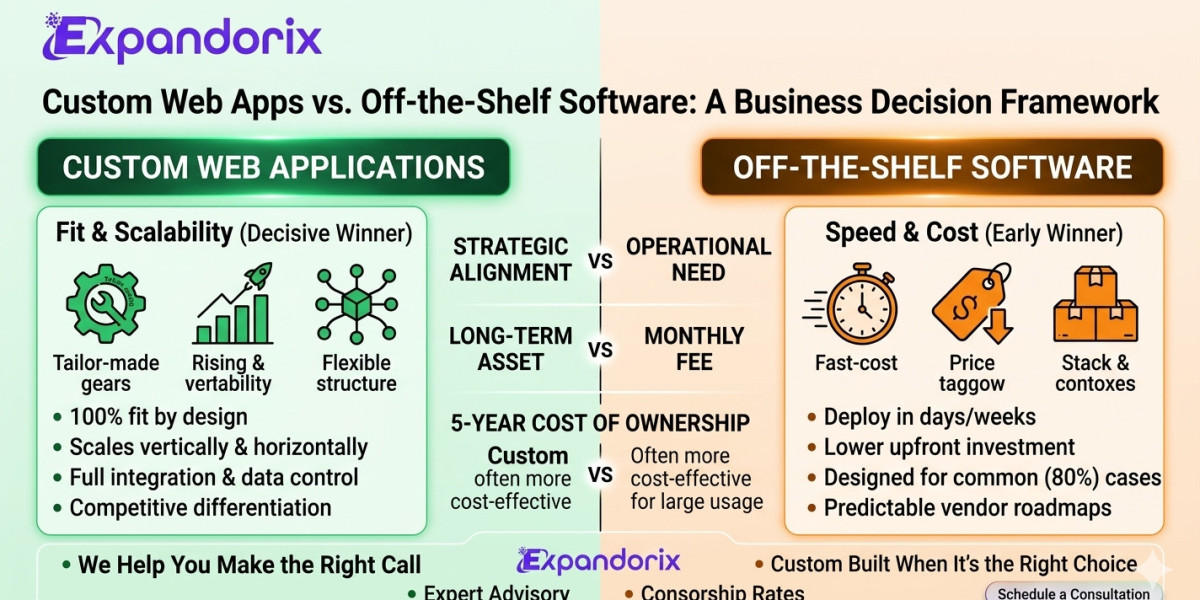

Every business eventually faces it: a critical process that existing software can't handle well. Maybe it's a workflow unique to your industry. Maybe it's an integration gap that forces manual workarounds. Maybe you've simply outgrown the tool you started with.
At this inflection point, businesses must choose: invest in custom web application development services, or find a better off-the-shelf solution?
This isn't a simple question with a universal answer. The right choice depends on your business's complexity, growth stage, competitive strategy, and financial resources. This comprehensive comparison gives you the framework to make the right decision.
What Are We Actually Comparing?
Before diving into the comparison, let's be precise about definitions.
Off-the-Shelf Software
Pre-built software designed for a broad market. Examples:
- CRM: Salesforce, HubSpot, Zoho
- Project management: Asana, Monday.com, Jira
- E-commerce: Shopify, BigCommerce, Magento
- ERP: SAP, Oracle NetSuite, Microsoft Dynamics
- HR: BambooHR, Workday, ADP
- Analytics: Tableau, Power BI, Looker
Custom Web Applications
Software built specifically for one business. Examples:
- A logistics platform built around your specific routing algorithms
- A client portal integrated with your unique ERP system
- A marketplace connecting your specific type of buyer and seller
- An internal operations tool automating your unique business processes
The Seven Dimensions of Comparison
Dimension 1: Cost (Upfront vs. Total Cost of Ownership)
This is where the comparison is most commonly misunderstood. Off-the-shelf software looks cheaper upfront. But that analysis often breaks down over time.
Off-the-shelf software costs:
- Monthly/annual subscription (often per-seat)
- Add-on module costs
- Integration costs (middleware, API connectors)
- Customization fees (within allowed limits)
- Training and onboarding
- Data migration costs when switching
- Workaround costs (manual labor, multiple tools)
Custom development costs:
- Initial development investment
- Ongoing maintenance (typically 15-25% of build cost/year)
- Infrastructure/hosting
- Future feature development
The math over 5 years: For a 50-person company using a mid-tier SaaS platform at $100/seat/month:
- Year 1: $60,000 in licenses + $30,000 in customization/integrations = $90,000
- Years 2-5: $60,000/year (growing as seats grow) = $240,000+
- 5-year total: $330,000+ (and you own nothing)
For a custom application serving the same 50 people:
- Year 1 build: $150,000
- Years 2-5 maintenance: $30,000/year = $120,000
- 5-year total: $270,000 (and you own a valuable asset)
This math doesn't always favor custom development — but it often does for core business systems with significant user counts and complex requirements.
Winner by situation:
- Short-term, limited scope → Off-the-shelf
- Long-term, heavy usage, growth trajectory → Custom development
Dimension 2: Fit and Functionality
Off-the-shelf software: Designed for the 80% case. If your business processes align well with what the tool offers, you'll get most of what you need. If your processes are unusual, you'll spend significant energy adapting your processes to the software (instead of the reverse).
Custom web applications: 100% fit by design. Every feature serves a specific purpose you've defined. No wasted functionality, no missing capabilities.
The real cost of poor fit: Companies using poorly-fitted off-the-shelf software typically see:
- 20-40% of employee time consumed by manual workarounds
- Higher error rates from manual data transfer
- Shadow IT (employees using unauthorized tools to compensate)
- Data silos that impede decision-making
Winner: Custom development — decisively
Dimension 3: Implementation Speed
- Off-the-shelf software: Typically deployable in days to weeks. This speed advantage is real and significant, especially when you need to solve a problem immediately.
- Custom web applications: Development timelines range from 3-4 months for simple applications to 12+ months for complex systems. This is a genuine disadvantage of custom development.
- Nuance: Many businesses take a phased approach — deploying an off-the-shelf tool as an interim solution while custom development proceeds. This bridges the speed gap without forgoing the long-term benefits of custom software.
- Winner: Off-the-shelf — but the gap is smaller than most assume for well-run custom projects
Dimension 4: Scalability
- Off-the-shelf software: Scales in the ways the vendor has planned for. If your scaling needs align with their architecture, you're fine. If you grow beyond the parameters the vendor designed for, you hit a ceiling — and switching costs become enormous.
- Custom web applications: Architected for your specific growth trajectory. As your user volume, transaction volume, and feature needs grow, your custom application can be scaled horizontally, optimized, and extended — all within your control.
- Winner: Custom development
Dimension 5: Integration with Your Systems
- Off-the-shelf software: Comes with a marketplace of integrations — but only the integrations the vendor has built or approved. If you use unusual tools, legacy systems, or have complex integration requirements, gaps appear quickly. Middleware tools (Zapier, Make, Workato) fill some gaps but add cost and complexity.
- Custom web applications: Integration with any system — legacy or modern, standard or proprietary — is built as needed. No constraints from a vendor's integration marketplace.
- Winner: Custom development
Dimension 6: Security and Data Control
- Off-the-shelf software: Your data lives in a vendor's cloud. You're dependent on their security practices, their compliance certifications, and their data policies. In most cases, this is perfectly adequate — major SaaS vendors invest heavily in security. But you have limited visibility and control, and you're at risk if the vendor suffers a breach.
- Custom web applications: You control where your data lives, who can access it, and how it's protected. For businesses in regulated industries or handling highly sensitive data, this control is often non-negotiable.
- Winner: Custom development for compliance-sensitive environments; off-the-shelf adequate for most
Dimension 7: Competitive Differentiation
- Off-the-shelf software: If you and your competitors use the same CRM, ERP, or e-commerce platform, you have no technology-based competitive advantage. You're starting from the same place.
- Custom web applications: A custom system built around your unique processes, customer experience, or data models is hard to replicate. It can become a genuine competitive moat — especially when continuously invested in.
- Winner: Custom development — decisively for businesses where technology is a strategic differentiator
Decision Framework: Which Should You Choose?
Use this framework to guide your decision.
Choose off-the-shelf software when:
- Your needs align well with what available tools offer (70%+ fit)
- You need to deploy quickly (weeks, not months)
- You're in an early stage and still validating your business model
- The process you're automating is not a competitive differentiator
- Budget is severely constrained and the long-term volume won't justify custom development
- Available off-the-shelf tools are highly mature and well-supported in your use case
Choose custom web application development services when:
- Your process is unique and no off-the-shelf tool covers it adequately (below 70% fit)
- Technology is central to your competitive strategy
- You're in a highly regulated industry with specific compliance requirements
- Long-term user count or transaction volume makes custom development cost-competitive
- You've outgrown off-the-shelf tools and are spending significant resources on workarounds
- Data ownership and security are critical
- Integration requirements are complex and not served by available connectors
- You're building a product you plan to sell
The Hybrid Approach: The Best of Both Worlds
Many businesses don't have to make a binary choice. A common and effective approach:
- Use off-the-shelf tools for commoditized functions (email, HR, standard CRM)
- Build custom for core business-critical systems that differentiate you
- Integrate the two through custom APIs and middleware
This hybrid strategy often delivers the best overall ROI: buying commodity functionality cheaply while investing in custom development where it creates the most differentiation and efficiency.
Real-World Decision Examples
Case 1: Regional accounting firm Off-the-shelf wins: Standard accounting, HR, and general CRM functions can be served well by established tools. Custom development is overkill for these commodity processes. Budget better spent on custom client portal and automated reporting tools.
Case 2: Logistics startup Custom wins: Route optimization, dynamic pricing, driver management, and client tracking all require custom logic that no standard tool handles. Custom development is the foundation of their competitive advantage.
Case 3: Healthcare network Hybrid wins: Standard off-the-shelf EHR system for clinical records (high compliance, mature market). Custom patient portal, scheduling system, and analytics platform built to differentiate the patient experience and operational efficiency.
Case 4: E-commerce brand Depends on stage: Shopify adequate for early stage. Custom development justifiable when annual GMV exceeds $10-20M and the Shopify constraint costs are measurable.
Making the Final Decision: A Checklist
Before committing to either path, answer these questions:
☐ What percentage of your requirements can a specific off-the-shelf tool meet? ☐ What is the annual cost of workarounds for the gaps? ☐ What's the 5-year total cost of ownership for each option? ☐ How central is this capability to your competitive strategy? ☐ What are your data security and compliance requirements? ☐ How much will your user base and usage volume grow in 3-5 years? ☐ What is the switching cost if the off-the-shelf tool becomes inadequate?
Expandorix: Helping You Make the Right Call
At Expandorix, we don't believe custom development is always the right answer. We'll tell you honestly when a well-chosen off-the-shelf tool might serve your needs better — and when the investment in custom web application development services is clearly justified.
When custom is the right call, we're ready to build it.
Conclusion
The custom vs. off-the-shelf decision is not about which approach is universally better. It's about which approach is right for your specific situation — your business model, competitive strategy, budget, timeline, and growth trajectory.
Use the framework in this guide, be honest about your requirements and constraints, and don't let either sticker shock or FOMO drive the decision. The right choice, made for the right reasons, sets you up for sustainable technology success.
Ubicación del Autor
Noida