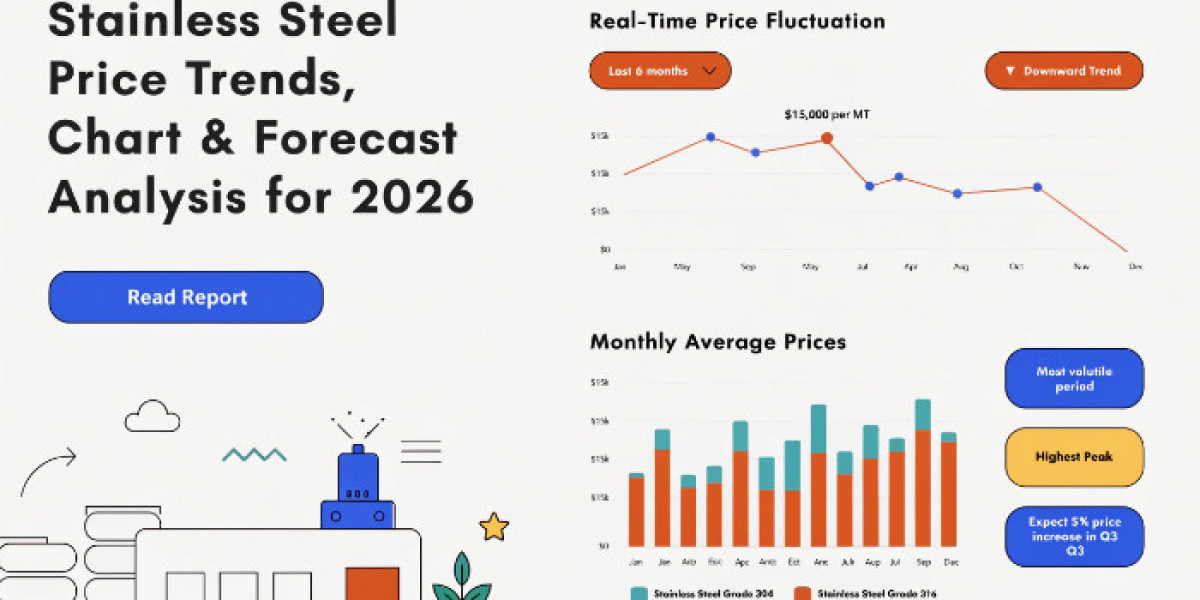

The global Stainless Steel Price Trend in 2026 reflects a cautiously bullish market, supported by recovering industrial demand and fluctuating raw material costs. As of Q1 2026, stainless steel prices are ranging between USD 2,400–3,600 per metric ton (MT) depending on grade and region. Asia-Pacific markets recorded prices around USD 2,400–2,900/MT, while Europe remained higher at USD 3,200–3,600/MT, and North America averaged USD 2,800–3,200/MT.
The latest Stainless Steel Price History Chart indicates a gradual recovery after volatility in 2024–2025, driven by nickel price fluctuations and supply chain adjustments.
Stainless Steel Market Overview and Price Insights
Stainless steel is a critical material used across construction, automotive, energy, and manufacturing industries. Its pricing is heavily influenced by key raw materials such as nickel, chromium, and iron ore.
In recent months, the stainless steel price today has shown resilience due to improving global demand and infrastructure investments. Additionally, rising energy costs and environmental regulations in key regions have contributed to higher production costs.
Businesses are increasingly relying on the Stainless Steel Price History Chart to track long-term price movements and plan procurement strategies effectively.
Price Trend Analysis of Stainless Steel
The Stainless Steel Price Trend during 2025–2026 shows a mixed and highly region-specific movement pattern, shaped by fluctuating raw material costs, demand slowdowns in certain regions, and uneven industrial recovery. While the broader market recovered toward late 2025, April 2026 data indicates renewed pressure in several key regions due to weak downstream demand and correction in alloy input costs.
Overall, the stainless steel price chart reflects divergence: Europe remains firm with positive momentum, while most other regions, including North America and Northeast Asia, are experiencing short-term price corrections.
Stainless Steel Price Comparison by Region (April 2026)
In April 2026, the global stainless steel market showed mixed price movements across regions, reflecting varying demand conditions and production costs.
- Northeast Asia: USD 1.69/kg (USD 1690/MT), down by 5.6%
- Europe: USD 2.84/kg (USD 2840/MT), up by 6.8%
- India: USD 2.31/kg (USD 2310/MT), down by 2.9%
- Middle East: USD 2.47/kg (USD 2470/MT), down by 1.2%
- Southeast Asia: USD 2.35/kg (USD 2350/MT), down by 5.2%
- North America: USD 2.96/kg (USD 2960/MT), down by 6.0%
Overall, Europe remained the only region showing a strong upward Stainless Steel Price Trend, while most other regions experienced mild to moderate corrections due to softer industrial demand and inventory adjustments.
Region-wise Analysis USA, APAC & Europe:
North America
In North America, the Stainless Steel Price Trend recorded a decline of 6.0% in April 2026, bringing prices to around USD 2.96/kg (USD 2960/MT). The downturn is mainly attributed to weaker industrial demand from automotive and construction sectors, along with improved inventory levels. Despite this correction, long-term fundamentals remain supported by steady infrastructure spending.
Asia-Pacific (APAC)
Asia-Pacific markets showed a mixed but mostly downward trend in April 2026. Northeast Asia witnessed a 5.6% decline, while Southeast Asia fell by 5.2%, reflecting soft export demand and cautious buying behavior. India also saw a mild 2.9% decrease, despite relatively stable domestic consumption. The stainless steel price history in the region continues to reflect volatility tied to steel mill output and fluctuating raw material costs.
Europe
Europe remains the strongest performing region in the latest Stainless Steel Price Trend, with prices rising by 6.8% to USD 2.84/kg (USD 2840/MT) in April 2026. The increase is driven by higher energy costs, tightening supply conditions, and firm demand from high-value manufacturing sectors. The stainless steel price index in Europe continues to show resilience despite global market softness, supported by strict environmental regulations and limited domestic production capacity.
Middle East
The Middle East recorded a slight decline of 1.2%, with prices settling at USD 2.47/kg (USD 2470/MT). The region remains relatively stable due to balanced import demand and steady construction activity. However, global price pressure and softer Asian demand have contributed to minor downward adjustments.
Overall, the latest Stainless Steel Price Trend in April 2026 highlights a fragmented global market. While Europe continues to strengthen, most other regions are experiencing short-term corrections, creating a complex and highly dynamic stainless steel price chart environment for global buyers and traders.
Stainless Steel Price Index Insights
The stainless steel price index provides a comprehensive view of market trends over time. Over the past year, the index has shown a gradual upward movement, reflecting recovery in industrial demand.
Key highlights:
- Q2 2025: Price correction due to weak demand
- Q3 2025: Market stabilization
- Q4 2025–Q1 2026: Gradual price increase
Tracking the Stainless Steel Price History Chart helps businesses identify long-term trends and optimize sourcing strategies.
Supply and Demand Dynamics in the Global Market - Overview
The stainless steel market is influenced by both supply-side and demand-side factors. On the supply side, raw material availability and production capacity play a crucial role. On the demand side, infrastructure development and industrial growth drive consumption.
Demand drivers include:
- Construction and infrastructure projects
- Automotive production
- Renewable energy installations
Supply factors include:
- Nickel and chromium price volatility
- Production costs and energy prices
- Trade policies and tariffs
These dynamics significantly impact the stainless steel price today and overall market outlook.
Key Factors Influencing Stainless Steel Prices
- Nickel and chromium price fluctuations
- Global demand from construction and automotive sectors
- Energy and production costs
- Supply chain disruptions
- Import-export regulations and tariffs
- Currency exchange rate movements
Recent Developments in the Stainless Steel Industry
The stainless steel industry is evolving with a focus on sustainability and innovation. Key developments include:
- Expansion of production capacities in Asia
- Adoption of green steel technologies
- Increased recycling and circular economy practices
- Strategic investments in energy-efficient manufacturing
These advancements are expected to influence the stainless steel price chart in the coming years.
Stainless Steel Price Forecast (Future Outlook)
The Stainless Steel Price Trend for 2026 is expected to remain moderately bullish, with prices projected between USD 2,500–3,800/MT depending on region and grade.
Short-term outlook:
- Stable to slightly rising prices
- Continued influence of raw material costs
Long-term outlook:
- Gradual price increase due to sustainability investments
- Potential supply constraints in Europe
Businesses should monitor the Stainless Steel Price History Chart closely to make informed procurement decisions.
? Get real-time Stainless Steel price insights to stay ahead in procurement and strategic planning: https://www.imarcgroup.com/stainless-steel-pricing-report/requestsample
Applications and End-Use Industries of Stainless Steel
- Construction and infrastructure
- Automotive and transportation
- Energy and power generation
- Food processing and equipment
- Medical and healthcare devices
- Consumer goods and appliances
FAQs Stainless Steel Prices, Trends, History & Forecast:
What is the current stainless steel price in 2026?
The stainless steel price today ranges between USD 2,400 and USD 3,600 per MT depending on region and grade. Prices are influenced by raw material costs, demand from key industries, and global supply conditions.
What drives the stainless steel price trend?
The Stainless Steel Price Trend is mainly driven by nickel and chromium prices, industrial demand, energy costs, and global trade conditions. Supply chain disruptions and environmental regulations also impact price movements.
Why are stainless steel prices higher in Europe?
Europe has higher stainless steel prices due to elevated energy costs, strict environmental regulations, and limited production capacity. These factors increase manufacturing costs and push prices higher compared to other regions.
How can businesses use the stainless steel price index?
The stainless steel price index helps businesses track historical trends, forecast future prices, and optimize procurement strategies. It provides valuable insights for managing cost risks in a volatile market.
What is the stainless steel price forecast for 2026?
The Stainless Steel Price Trend is expected to remain stable to bullish in 2026, with prices ranging from USD 2,500 to USD 3,800 per MT. Demand growth and raw material costs will be key influencing factors.
Contact Us:
IMARC Group
134 N 4th St. Brooklyn, NY 11249, USA
Email: sales[@]imarcgroup.com
Tel No:(D) +91 120 433 0800
United States: +1-201971-6302