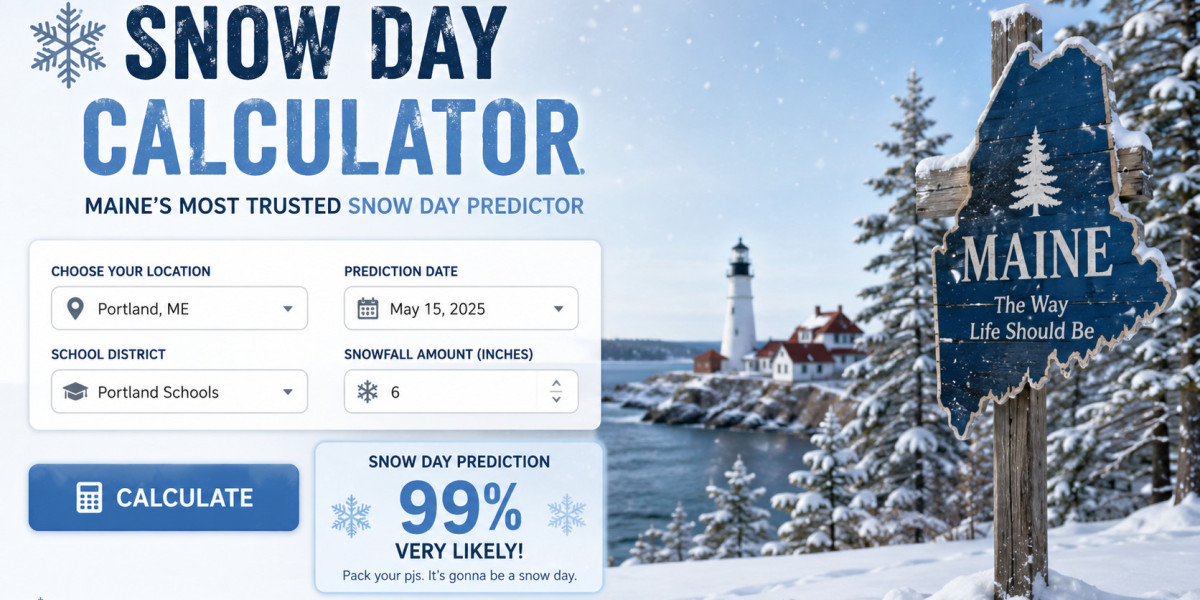

It is 9 PM. The sky is getting that heavy gray look. A nor'easter is on the radar. You have two kids, a work meeting at 8 AM, and absolutely no idea whether to set an alarm or make pancake plans.
If you live in Maine, you know this feeling intimately. And you also know that checking a national weather app tells you almost nothing useful. Maine is not one weather zone. It is six or seven. A storm that drops 14 inches in Portland may leave Farmington with six and Caribou with three.
That is the exact problem a snow day calculator for Maine is designed to solve. This guide explains how the best prediction tools work, what triggers a closure in each region of the state, how Maine's shifting mix of traditional snow days and remote learning days affects your morning plans, and which resources give you the most reliable signal before sunrise.
What Makes Maine's Snow Day Prediction Uniquely Challenging?
Maine is the largest state in New England, stretching roughly 300 miles from the southern coast to the Canadian border. That geography creates dramatically different winter weather patterns across regions, and no single forecast covers them all.
Here is how snowfall normals break down across the state according to National Weather Service climate data:
- Portland (southern coast): approximately 71 inches annually
- Augusta (central inland): approximately 79 inches annually
- Farmington (western foothills): approximately 93 inches annually
- Rumford (western mountains): approximately 93 inches annually
- Eastport (far northeast coast): approximately 72 inches annually
Western Maine near the New Hampshire border receives consistently heavier snowfall than the coast. Coastal areas face a different threat: nor'easters that bring heavy wet snow, intense winds up to 50 mph, and coastal flooding that create dangerous conditions even when totals are modest.
A snow day calculator built for Maine must account for all of this regional variation. ZIP-code-level precision is not optional here. It is the entire point.
How the Maine Snow Day Calculator Works in 2026
The best AI-powered prediction tools now analyze far more than snowfall totals. Here is what the algorithm is actually weighing when it calculates your school closure probability:
Storm Timing Relative to the Morning Window
Timing matters more than total accumulation. Snow that falls between midnight and 6:30 AM sits on roads before plows make a first pass. The same six inches falling after noon is a different story entirely. Top calculators weight the morning window heavily because early accumulation is what prevents buses from running safely.
Road Surface Temperature and Icing Risk
Temperature at ground level matters more than air temperature. A storm hitting pavement at 30°F creates a dangerous freezing layer. The same storm on 35°F pavement may produce slush that drains away. Calculators that track road surface temperature give you a meaningfully better prediction than those using air temperature alone.
Nor'easter Coastal Track and Wind Speed
Maine's most disruptive winter events are nor'easters, intense Atlantic storms known for heavy snow, strong winds, and coastal flooding. The track of a nor'easter determines everything: a storm hugging the coast hits Portland hard but may spare Bangor. A storm cutting inland sends heavy snow to Augusta and Lewiston while coastal communities get mostly rain.
During the February 2026 nor'easter, the storm delivered seven to fourteen inches of snow with gusts reaching 50 mph. Schools in Portland, Biddeford, Lewiston, and Bangor all announced closures, and Governor Janet Mills stated directly that the storm was expected to bring challenging travel conditions across the state.
District History and Rural Route Conditions
No two Maine districts close at the same threshold. A district with long rural bus routes across unpaved township roads closes at different snowfall totals than a compact urban district like Portland. MSAD and RSU districts serving remote areas factor in road commission reports and law enforcement assessments before any call is made.
Maine's Snow Day Reality: Traditional Days vs. Remote Learning in 2026
This is the section most generic snow day articles miss completely, and for Maine families in 2026, it is arguably the most important thing to understand.
The traditional Maine snow day, where school is cancelled and everyone stays home, is increasingly rare in many districts. The pandemic accelerated a shift toward remote learning days, and that shift has now become a permanent feature of Maine's winter school calendar.
Here is what the current landscape looks like across major districts:
Portland: Three traditional snow days before switching to remote learning. The district pre-distributes hard copy materials to younger students weeks in advance to avoid scrambling during storms.
Scarborough: Two traditional snow days before transitioning to remote instruction.
Yarmouth: No more than four traditional snow days. Remote learning activates after that threshold.
South Portland, Gorham, and Brunswick: All consider remote learning after the fifth closure.
MSAD 15 (Gray/New Gloucester): Defaults to remote learning immediately. A traditional full cancellation only happens in the event of a significant power outage.
Lewiston: Still uses traditional snow days as the primary response. Superintendent Jake Langlais has been publicly skeptical of remote learning effectiveness, citing lost documents, device access gaps, and the challenge of providing lunch to students who depend on school meals.
Augusta: Implements a flexible policy that prioritizes remote learning days over snow days, with notifications to families by 1 PM the day before when advance warning allows.
The practical result: a "school closure" announcement in 2026 Maine does not automatically mean a free day. Your child may still be expected online for three hours of instruction. Check your district's current policy at the start of the school year, not the morning of the storm.
The Blizzard Bag: Maine's Original Remote Snow Day Solution
Before remote learning became mainstream, Maine districts pioneered what became known as the Blizzard Bag, a packet of pre-assembled academic work sent home with students in advance of a storm.
RSU 38 (Maranacook area) launched one of the state's earliest Blizzard Bag pilot programs when the district had already used five of its seven built-in snow days and needed to protect instructional time. Teachers were available by email from 9 AM to 3 PM, and students without internet access received hard copies or mobile hotspots from the school.
The Blizzard Bag model addressed a real equity problem: not every Maine student has reliable home internet, especially in rural areas where connectivity gaps remain significant. Even in 2026, many districts maintain a hybrid approach, sending digital work to most students while distributing printed packets to families who need them.
Step-by-Step: How to Predict a Maine Snow Day the Night Before
Here is the sequence that works best for Maine families, starting around 8:30 PM the evening before a potential storm.
Step 1: Check the National Weather Service Gray, Maine forecast. The NWS office in Gray serves southern and central Maine. Look specifically for winter storm warnings, blizzard warnings, and coastal flood advisories. Note when accumulation is expected to peak.
Step 2: Run a ZIP-code-specific snow day calculator. Enter your exact Maine ZIP code rather than a city name. Conditions across southern, central, and western Maine diverge significantly during nor'easters, and ZIP-level data reflects that.
Step 3: Check the AccuWeather WinterCast for your city. AccuWeather provides school closure probability percentages specific to Maine locations. A probability above 60 percent the night before a major storm is a strong signal.
Step 4: Monitor NEWSCENTER Maine (WCSH 6 and WLBZ 2) starting at 5 AM. This is the most authoritative real-time source once decisions are made. The NEWSCENTER Maine closings page updates as districts report in and is widely used by superintendents across the state as their public announcement channel.
Step 5: Check WGME CBS 13 closings for southern Maine. WGME's closings list covers Portland, Lewiston, Augusta, Brunswick, Westbrook, Biddeford, Saco, Sanford, and dozens of surrounding communities. Essential for anyone in Cumberland or York County.
Step 6: Check your district's direct communication channel. Many Maine districts now use ParentSquare, School Messenger, or direct email to notify families before local TV stations post closures. If your district uses one of these systems, it is almost always faster than waiting for the TV scroll.
Maine's Snow Day Decision Timeline: What Happens Before 5 AM
Most Maine families do not realize how early the process begins on a potential storm morning.
By 3 AM to 4 AM, transportation directors are already driving key bus routes in the dark. They are assessing road conditions firsthand and reporting back to the superintendent. The superintendent consults with the local road commission, state police, and sometimes neighboring districts before making a call.
Most Maine districts aim to announce by 5:30 AM. Districts serving large rural areas may call earlier to give bus drivers adequate preparation time.
The hardest decisions, as one Maine administrator described it, are borderline events where conditions vary across a large district. A storm that ices over Route 17 in the western foothills may leave Route 1 along the coast passable. Those are the mornings when the phone stays glued to your hand until the announcement comes.
Key Takeaways: The Maine Snow Day Framework
These are the core principles that distinguish accurate Maine school closure prediction from generic national tools.
The Nor'easter Track Rule: The path of a coastal storm determines regional impact more than total snowfall. A storm tracking close to the coast hits southern Maine hardest. An inland track means heavier totals in central and western regions.
The Remote Day Rule: In 2026, a closure announcement does not equal a free day. Know your district's remote learning threshold before winter begins, not during a storm.
The Rural Route Rule: Districts with unpaved township roads and long rural bus routes close at lower snowfall thresholds than compact urban districts. The same storm can close RSU 73 and leave Portland open.
The Timing Rule: Six inches of snow falling between midnight and 6 AM triggers far more closures than eight inches falling from noon onward. Storm timing is the most underrated variable in Maine closure prediction.
The Blizzard Bag Rule: If your district still uses physical blizzard bags, check that your child brings theirs home every Thursday in winter. Storms do not wait for convenient timing.
Conclusion
The snow day calculator for Maine in 2026 is not just a novelty for excited kids. For working parents, remote workers managing childcare, and educators planning instructional time, it is a practical planning tool that the state's increasingly complex closure landscape has made genuinely necessary.
The best approach combines multiple sources: a ZIP-code-specific prediction tool for probability, the NWS Gray office for raw storm data, NEWSCENTER Maine or WGME for official district closures, and your district's own communication app for the fastest possible notification.