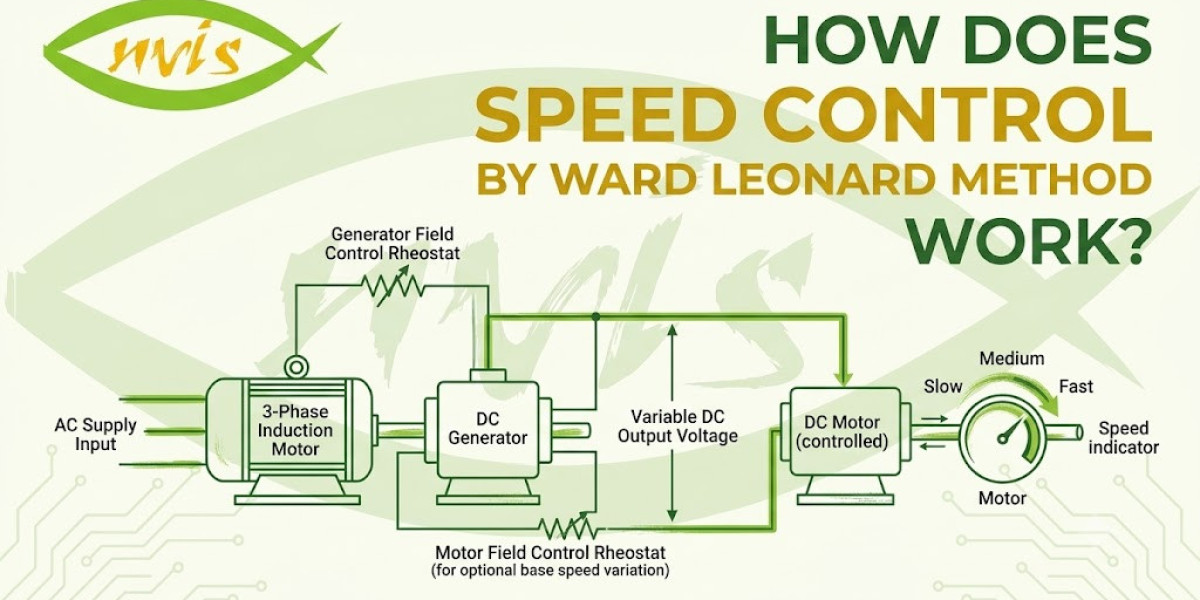

How Does Speed Control by Ward Leonard Method Work?
The ability to control the speed of electric motors has always been essential in industrial applications. Before the development of modern electronic drives and Variable Frequency Drives (VFDs), engineers relied on several electrical and mechanical techniques to regulate motor speed. One of the most effective and widely used methods was the Ward Leonard speed control system.
The Ward Leonard method provided smooth, precise, and efficient speed regulation for DC motors, making it ideal for applications such as elevators, cranes, rolling mills, and mine hoists. Although modern drive technologies have replaced it in many industries, understanding the Ward Leonard method remains important for electrical engineering students and professionals.
In this article, we will explore the working principle, construction, advantages, disadvantages, and applications of the Ward Leonard speed control system.
What Is the Ward Leonard Method?
The Ward Leonard method is a DC motor speed control system that uses a motor-generator set to provide a variable voltage supply to a DC motor.
The system typically consists of:
An AC motor (prime mover)
A DC generator
A DC motor whose speed is to be controlled
The AC motor mechanically drives the DC generator. The generator produces a variable DC voltage that is supplied to the DC motor. By changing the generator's output voltage, the speed of the DC motor can be controlled smoothly over a wide range.
Basic Principle of Ward Leonard Speed Control
The speed of a DC motor primarily depends on the armature voltage and magnetic flux. The relationship is:
N ∝ (V − IaRa) / Φ
Where:
N = Motor speed
V = Armature voltage
Ia = Armature current
Ra = Armature resistance
Φ = Magnetic flux
In the Ward Leonard system, the armature voltage supplied to the motor is varied continuously by adjusting the output voltage of the DC generator.
Increasing the armature voltage increases motor speed.
Decreasing the armature voltage reduces motor speed.
This provides smooth and accurate speed regulation with minimal power loss.
Construction of the Ward Leonard System
A typical Ward Leonard system consists of three main machines:
1. AC Motor
An AC induction motor or synchronous motor acts as the prime mover. Its function is to drive the DC generator at a constant speed.
2. DC Generator
The DC generator converts mechanical energy from the AC motor into electrical energy. Its output voltage can be varied by adjusting the field current.
3. DC Motor
The DC motor receives power from the generator. The motor speed changes according to the voltage supplied by the generator.
Working of Speed Control by Ward Leonard Method
Step 1: Starting the Prime Mover
The AC motor starts and rotates the DC generator at a constant speed.
Step 2: Generator Field Control
The field winding of the DC generator is supplied with a controllable field current.
By changing the field current:
Generator output voltage increases or decreases.
Motor armature voltage changes accordingly.
Step 3: Motor Speed Adjustment
The DC motor receives the variable voltage generated by the DC generator.
When the generator voltage is increased:
Armature voltage increases.
Motor speed rises.
When the generator voltage is reduced:
Armature voltage decreases.
Motor speed falls.
Step 4: Reversing Motor Direction
The polarity of the generator output can be reversed.
This reverses the current supplied to the motor armature, causing the motor to rotate in the opposite direction. This feature made the Ward Leonard system highly suitable for cranes, elevators, hoists, and other applications requiring frequent reversing.
Speed-Torque Characteristics
One of the biggest advantages of the Ward Leonard method is its excellent speed-torque performance.
Key characteristics include:
Smooth acceleration
Smooth deceleration
Wide speed range
High starting torque
Accurate speed regulation
Easy reversal of direction
These characteristics made it a preferred choice for heavy industrial machinery.
Advantages of Ward Leonard Speed Control
Precise Speed Control
The system provides highly accurate speed regulation across a wide operating range.
Smooth Operation
Speed changes occur gradually without sudden jerks or mechanical stress.
Wide Speed Range
Both low-speed and high-speed operation can be achieved effectively.
High Starting Torque
The motor can produce high torque even at low speeds.
Easy Reversal
Direction can be changed easily by reversing the generator output polarity.
Excellent Load Handling
The system maintains stable speed even when load conditions change.
Disadvantages of Ward Leonard Method
Despite its advantages, the Ward Leonard system has some limitations:
High initial installation cost
Requires multiple machines
Large space requirement
Higher maintenance compared to modern drives
Lower efficiency than modern electronic speed control systems
These disadvantages eventually led to the adoption of solid-state drives and VFDs.
Applications of Ward Leonard Speed Control
The Ward Leonard method was widely used in industries where precise speed control and frequent speed variation were required.
Elevators
Provides smooth acceleration and deceleration for passenger comfort.
Cranes
Allows precise lifting and lowering of heavy loads.
Mine Hoists
Ensures controlled movement of materials and equipment.
Rolling Mills
Supports variable-speed operation during metal processing.
Printing Presses
Maintains consistent speed for improved print quality.
Steel Plants
Used for heavy-duty motor control applications requiring precise regulation.
Ward Leonard Method vs Modern VFDs
| Feature | Ward Leonard Method | VFD |
|---|---|---|
| Speed Control Accuracy | High | Very High |
| Efficiency | Moderate | High |
| Maintenance | High | Low |
| Installation Cost | High | Lower |
| Space Requirement | Large | Compact |
| Reliability | Good | Excellent |
Although VFDs have become the preferred solution for modern motor control, the Ward Leonard system played a significant role in the development of advanced drive technologies.
Why Is the Ward Leonard Method Still Important?
Even though it is less commonly used today, engineering students continue to study the Ward Leonard system because:
It explains the fundamentals of DC motor speed control.
It demonstrates armature voltage control techniques.
It remains part of many electrical engineering curricula.
It frequently appears in technical examinations and interviews.
Understanding the Ward Leonard method provides valuable insight into the evolution of modern motor control systems.
Conclusion
The Ward Leonard method of speed control is one of the most important developments in the history of electric motor control. By using a motor-generator set to supply a variable DC voltage, the system enables smooth, accurate, and wide-range speed regulation of DC motors.
Although modern VFDs and electronic drives have largely replaced it, the principles behind the Ward Leonard method remain highly relevant in electrical engineering education. Its ability to provide precise speed control, high starting torque, smooth acceleration, and easy directional reversal made it a groundbreaking solution for industrial applications.
For students and professionals studying motor control systems, the Ward Leonard method continues to provide a strong foundation for understanding modern speed control technologies.
Ubicación del Autor
New Delhi