
Water is one of those resources we rarely think about until something goes wrong—a pump failure, a burst pipe, a dry well. For generations, managing water meant manual checks: walking fields to read flow meters, climbing ladders to inspect tank levels, or driving hours to a remote pumping station. That worked when labour was cheap and time was abundant. Today, it’s neither. Farms are larger, water costs are climbing, and the margin for error is shrinking. This beginner’s guide to Remote Water Management introduces a smarter, connected approach that lets you monitor and control water systems from anywhere, using sensors, data dashboards, and automated alerts. If you’re ready to stop chasing problems and start anticipating them, you’re in the right place.
What Is Remote Water Monitoring?
At its heart, remote water monitoring is the practice of using digital sensors and communication networks to collect real‑time information about water systems without being physically present. Think of it as giving your water infrastructure a voice—telling you how much water is flowing, whether quality parameters are in range, and if a tank is about to overflow. Unlike traditional logging, where someone writes down readings once a day, this technology updates continuously, giving you a live picture of what’s happening across a property, watershed, or entire utility network.
The magic isn’t just in seeing numbers on a screen. It’s about transforming data into decisions. A sensor that reads soil moisture can trigger an irrigation valve to open only when needed. A pressure transducer on a municipal main can detect a leak the moment it forms, not after a homeowner reports a swampy lawn. These systems blend hardware, software, and connectivity into a seamless loop of measure, analyse, and act.
Why It’s Time to Rethink Water Monitoring
If you rely on manual checks, you’re always looking in the rear‑view mirror. By the time someone notices an anomaly—a spike in usage, a sudden drop in pressure—the damage is often done. Ageing infrastructure compounds the problem. A 2023 survey of North American water utilities found that nearly 30% of treated water is lost to leaks before it ever reaches a tap. That’s a staggering volume, and most of those leaks go undetected for weeks.
Climate volatility adds another layer of urgency. Erratic rainfall, prolonged droughts, and the need to justify every drop used for agriculture or industry mean you can’t afford guesswork. Remote monitoring gives you the granular visibility to cut waste, comply with tightening regulations, and protect your bottom line. It’s not just a convenience—it’s a necessity for anyone serious about stewardship and efficiency.
The Key Components of a Remote Water System
Before you jump into buying hardware, it helps to understand the anatomy of a typical setup. Most remote water monitoring systems are built from four core blocks:
1. Sensors and Data Loggers
Sensors are the workhorses that measure physical parameters. You’ll encounter:
Flow meters (electromagnetic, ultrasonic, or mechanical) to track water movement through pipes or channels.
Pressure transducers that sit at critical points and detect drops indicating leaks or pump failures.
Level sensors—ultrasonic, radar, or float‑based—for tanks, reservoirs, and streams.
Water quality sensors measuring pH, turbidity, dissolved oxygen, conductivity, and temperature.
Data loggers collect signals from these sensors and convert them into digital information, often storing it locally as a backup.
2. Communication and Connectivity
Raw data is useless if it can’t reach you. Connectivity options depend on location and scale:
Cellular (4G/5G) – reliable in most places with mobile coverage, ideal for dispersed rural assets.
LoRaWAN – low‑power, long‑range radio that excels in agricultural settings where sensors are scattered across kilometres.
Wi‑Fi – simple for residential or small indoor setups.
Satellite – for the truly off‑grid locations where nothing else reaches.
Modern gateways often support multiple protocols, bridging sensor networks to the cloud.
3. Cloud Software and Dashboards
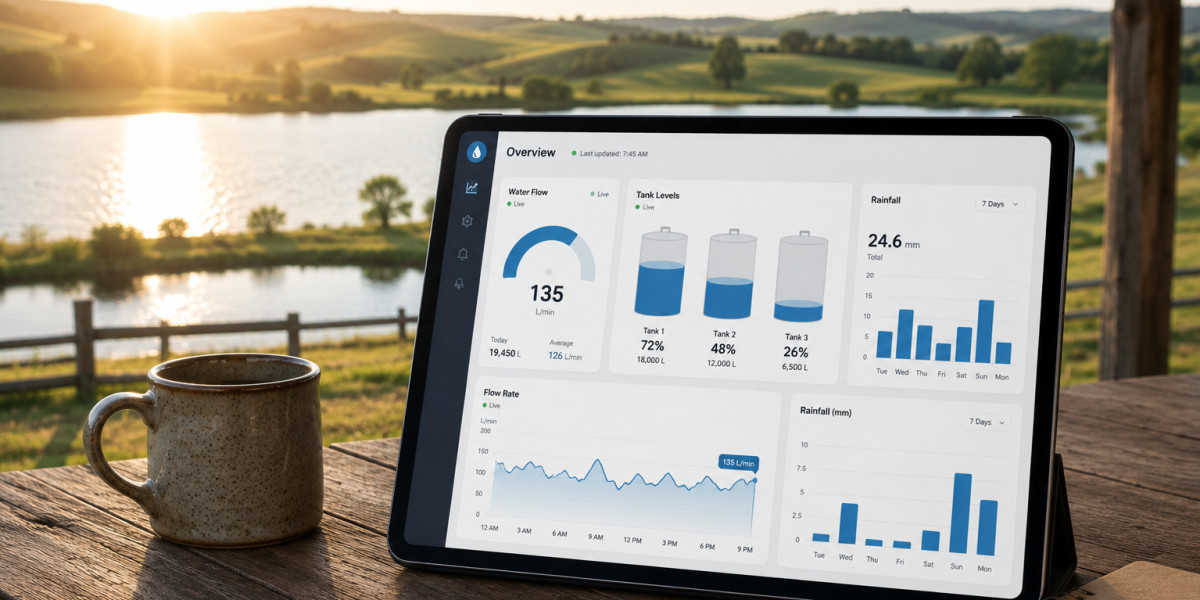
The cloud is the brain. Incoming data streams are processed, stored, and displayed on web‑based dashboards or mobile apps. Here, you can view real‑time metrics, historical trends, and custom reports. The best platforms let you overlay data from many sources—for example, combining soil moisture, weather forecasts, and pump status on a single screen.
4. Alerts and Automation
This is where passive monitoring turns into active management. Set thresholds for each parameter, and the system sends alerts via SMS, email, or app notification the moment something breaches a limit. Some setups go further, triggering valves, pumps, or alarms automatically. Imagine a livestock water trough that refills itself when the level drops below 20%, then sends you a confirmation ping. That’s the power of closing the loop.
How to Start with Remote Water Monitoring: A 5‑Step Guide
Setting up your first remote monitoring project doesn’t require an engineering degree. Break it down methodically.
Step 1: Map Your Water Assets and Goals
Walk your property or site and list every point where water enters, exits, is stored, or changes quality. Decide what you need to know: Do you want to cut irrigation waste? Prevent tank overflows? Prove compliance with environmental permits? Your goals will dictate which sensors matter most.
Step 2: Choose the Right Sensors for the Job
Match parameters to sensor types. For a farm, you might start with a flow meter on the main supply line, a few soil moisture probes in key zones, and a level sensor in your storage tank. For a rural water utility, focus on pressure transducers at district metering areas and turbidity sensors at the treatment plant intake. Always check environmental ratings—outdoor sensors need to handle dust, moisture, and temperature swings.
Step 3: Decide on Connectivity
Ask yourself: Is there reliable cell signal at every sensor location? If yes, cellular loggers are the quickest to deploy. If you’re covering hundreds of acres with no reception, consider a LoRaWAN gateway on a high point that can cover a 10–15 km radius. Pair it with a satellite backhaul if the site itself is off‑grid. Power options include solar panels with battery backup for remote nodes.
Step 4: Configure and Test Your Alerts
One common mistake is creating alert fatigue. If you get a notification for every minor fluctuation, you’ll start ignoring them. Set meaningful thresholds based on normal operational ranges. For example, a flow meter on a drip irrigation line might alert only if flow drops below 90% of expected (indicating a clog) or spikes above 120% (indicating a leak). Run a test with a simulated anomaly to make sure notifications reach the right people.
Step 5: Analyse and Optimise Over Time
The real value emerges after the first few weeks of data collection. Look for patterns: Does your water usage spike at 3 a.m. every Tuesday? That might be an automated valve schedule you can tweak. Does pressure drop gradually over a month, hinting at a small leak? Catching those trends early prevents emergencies and slashes costs.
Real‑World Applications
The beauty of remote water monitoring is how broadly it applies across different sectors.
Agriculture: Farmers use soil moisture and weather data to schedule precise irrigation, reducing water use by up to 30% while boosting crop yields. Livestock operations monitor remote troughs and tanks to ensure animals never run dry.
Municipal Water Supply: Towns deploy acoustic loggers and pressure sensors across their distribution networks to pinpoint leaks long before they surface. This cuts non‑revenue water and extends the life of aging pipes.
Industrial Processes: Manufacturing plants track cooling water, wastewater discharge, and chemical dosing to stay within environmental permits and avoid costly fines.
Residential and Small Community Systems: Homeowners on wells monitor pump performance and tank levels from their phones. Small shared water systems use affordable kits to keep an eye on water quality and usage without hiring a full‑time operator.
For those looking to get started without assembling a system from scratch, some providers have simplified the process considerably. For example, NightOwl Monitoring offers pre‑configured kits that combine rugged sensors, a plug‑and‑play gateway, and a user‑friendly mobile dashboard—making it feasible for a small orchard or off‑grid cabin to gain professional‑grade oversight within a single afternoon.
Unpacking the Benefits That Go Beyond Convenience
While the “check from anywhere” factor is nice, the strategic benefits run deeper.
Early Leak Detection: Continuous monitoring spots tiny changes that signal a leak. Fixing a pinhole leak early can save thousands of litres and prevent catastrophic pipe failures.
Water Conservation: Data‑driven irrigation and process control eliminate guesswork. When every drop is accounted for, waste drops dramatically.
Cost Reduction: Fewer emergency repairs, lower energy bills from optimised pumping, and reduced water purchase or extraction fees add up quickly.
Regulatory Compliance: Automated logging of flow, quality, and discharge data creates an audit trail that satisfies environmental agencies without extra paperwork.
Peace of Mind: Knowing your system will alert you the moment something drifts out of normal range means you can focus on other work—or even take a vacation—without anxiety.
Common Challenges and How to Overcome Them
No technology is perfect, and remote water monitoring comes with its own learning curve.
Connectivity gaps: Rural areas often lack reliable cell service. The workaround is a hybrid approach—combine LoRaWAN for local sensor communication with a single satellite or long‑range radio uplink at the gateway. Some modern gateways cache data during outages and backfill once the connection returns.
Power supply: Sensors in the middle of a field can’t run extension cords. Solar panels paired with lithium batteries are the standard solution. Look for loggers with ultra‑low sleep currents that can run for months on a small panel, even in cloudy climates.
Data security: Sending water system data over the internet raises valid concerns. Stick with platforms that offer end‑to‑end encryption, multi‑factor authentication, and regular firmware updates. Treat your water network with the same digital hygiene you’d apply to online banking.
Upfront cost: A full‑scale deployment can feel expensive. Start small—pick your most critical asset, install two or three sensors, and prove the value. The savings from even one avoided leak or pump failure often pay for the initial investment within the first year.
User adoption: If the dashboard is clunky or the alerts are irrelevant, people will ignore the system. Involve the people who will use it daily in the setup phase. Choose platforms with intuitive mobile interfaces and clear visualisations. Training shouldn’t take more than an hour.
What the Future Holds for Smart Water Systems
The technology is evolving fast. Artificial intelligence is beginning to move from buzzword to practical tool. Machine learning models, trained on years of historical data, can now predict pump failures weeks in advance by detecting subtle vibration or current changes. Predictive irrigation, which automatically adjusts schedules based on hyper‑local weather forecasts and plant growth models, is becoming available to smaller growers, not just large enterprises.
Integration is the next frontier. Imagine your water monitoring system talking to your smart home hub, your utility’s demand‑response platform, and your insurance provider. A leak detected at 2 a.m. could automatically shut the main valve, alert the homeowner, and file a claim with the insurer, all within seconds. On a city scale, interconnected systems will dynamically balance pressure zones, redirect flows around construction, and report water quality in real‑time to public dashboards—building trust and resilience into the community.
Conclusion
Getting started with remote water monitoring doesn’t demand a huge budget or a technical background. It starts with a clear picture of what you want to achieve, a handful of well‑chosen sensors, and a platform that turns raw data into actionable insights. From smallholder farms to sprawling municipal networks, the principles are the same: measure what matters, respond quickly to anomalies, and let the data guide your decisions. The days of clipboards and late‑night panic drives to check a tank are fading. With the right tools and a gradual, step‑by‑step approach, anyone can move from reactive firefighting to proactive, confident water stewardship.
Frequently Asked Questions
How does remote water monitoring work?
Sensors placed at key points—pipes, tanks, wells—measure flow, pressure, level, or quality. A data logger collects those readings and transmits them wirelessly (via cellular, Wi‑Fi, or radio) to a cloud platform. That platform processes the information and displays it on a dashboard, where you can view trends and set up alerts for abnormal conditions.
What are the benefits of monitoring water remotely?
You gain real‑time visibility, which helps catch leaks early, reduce water waste, cut operating costs, and meet regulatory requirements. It also eliminates the need for frequent manual readings and gives you peace of mind when you’re away from the site.
Can I monitor water quality remotely?
Yes. Modern sensors can measure pH, turbidity, dissolved oxygen, conductivity, and temperature continuously. This is especially valuable for drinking water systems, aquaculture, and industrial discharges where quality standards must be maintained around the clock.
What types of sensors are used in water monitoring systems?
Common types include flow meters (electromagnetic, ultrasonic), pressure transducers, ultrasonic or radar level sensors, soil moisture probes, rain gauges, and multi‑parameter water quality sondes. The choice depends on what you need to measure and the environmental conditions.
Is it difficult to install a remote water monitoring system?
Many modern systems are designed for simple installation. Battery‑powered sensors with clamp‑on or threaded fittings can often be placed without cutting pipes. Cellular loggers activate with a SIM card and connect automatically. For larger or multi‑site deployments, a professional integrator can streamline the process.
How much does a remote water monitoring system cost?
Costs vary widely based on the number of monitoring points, sensor types, and connectivity. A basic single‑point residential system might start around a few hundred dollars, while a farm‑wide or municipal network with dozens of sensors could run into the thousands. However, the water and cost savings typically recover the investment quickly.
Ubicación del Autor
United State Route 77 Business