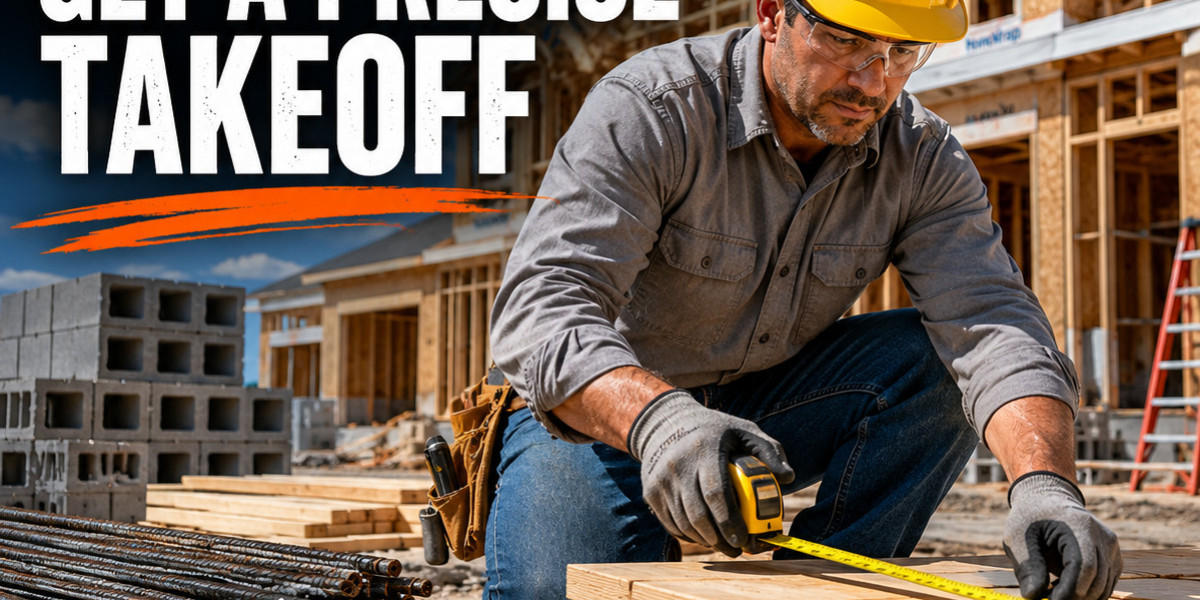

Ask any experienced contractor what kills a project budget the fastest, and most will tell you the same thing: bad material counts. Not bad luck. Not market prices. Just numbers that were wrong from the very first day of planning.
This is exactly where material takeoff services come in. They are not just a formality before bidding. Done right, they are one of the few parts of a project that directly protect your profit margin from day one.
What Material Takeoff Services Actually Include?
A material takeoff is the process of measuring a project's blueprints and producing an exact list of every material required to complete it, down to individual quantities of concrete, lumber, drywall, steel, insulation, and finishes.
It sounds simple on paper. In practice, it is one of the most detail-heavy parts of pre-construction. A single missed measurement on a set of plans can throw off an entire order, and that mistake usually does not show up until materials are already on site or, worse, until they are not.
Professional material takeoff services use software like Planswift and Bluebeam to measure directly from digital blueprints, cross-checking quantities trade by trade so nothing gets missed or double-counted.
The Real Cost of Skipping This Step
Contractors who skip a proper takeoff, or rush through one manually, usually run into one of two expensive problems.
Over-ordering wastes money outright. Extra lumber, excess concrete, unused drywall, all of it sits there as a sunk cost. On larger projects, over-ordering by even five or ten percent can mean thousands of dollars in materials that never get used.
Under-ordering is worse. It does not just cost money; it costs time. A mid-project material shortage means a paused crew, a delayed schedule, and often a rush order at a higher price just to keep things moving. Clients notice delays. Subcontractors notice delays. And delays have a way of compounding into bigger problems.
A detailed material takeoff prevents both situations by giving you exact numbers before a single order is placed.
How Accurate Takeoffs Improve Your Bids?
Material takeoffs are not just useful after you win a bid; they are critical before you even submit one.
When your material counts are accurate, your bid reflects the real cost of the project. That means you are not underbidding and eating the difference later, and you are not overbidding and losing the job to a competitor with better numbers.
This is especially important in competitive markets where multiple contractors are bidding on the same project. The contractor with the most accurate takeoff usually submits the most competitive and most sustainable bid.
What to Look for in a Reliable Material Takeoff Service?
Not every takeoff service delivers the same level of detail. Here is what separates a reliable one from a rushed one.
Trade-specific accuracy. A good takeoff breaks materials down by trade: concrete, framing, MEP, finishes, rather than giving you one vague combined number.
Software-based measurement. Manual takeoffs from printed plans introduce human error. Digital takeoffs using tools like Planswift or Bluebeam are faster and significantly more precise.
Fast turnaround. Bidding windows do not wait. A reliable takeoff service should be able to turn around detailed material lists within 24 to 48 hours, not a week or more.
Current market pricing. A material count is only half the picture. The best services pair quantities with up-to-date local pricing, so you know not just what you need, but what it will actually cost.
Who Benefits Most From Professional Takeoffs?
Material takeoff services are not only for large general contractors. Homebuilders use them to keep custom residential projects on budget. Subcontractors use them to bid their specific scope of work accurately.
Developers use them during early planning to assess project feasibility before committing to a design. Even architects rely on early takeoffs to understand whether a design is realistic within a client's budget.
In every case, the goal is the same: replace guesswork with real numbers before money is spent.
Why Are Material Takeoff Services Worth the Investment?
The contractors who consistently stay profitable are rarely the ones who get lucky on pricing. They are the ones who do not leave material counts to estimation or memory. They invest in a proper takeoff before the first order is placed, and it pays off on every single project.
If your last few projects ran over budget on materials, the issue is rarely the market. It is usually the takeoff. Getting that one step right is one of the simplest ways to protect your profit margin without cutting corners anywhere else.
Texas Estimators provides detailed material takeoff services for residential, commercial, and industrial projects across Texas, with turnaround times of 24 to 48 hours. If you are tired of guessing on material counts, visit texasestimators.com or call +1 726 220 6896 to get started.
Frequently Asked Questions
How long does a material takeoff usually take?
Most material takeoff services deliver results within 24 to 48 hours, depending on the size and complexity of the project. Larger industrial or commercial projects with multiple trades may take slightly longer to ensure full accuracy.
Is a material takeoff the same as a cost estimate?
No. A material takeoff lists the exact quantities of materials needed for a project. A cost estimate takes those quantities and applies current pricing to produce an actual dollar figure. Many contractors order both together.
Can a material takeoff be done from digital plans only?
Yes. Most professional takeoff services work directly from digital blueprints using software like Planswift or Bluebeam, which is faster and more accurate than measuring from printed plans.
Do small residential projects need a professional material takeoff?
Yes, even smaller projects benefit. Over-ordering and under-ordering happen on projects of every size, and a professional takeoff helps avoid both, regardless of how large or small the build is.
Ubicación del Autor
United States of America