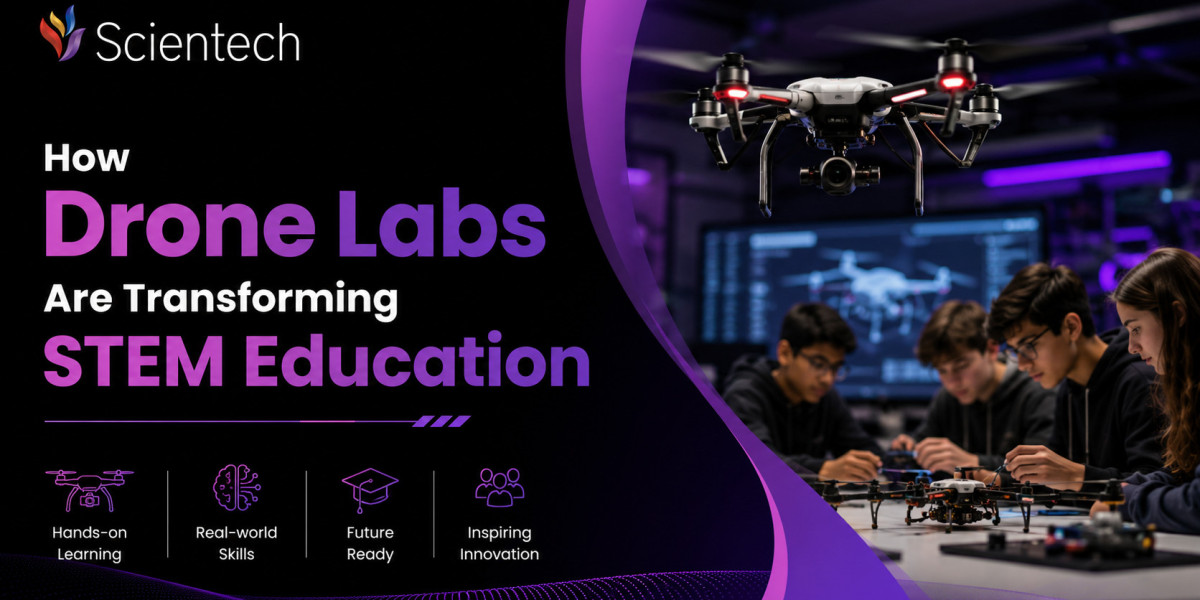

STEM education is evolving rapidly. While classroom learning provides a strong theoretical foundation, employers increasingly value graduates who can apply their knowledge to real-world problems. This shift has encouraged schools, colleges, and universities to adopt hands-on learning environments that bridge the gap between theory and practice.
One of the most impactful additions to modern education is the drone lab. By combining engineering, electronics, programming, artificial intelligence (AI), and data analysis, drone labs create an interdisciplinary learning experience that prepares students for emerging industries.
In this blog, we'll explore how drone labs are transforming STEM education and why they are becoming an essential part of modern technical institutions.
What Is a Drone Lab?
A drone lab is a dedicated learning space where students design, assemble, program, test, and operate unmanned aerial vehicles (UAVs). Rather than focusing only on flying drones, these laboratories expose students to the complete drone ecosystem, including hardware, software, communication systems, sensors, and flight operations.
A well-equipped drone lab typically includes:
Drone assembly kits
Flight controllers
Electronic components
Sensors
Battery management systems
Flight simulators
Programming tools
Indoor flight training area
Mapping and GIS software
These resources help students gain practical experience while reinforcing concepts taught in STEM courses.
Why Drone Labs Matter in STEM Education
Traditional STEM education often emphasizes lectures, textbooks, and laboratory experiments focused on individual subjects. Drone labs encourage students to combine knowledge from multiple disciplines to solve real-world engineering challenges.
For example, building a drone involves understanding:
Physics for aerodynamics and flight
Mathematics for navigation and calculations
Electronics for circuits and sensors
Mechanical engineering for structural design
Computer science for programming and automation
AI for autonomous flight and object detection
This interdisciplinary approach develops both technical expertise and problem-solving skills.
Practical Learning Beyond the Classroom
Students learn more effectively when they apply concepts through real projects.
In a drone lab, learners can:
Assemble drone components
Configure flight controllers
Program autonomous missions
Test wireless communication systems
Analyze flight performance
Troubleshoot hardware issues
Integrate cameras and sensors
Collect and process aerial data
These experiences improve technical understanding while building confidence in handling advanced technologies.
Encouraging Innovation Through Project-Based Learning
Drone labs provide an ideal environment for project-based learning.
Students can develop projects such as:
Autonomous navigation systems
Precision agriculture drones
Search and rescue drones
Infrastructure inspection systems
Environmental monitoring solutions
GIS mapping applications
Delivery drone prototypes
Working on these projects encourages creativity, teamwork, research, and innovation.
Building Industry-Relevant Skills
Drone technology combines several high-demand technologies into one platform.
Students gain experience in areas such as:
UAV design
Embedded systems
Programming
Wireless communication
Sensor integration
Artificial intelligence
Machine learning
GIS mapping
Computer vision
Flight planning
These skills are increasingly valuable across multiple industries.
Supporting Multiple Engineering Disciplines
One of the biggest strengths of a drone lab is its ability to support students from different academic backgrounds.
Mechanical Engineering
Students learn:
Frame design
Aerodynamics
Material selection
Propulsion systems
Electronics Engineering
Students work with:
Flight controllers
Sensors
Power distribution
Communication modules
Computer Science
Students develop:
Flight algorithms
Autonomous navigation
AI models
Drone software applications
Civil Engineering
Students explore:
Surveying
Mapping
Infrastructure inspection
Construction monitoring
Agriculture
Students study:
Crop monitoring
Precision farming
Field mapping
Spraying technologies
This multidisciplinary learning reflects how drone technology is used in real industries.
Preparing Students for Emerging Careers
The demand for professionals with UAV skills continues to grow across industries.
Drone labs help students prepare for roles such as:
UAV Engineer
Drone Pilot
GIS Analyst
Robotics Engineer
AI Engineer
Survey Engineer
Drone Software Developer
Research Associate
Inspection Spet
Agriculture Technology Expert
Practical experience gained in a drone lab makes graduates more industry-ready.
Applications Students Can Explore
Modern drone labs introduce learners to a wide range of real-world applications.
Agriculture
Students learn how drones support:
Crop monitoring
Precision spraying
Soil analysis
Yield estimation
Infrastructure
Drone labs help students understand:
Bridge inspection
Building surveys
Road monitoring
Construction progress tracking
Environmental Monitoring
Projects may include:
Forest surveys
Wildlife observation
Water resource monitoring
Disaster assessment
Smart Cities
Students explore:
Traffic monitoring
Urban mapping
Utility inspections
Public safety applications
Promoting Research and Innovation
Drone labs also serve as research centers where students and faculty can experiment with emerging technologies.
Research areas include:
Autonomous UAV systems
Swarm drones
AI-powered navigation
Advanced sensors
Drone communication networks
Payload optimization
Energy-efficient flight systems
These projects contribute to innovation while strengthening academic research.
Why Educational Institutions Are Investing in Drone Labs
Educational institutions recognize that employers increasingly value graduates with practical skills.
A dedicated drone lab helps institutions:
Enhance STEM education
Support interdisciplinary learning
Encourage innovation
Improve research capabilities
Prepare students for industry
Strengthen industry collaborations
Offer project-based learning opportunities
These benefits make drone laboratories a valuable investment for colleges, universities, research centers, and technical institutes.
The Future of Drone Labs in STEM Education
As drone technology continues to evolve, educational institutions will expand their focus beyond basic flight training.
Future drone labs are expected to incorporate:
Artificial intelligence
Machine learning
Digital twins
Edge computing
5G communication
Autonomous navigation
Advanced simulation platforms
Collaborative robotics
This evolution will help students stay aligned with future industry requirements.
Conclusion
A drone lab is more than a place to learn how to fly drones. It is an interdisciplinary learning environment where students combine engineering, programming, electronics, AI, and data analysis to solve real-world problems.
By providing hands-on experience, encouraging innovation, and developing industry-relevant skills, drone labs are transforming STEM education and preparing the next generation of engineers, researchers, and technology professionals.
As industries continue to adopt UAV technology, educational institutions that invest in modern drone laboratories will be better positioned to equip students with the knowledge and practical experience needed for successful careers.
Ubicación del Autor
India