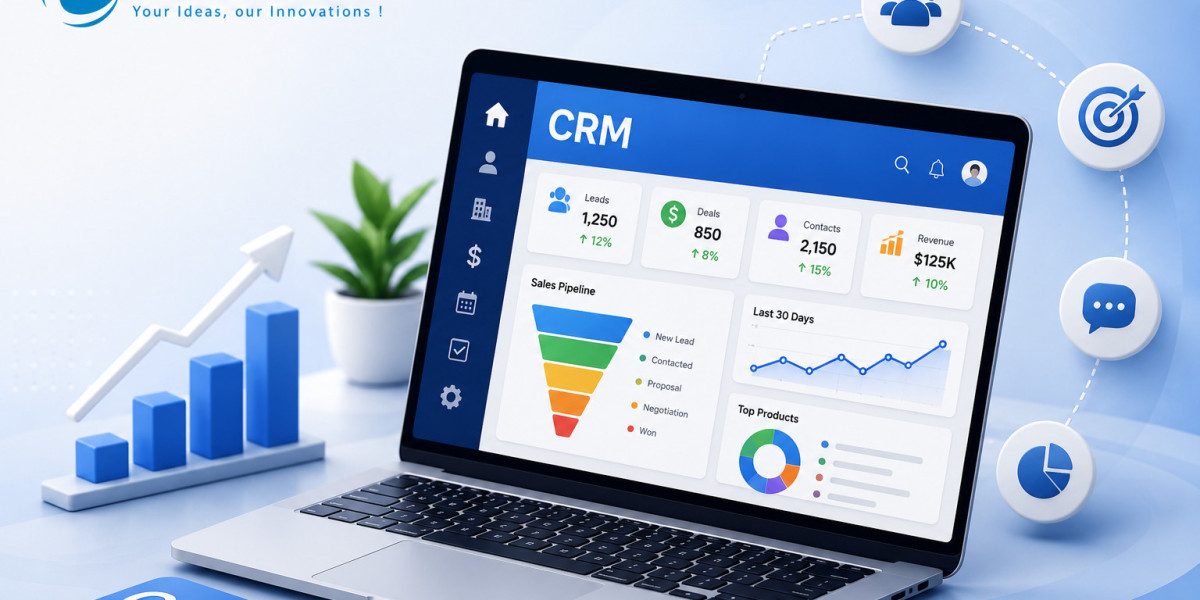

Customer relationships play a major role in business growth, regardless of company size. A startup trying to acquire its first hundred customers and an enterprise managing millions of customer interactions share one common challenge: organizing and using customer data effectively.
This is where Customer Relationship Management (CRM) systems become essential. A CRM platform helps businesses track leads, manage customer interactions, automate processes, and improve communication across teams. However, every organization has different goals, workflows, and operational structures. As a result, businesses often need more than an out-of-the-box CRM solution.
This is one of the main reasons companies choose to hire CRM developers. These professionals customize CRM systems, build integrations, automate workflows, and ensure the platform supports business growth. While startups and enterprises may have different priorities, both rely on CRM expertise to improve efficiency and strengthen customer relationships.
Startups Need CRM Systems That Support Rapid Growth
Startups often operate with limited resources, lean teams, and aggressive growth targets. During the early stages, managing customer information through spreadsheets or disconnected tools may seem manageable. However, as customer numbers increase, those methods quickly become inefficient.
A CRM system helps startups create structure without slowing down growth. But generic CRM setups rarely address the unique needs of a growing business.
For example, a SaaS startup may need automated lead nurturing workflows, while an online marketplace may require customer onboarding automation and support ticket integration.
When startups hire CRM developers, they gain the ability to customize CRM processes around their business model instead of forcing employees to adapt to standard software configurations.
This flexibility allows startups to scale more efficiently while maintaining a positive customer experience.
Enterprises Require Complex CRM Customization
Enterprise organizations face a different set of challenges. They often manage large customer databases, multiple departments, global operations, and complex workflows.
A standard CRM implementation may not be sufficient for handling these requirements.
Large organizations frequently need:
Multi-department workflows
Advanced reporting systems
Custom dashboards
Role-based permissions
Enterprise-grade security
Integration with legacy software
For instance, a multinational company may require customer information to flow between CRM systems, ERP platforms, customer support tools, and financial applications.
This level of complexity often requires specialized expertise. As a result, enterprises regularly hire CRM developers who can design solutions that align with existing infrastructure and operational requirements.
Without proper customization, large-scale CRM implementations can become difficult to manage and less effective for end users.
CRM Developers Help Businesses Automate Repetitive Tasks
As businesses grow, repetitive administrative tasks can consume significant time and resources. Manual data entry, lead assignment, follow-up scheduling, and report generation are common examples.
While these tasks are important, they rarely contribute directly to strategic growth.
CRM developers help automate these activities, allowing employees to focus on higher-value work.
Examples of CRM Automation
A CRM developer can create workflows that:
Assign leads automatically
Send follow-up emails after inquiries
Generate reminders for sales activities
Update customer records across systems
Trigger notifications for specific actions
Imagine a company receiving hundreds of inquiries every week. Without automation, employees may spend hours organizing and distributing leads manually.
Businesses that hire CRM developers often reduce administrative workloads and improve overall productivity through workflow automation.
Better Data Management Improves Decision-Making
Customer data is valuable only when it is accurate, organized, and accessible.
Many organizations struggle with fragmented information spread across multiple systems. Sales teams may use one platform, customer service teams another, and marketing teams a completely different tool.
This creates data silos that make informed decision-making difficult.
Creating a Unified Customer View
CRM developers help businesses centralize information and create a single source of truth.
For example, a developer may integrate:
Marketing software
Customer support platforms
Accounting systems
E-commerce websites
Sales tools
Once connected, these systems provide employees with a complete view of customer interactions.
When organizations hire CRM developers, they often gain improved visibility into customer behavior, helping leaders make more informed business decisions.
CRM Integrations Improve Operational Efficiency
Modern businesses rely on a growing number of software applications. While each system serves a specific purpose, disconnected tools can create inefficiencies and duplicate work.
CRM developers play an important role in connecting these systems.
For example, customer orders from an online store can automatically update CRM records. Support tickets can appear within customer profiles, and marketing campaigns can trigger actions based on customer behavior.
These integrations reduce manual work and improve collaboration between departments.
Real-World Example
Consider a retail business using separate tools for sales, inventory management, and customer support.
Without integration:
Employees manually update records.
Information becomes outdated.
Errors become more common.
With proper CRM integration, data flows automatically across systems, improving accuracy and reducing delays.
This is another key reason businesses choose to hire CRM developers as they expand operations.
CRM Developers Support Better Customer Experiences
Customer expectations continue to rise. People expect fast responses, personalized communication, and consistent experiences across every touchpoint.
A CRM system can support these expectations, but only when configured correctly.
CRM developers help businesses organize customer information in ways that make it more useful to employees.
Personalization Through CRM
For example, a support representative can quickly view:
Purchase history
Previous support requests
Customer preferences
Recent interactions
This allows employees to provide more personalized and efficient service.
A customer who contacts support does not want to repeat the same information multiple times. Access to complete customer records helps create smoother interactions and improves satisfaction.
Businesses that hire CRM developers often see improvements in customer engagement because their teams can respond more effectively to customer needs.
Scalability Is Important for Both Startups and Enterprises
One interesting similarity between startups and enterprises is the need for scalability.
Startups require systems that can support future growth. Enterprises need systems that can accommodate changing business requirements and increasing complexity.
CRM developers help organizations prepare for both situations.
Building for the Future
A scalable CRM system can support:
Additional users
New departments
Advanced automation
Expanded reporting
Additional integrations
New business locations
For example, a startup that begins with a five-person sales team may eventually expand into multiple regions. Similarly, an enterprise may acquire another company and need to merge customer data from multiple systems.
Businesses that hire CRM developers early often avoid costly system redesigns later.
Scalability planning helps organizations adapt more smoothly to growth and change.
Understanding the Cost of Hiring CRM Developers
One of the reasons businesses explore CRM development services is flexibility in hiring models.
According to current CRM developer hiring models, businesses can choose between hourly engagement, dedicated developers, or full development teams depending on project requirements. CRM developer rates typically start from $20–$35 per hour, while a dedicated CRM developer generally starts at approximately $2,800 per month for full-time engagement. Larger CRM projects may require dedicated teams that include developers, Quality assurance professionals, project managers, and integration experts.
For startups, hourly or part-time engagement may be sufficient for specific customization projects.
Enterprises often prefer dedicated developers or teams because they require ongoing support, integrations, and continuous platform optimization.
The right approach depends on business goals, project complexity, and long-term CRM requirements.
Conclusion
Although startups and enterprises operate at different scales, both rely on customer relationships to drive growth. CRM systems help manage those relationships, but the true value often comes from customization, automation, integration, and scalability.
This is why organizations continue to hire CRM developers. Whether the goal is improving operational efficiency, automating repetitive tasks, enhancing customer experiences, or preparing for future expansion, CRM developers help businesses build systems that support long-term success.
As customer expectations continue evolving and business processes become more interconnected, CRM expertise remains a valuable resource for companies of all sizes. Organizations such as EmizenTech continue contributing to the CRM development landscape by helping businesses create customer management solutions that align with both current needs and future growth objectives.
FAQs
Why do startups hire CRM developers?
Startups hire CRM developers to customize CRM systems, automate workflows, and build scalable solutions that support growth.
Why do enterprises need CRM developers?
Enterprises often require advanced integrations, security controls, custom workflows, and large-scale CRM management capabilities.
How much does it cost to hire CRM developers?
CRM developers typically cost $20–$35 per hour, while dedicated developers generally start at around $2,800 per month, depending on project requirements.
Can CRM developers improve customer experience?
Yes. CRM developers help organize customer data and create workflows that support faster, more personalized customer interactions.
What is the biggest benefit of hiring CRM developers?
One of the biggest benefits is the ability to customize and optimize CRM systems to match specific business processes and growth goals.
Ubicación del Autor
30 Ngould St Ste R Sheridan,WY 82801