
Businesses in 2026 operate in an environment where customer expectations continue to rise, competition is becoming stronger, and digital interactions are increasing across multiple channels. Customers expect quick responses, personalized communication, and consistent service whether they connect through websites, mobile apps, social media, or email. Managing these interactions manually is no longer practical, especially for growing organizations.
Customer Relationship Management (CRM) systems have become an essential part of modern business operations because they help organize customer information, improve communication, and streamline everyday tasks. However, simply having a CRM is not enough. Businesses now require solutions that align with their workflows, integrate with existing software, and adapt to future growth. This shift makes reliable CRM development an important consideration for organizations looking to improve efficiency and customer experience over the long term.
Why CRM Matters More Than Ever in 2026?
The role of CRM has expanded far beyond storing customer contact information. Modern businesses collect data from multiple sources, including websites, online stores, customer support channels, marketing campaigns, and mobile applications. Without a centralized system, valuable customer information often becomes scattered across different platforms.
In 2026, organizations also rely heavily on automation and data-driven decision-making. Sales teams need accurate lead tracking, marketing departments require customer insights for personalized campaigns, and support teams depend on complete customer histories to resolve issues quickly. A well-designed CRM helps connect these departments by providing a single source of accurate information.
The growing use of artificial intelligence has further increased the importance of CRM systems. Businesses can now identify customer behavior patterns, forecast sales opportunities, and automate repetitive tasks, allowing employees to focus on higher-value activities. As customer expectations continue to evolve, CRM has become a strategic tool rather than just a software application.
What Does a CRM Development Company Do?
A CRM Development Company designs, develops, customizes, and maintains CRM solutions that match the specific operational needs of a business. Instead of relying only on standard software features, businesses often require systems that reflect their internal workflows, customer journeys, and reporting requirements.
A development company typically begins by understanding business objectives and existing processes before creating a CRM solution that supports sales, customer service, marketing, and operational management. It also integrates the CRM with other business applications such as ERP systems, accounting software, communication platforms, inventory management tools, and eCommerce platforms.
Another important responsibility involves improving system performance through automation, security enhancements, and regular updates. As businesses grow, CRM solutions require continuous improvements to support new users, additional features, and changing customer expectations. Ongoing maintenance helps ensure the CRM remains reliable, secure, and aligned with evolving business requirements.
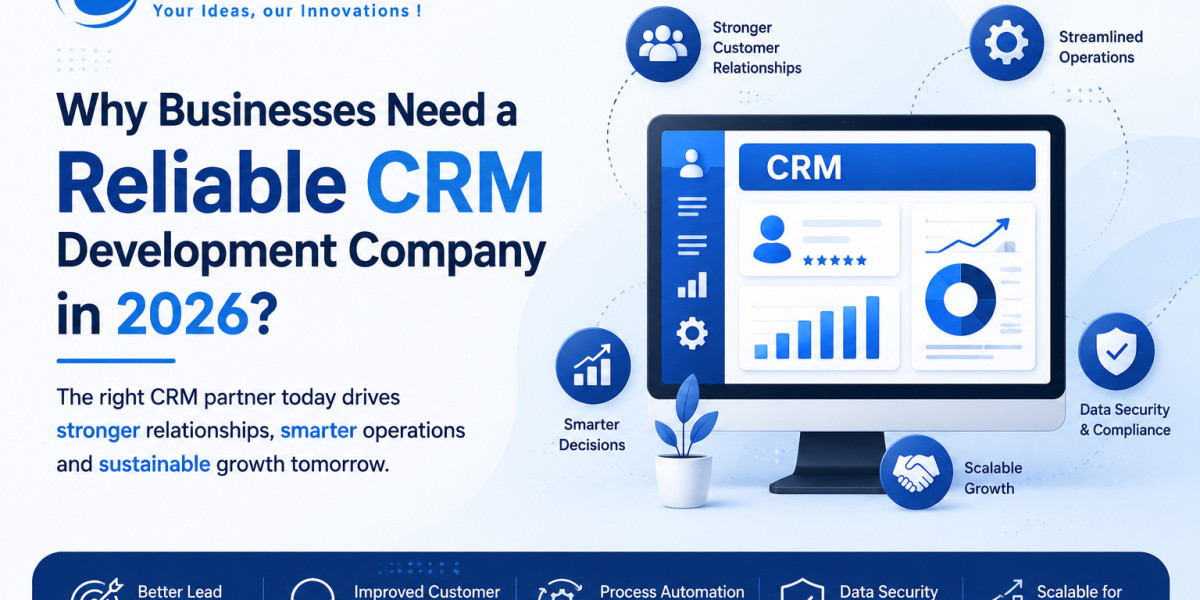
Top Reasons Businesses Need a Reliable CRM Development Company in 2026
As businesses continue to expand their digital operations, choosing the right development partner becomes increasingly important. A reliable company helps create CRM solutions that improve efficiency while remaining flexible enough to support future growth.
Customized Solutions for Unique Business Processes
Every organization operates differently, making standardized CRM software insufficient for many businesses. Custom-built CRM solutions support unique workflows, automate specific tasks, and provide features that align with actual business requirements instead of unnecessary functionality.
Better System Integration
Modern organizations depend on multiple software platforms every day. Professional CRM Development service providers integrate CRM systems with accounting software, ERP platforms, marketing automation tools, payment systems, and communication applications to ensure smooth data sharing across departments.
Improved Customer Experience
Reliable CRM development enables businesses to provide faster responses, personalized communication, and consistent service throughout the customer journey. Employees can quickly access complete customer histories, helping resolve issues efficiently and strengthen long-term customer relationships.
Scalability for Future Growth
Business needs change as organizations expand into new markets, launch additional products, or increase customer volume. A scalable CRM architecture allows businesses to add users, modules, and integrations without replacing the entire system.
Stronger Data Security
Customer information is among the most valuable business assets. Reliable CRM development includes secure authentication, role-based access controls, encryption, regular security updates, and compliance measures that help protect sensitive customer and business data.
Automation That Improves Productivity
Many routine business activities such as lead assignment, follow-up reminders, email notifications, reporting, and workflow approvals can be automated. Automation reduces manual effort, minimizes errors, and allows employees to spend more time on strategic responsibilities.
Better Reporting and Decision-Making
Modern CRM systems collect valuable business information that supports smarter decisions. Interactive dashboards, real-time analytics, and customized reports help managers monitor sales performance, customer behavior, and operational efficiency more accurately.
Essential Features Businesses Should Expect from Modern CRM Development
Modern CRM platforms should do more than manage customer records. They should simplify business operations, improve collaboration, support intelligent decision-making, and adapt to changing business needs while remaining easy for employees to use.
Centralized Customer Database
A modern CRM stores customer profiles, communication history, purchase records, service requests, and interactions within one centralized platform, allowing every department to access accurate and updated information whenever needed.
Workflow Automation
Automated workflows eliminate repetitive manual activities by assigning leads, sending follow-up emails, generating notifications, scheduling reminders, and updating records automatically, improving overall operational efficiency across departments.
Mobile Accessibility
Employees increasingly work remotely or travel frequently. Mobile CRM access enables sales representatives and customer support teams to update records, access customer information, and respond quickly regardless of their location.
Third-Party Integration
Modern CRM systems should connect seamlessly with email platforms, accounting software, ERP solutions, marketing tools, customer support applications, and cloud services to eliminate duplicate work and improve operational consistency.
Future CRM Development Trends Businesses Should Watch in 2026
CRM technology continues to evolve as businesses adopt artificial intelligence, automation, and advanced analytics. Understanding these emerging trends helps organizations prepare for changing customer expectations and maintain efficient customer relationship strategies.
AI-Powered Virtual Assistants
AI assistants can schedule meetings, summarize customer conversations, recommend follow-up actions, and answer employee questions, reducing administrative work while improving productivity across sales and customer service teams.
Predictive Customer Analytics
Predictive analytics examines historical customer behavior to identify future purchasing trends, customer retention risks, and sales opportunities, helping businesses make proactive decisions before challenges arise.
Hyper-Personalized Customer Engagement
CRM platforms increasingly deliver personalized recommendations, customized communication, and targeted marketing campaigns based on customer preferences, previous interactions, and purchasing history across multiple digital channels.
Voice-Enabled CRM Functions
Voice commands enable employees to retrieve customer information, update records, create tasks, and generate reports hands-free, improving convenience and supporting faster business operations.
Privacy-Focused CRM Solutions
As data privacy regulations continue to evolve worldwide, CRM systems increasingly include stronger consent management, secure data handling, encryption, and compliance features that protect customer information.
How to Choose the Right CRM Development Company?
Selecting the right development partner requires careful evaluation beyond technical capabilities. Businesses should begin by assessing whether the company understands their industry, operational challenges, and long-term objectives rather than simply offering generic software solutions.
Reviewing previous CRM projects, client case studies, and technical expertise provides valuable insight into the company's experience. Businesses should also evaluate the team's ability to build scalable solutions, integrate third-party applications, implement security best practices, and provide ongoing maintenance.
Communication is another important factor. A reliable development partner should maintain clear project planning, regular progress updates, transparent timelines, and collaborative problem-solving throughout the development process.
Finally, organizations should consider long-term support. CRM systems continue evolving after deployment, requiring performance optimization, feature enhancements, security updates, and compatibility improvements to remain effective as business requirements change.
Conclusion
A reliable CRM solution has become an important foundation for businesses seeking better customer relationships, improved operational efficiency, and informed decision-making in 2026. As customer expectations continue to evolve, organizations need CRM systems that support automation, integrate with existing technologies, protect valuable business data, and remain flexible for future growth. Selecting the right development approach helps businesses create solutions that align with their processes while supporting long-term digital transformation goals. Companies evaluating their CRM strategy can benefit from working with experienced technology partners such as EmizenTech, ensuring their solutions remain adaptable, secure, and capable of supporting future business requirements.
FAQs
1. Why is CRM important for businesses in 2026?
CRM helps businesses manage customer relationships, automate workflows, improve team collaboration, and make data-driven decisions to enhance customer experience and operational efficiency.
2. What does a CRM Development Company do?
A CRM Development Company develops, customizes, integrates, and maintains CRM solutions that align with a business's unique processes and operational requirements.
3. What features should a modern CRM include?
A modern CRM should include customer data management, sales pipeline tracking, workflow automation, AI-powered analytics, mobile access, third-party integrations, and role-based security.
4. How do I choose the right CRM development partner?
Look for industry experience, technical expertise, integration capabilities, strong security practices, client reviews, and reliable post-launch support when selecting a CRM development partner.
Ubicación del Autor
30 Ngould St Ste R Sheridan,WY 82801