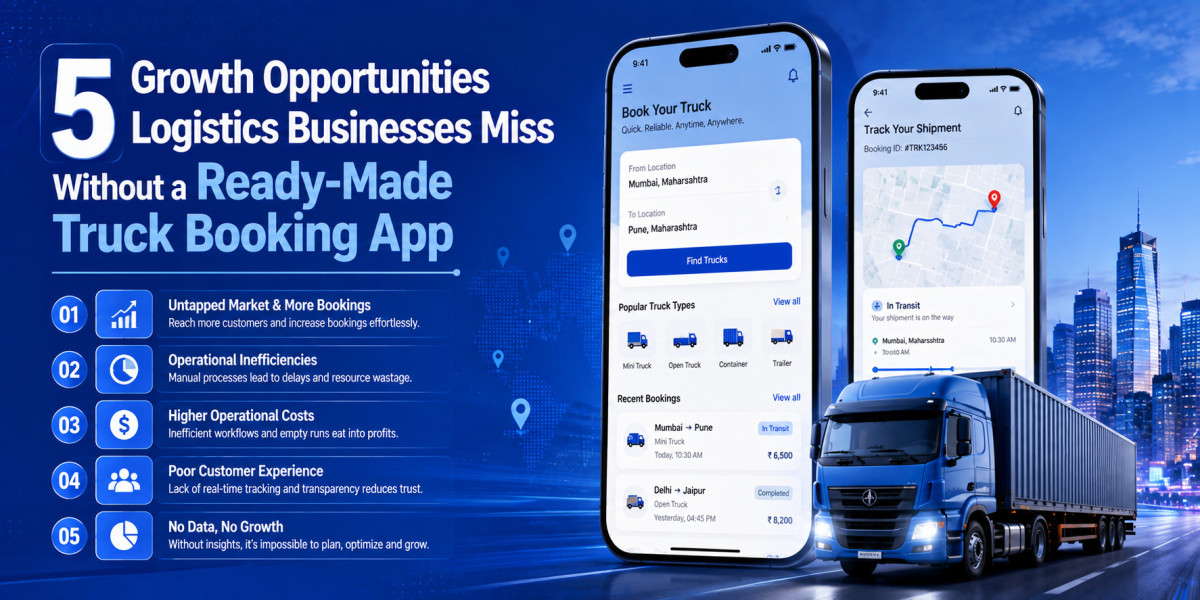

Every logistics company wants more deliveries.
But sustainable growth comes from handling more deliveries with the same resources .
Across regions like Southeast Asia , freight demand is increasing as eCommerce, manufacturing, and cross-border trade continues to expand. Yet many trucking businesses still depend on phone bookings, manual dispatching, and disconnected communication between customers and drivers. While operations continue, several growth opportunities quietly slip away.
A ready-made truck booking app isn't just a digital booking tool—it's a business accelerator that helps logistics companies scale faster without rebuilding operations from scratch. Modern platforms combine customer booking, driver management, automated dispatch, live tracking, and centralized administration into one connected ecosystem.
Opportunity #1: Expanding Without Hiring More Coordinators
As shipment requests increase, many businesses respond by hiring additional operations staff.
However, a large portion of their work involves repetitive tasks such as assigning drivers, confirming bookings, and updating customers.
A ready-made truck booking platform automates these activities, allowing existing teams to manage a significantly higher order volume while reducing operational overhead.
Opportunity #2: Winning Customers Who Need Instant Freight Booking
Modern businesses don't want to wait for callbacks before arranging transportation.
Manufacturers, wholesalers, retailers, and distributors increasingly expect instant truck availability, fare estimates, and booking confirmations.
Without a digital platform, logistics providers risk losing high-value customers to competitors that offer a faster booking experience.
Opportunity #3: Building a Reliable Driver Network
Many trucking businesses struggle to utilize available vehicles efficiently.
Some drivers remain idle while others become overloaded because assignments are managed manually.
A truck booking app intelligently connects available drivers with nearby purchasing shipment requests, improving fleet utilization while creating better opportunities for transport partners.
Opportunity #4: Expanding Into New Service Categories
Businesses often believe they need separate systems for different logistics operations.
In reality, one scalable platform can support multiple business models, including:
- Full truckload (FTL) transportation
- Less-than-truckload (LTL) deliveries
- Moving and relocation services
- Freight forwarding
- Construction material transport
- B2B logistics operations
This flexibility enables entrepreneurs to diversify without investing in entirely new software systems.
Opportunity #5: Growing Into Multiple Cities Faster
Opening operations in another city is challenging when dispatch, driver management, and bookings depend on manual coordination.
A cloud-based truck booking solution standardizes workflows across every location, allowing businesses to onboard new drivers, manage regional operations, monitor shipments, and maintain service quality from one centralized dashboard.
The result is faster geographic expansion with far less operational complexity.
Scale Your Logistics Business with SpotnRides
Growth in logistics isn't only about adding more trucks—it's about creating smarter operations that can handle increasing demand efficiently. Businesses that adopt digital freight management early are better positioned to improve customer satisfaction, optimize fleet performance, and expand into new markets with confidence.
SpotnRides offers a customizable white-label truck booking solution designed for freight operators, logistics startups, transport aggregators, and fleet businesses. The platform includes customer and driver apps, AI-powered dispatch, real-time GPS tracking, automated fare estimation, route optimization, secure payment integration, multilingual support, analytics, and centralized admin controls. Whether you're launching a regional trucking marketplace or building a national freight network, SpotnRides provides the technology foundation to accelerate growth while simplifying logistics operations.
Ubicación del Autor
United States of America