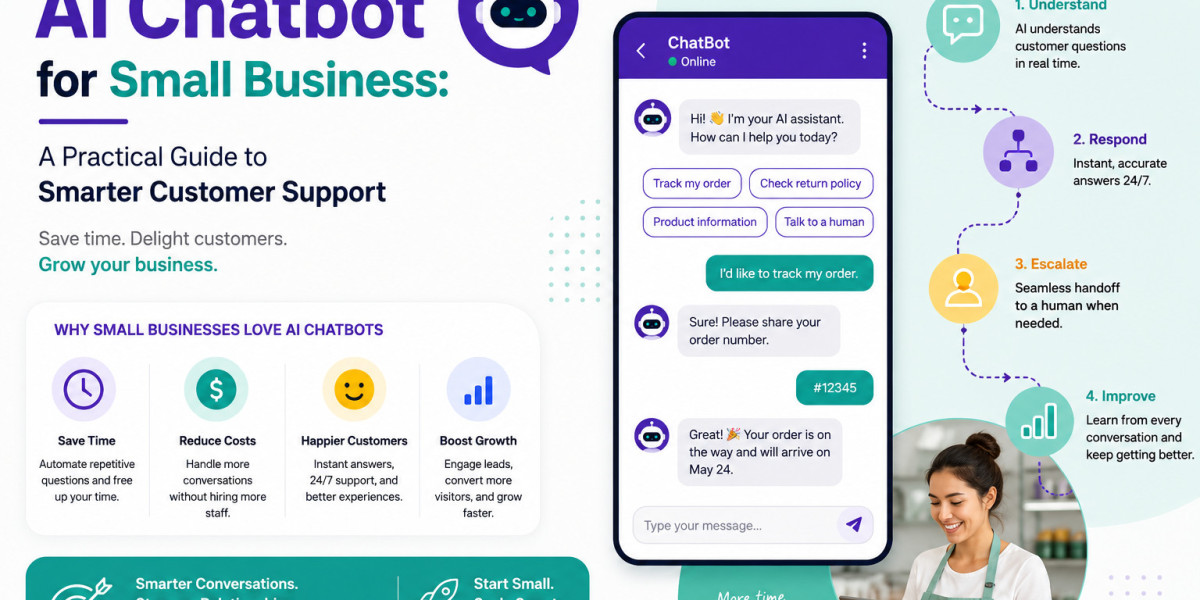

Small businesses often have to balance customer service, sales, marketing, and day-to-day operations with limited resources. Answering the same questions repeatedly can take valuable time away from tasks that require direct attention. This is one reason an AI chatbot for small businesses can be useful.
A website chatbot can provide visitors with quick answers, help businesses handle routine questions, and support lead-generation activities. Instead of replacing human employees, the technology can work alongside them by handling straightforward conversations and allowing staff to concentrate on more complicated customer needs.
WhisperChat is designed specifically around this type of first-line support workflow. It can answer website questions, capture leads, and reduce repetitive support work for small businesses.
What Is an AI Chatbot for Small Business?
An AI chatbot for small business is a conversational software solution that interacts with website visitors and customers using artificial intelligence.
A visitor might ask about a company's services, pricing, products, policies, or availability. Instead of searching through several pages or waiting for an employee to respond, the visitor can ask the chatbot directly.
The usefulness of an AI chatbot depends heavily on the information it has access to. Rather than relying on generic answers, businesses can train a chatbot using their own website content and other relevant information.
This approach can make conversations more closely aligned with the business's actual products and services.
Why Small Businesses Are Using AI Chatbots
Customer expectations have changed considerably. People often want information immediately, even when a business is outside its normal operating hours.
A small team may not have enough employees to provide continuous live support. An AI chatbot can provide an automated first point of contact when staff members are unavailable.
According to WhisperChat, its small-business chatbot can help customers get answers outside business hours, reduce repetitive replies, allow website visitors to ask questions before leaving, and capture potential leads.
These capabilities can be particularly useful for companies receiving a high volume of similar questions.
Handling Repetitive Customer Questions
Many businesses receive recurring questions.
Customers may ask:
What services do you provide?
How much does a particular service cost?
What plans are available?
How does the product work?
Where can I find your documentation?
What is your return policy?
How can I contact your team?
When employees answer these questions manually throughout the day, the time required can add up.
An AI chatbot can provide an initial response to common questions using approved business information. This allows employees to spend more time on conversations that require human judgment.
AI Chatbots for Lead Generation
Customer support is not the only potential application.
A website chatbot can also help businesses identify visitors who may be interested in their products or services. Instead of simply answering questions, the chatbot can collect relevant visitor information and route qualified conversations to the appropriate team.
For example, a service business could use a chatbot to ask about a visitor's requirements before connecting them with a sales representative.
WhisperChat states that its platform can collect visitor information and route qualified conversations to a business team.
This can make a website more interactive while supporting the sales process.
Common Small Business Use Cases
An AI chatbot can be adapted to different types of businesses.
Service Businesses
Service companies can use chatbots to answer questions about services, availability, pricing, and frequently requested information.
SaaS Companies
Software businesses can use chatbots to help visitors understand plans, features, onboarding processes, and documentation.
Ecommerce Businesses
Online stores can use conversational support for product-related questions, policies, and other common customer inquiries.
Agencies
Digital agencies can use AI chatbots to answer prospective client questions and support existing customers.
Consultation-Based Businesses
Professional services can use chatbots to collect basic information and help determine whether a visitor may be suitable for a consultation.
These are among the use cases highlighted on WhisperChat's small-business page.
Training a Chatbot With Business Information
One of the most important considerations when choosing an AI chatbot is how it obtains information.
A generic AI assistant may know a lot about general subjects, but a business chatbot needs to understand the specific organization it represents.
WhisperChat says its chatbot is trained on the business's real content rather than relying on a generic script. It can also provide confidence indicators and escalate conversations when it is unsure.
Using business-specific information can help create a more relevant customer experience.
Businesses should still review their source material regularly. If pricing, policies, products, or services change, the information available to the chatbot should be updated accordingly.
Human Support Still Has an Important Role
An AI chatbot does not need to replace a customer service team.
In fact, a hybrid approach can be more practical for many small businesses.
The chatbot can handle straightforward questions, while human employees take over when:
A customer has a complicated issue
The chatbot does not have enough information
A sensitive matter requires personal attention
A customer specifically requests human assistance
A sales conversation needs an employee
This approach allows automation to reduce routine work without removing the human element from customer service.
Can Small Businesses Install AI Chatbots Without Developers?
Technical complexity can be a major concern for small companies.
A business may want to experiment with AI but may not have a dedicated development team. A chatbot that requires extensive custom infrastructure can therefore be difficult to adopt.
WhisperChat states that small businesses can create and install its website chatbot without building custom AI infrastructure.
Ease of installation is worth considering when comparing chatbot solutions because a technically complicated setup can increase implementation time and costs.
Free and Paid Plans
Businesses that are new to AI chatbots may prefer to test a solution before committing to a larger plan.
WhisperChat recommends starting with its Free plan to test the chatbot on one website. Its Standard plan is positioned for businesses that need additional answer volume, more chatbots, lead capture, escalation routing, and support analytics.
A sensible approach is to start with the actual support problem rather than selecting a plan based only on feature counts.
For example, a small business could first identify how many repetitive questions it receives and determine whether an automated chatbot provides useful answers. Usage requirements can then guide the decision about whether additional functionality is necessary.
What to Look for in a Small Business Chatbot
Before selecting an AI chatbot, businesses should consider several factors.
1. Ease of Setup
The chatbot should be straightforward to install and configure.
2. Business-Specific Knowledge
The platform should be capable of using relevant business information rather than providing only generic answers.
3. Answer Quality
Businesses should test the chatbot using real customer questions.
4. Human Escalation
There should be a suitable process for handling questions that the chatbot cannot answer confidently.
5. Lead Capture
For sales-focused websites, lead collection can be an important feature.
6. Analytics
Support teams may benefit from understanding what visitors ask and which topics generate the most conversations.
7. Scalability
The solution should be able to accommodate increasing website traffic and customer interactions as the business grows.
How to Get Better Results From an AI Chatbot
Simply installing a chatbot is not enough. Businesses should also prepare the information it will use.
Start by collecting frequently asked questions, product information, pricing details, policies, documentation, and other customer-facing resources.
Next, identify questions that employees answer repeatedly. These are often good candidates for automated assistance.
The chatbot should then be tested using realistic customer questions. Review the responses and identify areas where information is missing or unclear.
Finally, monitor conversations over time and update the knowledge sources when the business changes.
This ongoing process can help maintain the usefulness of the chatbot.
AI Chatbots and Customer Experience
The ultimate purpose of an AI chatbot should be improving the customer experience rather than simply adding an AI feature to a website.
A useful chatbot should make it easier for visitors to find information. If customers have to repeat their question several times or receive irrelevant answers, the technology can create frustration instead of solving a problem.
Businesses should therefore measure success based on practical outcomes.
Useful questions include:
Are customers finding answers faster?
Are repetitive support requests decreasing?
Are more visitors engaging with the website?
Are qualified leads being captured?
Are human agents spending less time on routine questions?
Are customers successfully reaching human support when necessary?
These measurements provide a better indication of value than simply counting chatbot conversations.
The Future of AI-Powered Small Business Support
AI is becoming increasingly accessible to smaller organizations. Businesses no longer need large technical teams to experiment with conversational tools.
For small companies, this creates opportunities to automate selected parts of customer communication while keeping employees involved where their expertise matters most.
The most effective strategy is likely to be selective automation rather than attempting to automate every interaction.
An AI chatbot can answer common questions and support initial conversations, while human employees continue to handle complex requests, relationship-building, and decisions that require context.
Conclusion
An AI chatbot for small business can provide a practical way to manage repetitive customer questions, improve website assistance, and support lead generation.
The technology is particularly useful when businesses receive recurring questions about services, products, pricing, documentation, or policies. By training a chatbot with business-specific information, companies can provide more relevant automated assistance.
WhisperChat focuses on this first-line support model, offering features for website questions, lead capture, automated support, and escalation when additional human assistance is required.
However, businesses should evaluate chatbot solutions based on their actual needs rather than simply choosing the platform with the longest feature list. Ease of setup, knowledge management, response quality, human escalation, lead capture, analytics, and scalability are all important considerations.
When implemented thoughtfully, an AI chatbot can become a useful extension of a small business support team, helping customers find information faster while giving employees more time to focus on work that requires a human touch.
Ubicación del Autor
Surat, Gujarat, India