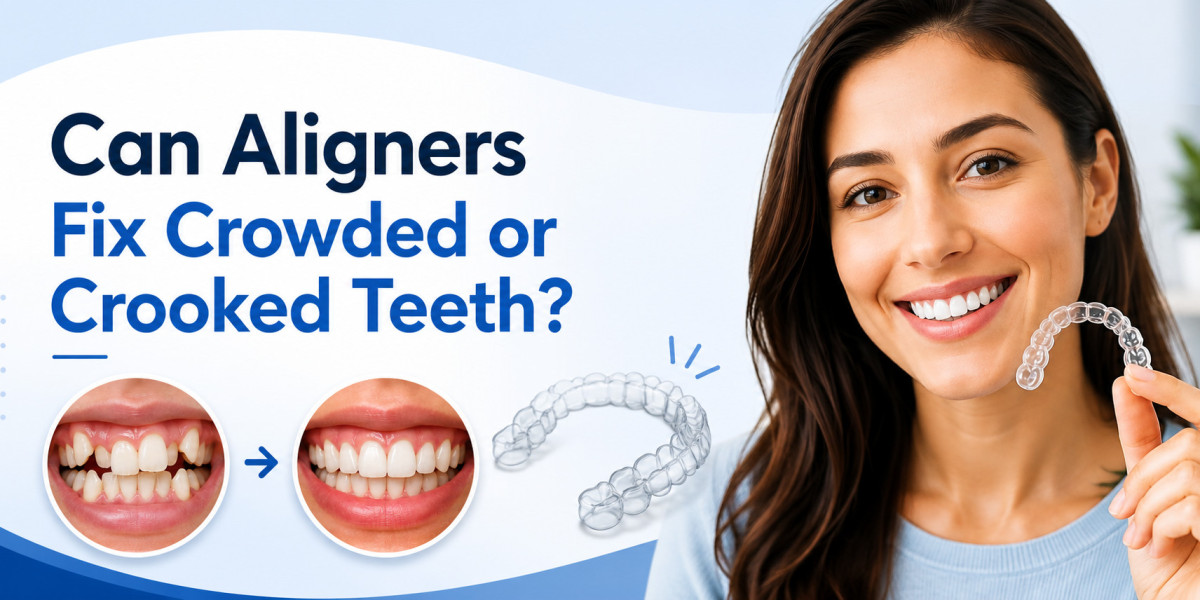

Crowded or crooked teeth are common concerns for people who want a straighter, healthier looking smile. When teeth overlap, twist, or sit too close together, brushing and flossing can also become more difficult. Fortunately, modern orthodontic treatment offers several ways to improve tooth alignment, including clear and removable aligners.
But can aligners really fix crowded or crooked teeth? In many cases, yes. However, the suitability of treatment depends on the severity of the crowding, the position of the teeth, your bite, and your overall oral health. Research suggests that clear aligners can be effective for many mild to moderate crowding cases, although their ability to handle complex tooth movements can be more limited.
What Causes Crowded or Crooked Teeth?
Crowding occurs when there is not enough available space for teeth to sit properly within the dental arch. As a result, teeth may overlap, rotate, tilt, or appear pushed forward or backward.
Several factors can contribute to crowded teeth. Genetics can influence the size of the jaw and teeth, while childhood habits, tooth loss, and changes in the dental arch can also affect alignment.
Crooked teeth can be more than a cosmetic concern. Overlapping areas may be harder to clean properly, allowing plaque and food particles to accumulate. Improving alignment can make daily brushing and flossing easier.
How Do Aligners Fix Crowded Teeth?
Aligners are custom made trays designed to gradually move teeth into planned positions. Instead of moving the entire set of teeth at once, treatment generally involves wearing a sequence of trays, with each tray applying controlled pressure to specific teeth.
As you progress through the series, your teeth gradually move toward their planned positions.
For people with suitable cases, teeth aligners can provide a discreet alternative to conventional braces. Since they are transparent and removable, they are particularly appealing to people and working professionals who prefer a discreet alternative to visible brackets and wires.
The treatment plan is usually created after examining the teeth and bite. Digital scans may also be used to create a three dimensional representation of the mouth and plan the movements required.
Can Aligners Fix Crooked Teeth?
Yes, aligners can correct many types of crooked teeth. They can be used to address teeth that are slightly rotated, tilted, overlapping, or positioned outside the ideal dental arch.
However, not every crooked tooth can be treated in exactly the same way. The complexity of the movement matters.
A systematic review found that clear aligners are effective for resolving mild to moderate crowding, while certain movements, such as significant rotations, can be less predictable.
This is why an orthodontic assessment is important before starting treatment. A person may see a crooked front tooth and assume it is a simple case, while the underlying bite or root position may make the treatment more complex.
What About Severe Crowding?
Severe crowding may require a different approach. In some cases, there may not be enough room to move all the teeth into proper positions without first creating additional space.
Depending on the individual situation, an orthodontist may consider options such as creating a small amount of space between selected teeth, expansion, or other orthodontic procedures. Some complex cases may be better managed with traditional braces or a combination of treatments.
Experts have reached consensus that clear aligners can be effective for certain mild and moderate malocclusions, while also recognising biomechanical limitations in more complex movements.
This means that invisible aligners should not be viewed as a universal replacement for every type of orthodontic treatment.
Are Invisible Teeth Aligners Comfortable?
One of the reasons people consider invisible teeth aligners is that they do not use traditional metal brackets and wires. The smooth trays are designed to fit over the teeth and can be removed when eating, drinking certain beverages, brushing, and flossing.
It is normal to experience some pressure or mild discomfort when starting a new set of aligners. This generally happens because the trays are applying controlled forces to move the teeth.
The most important factor is consistency. Aligners need to be worn according to the orthodontist's instructions for the treatment to progress as planned.
How Long Does Treatment Take?
Treatment duration varies from person to person. It depends on the amount of movement required, the severity of crowding, the patient's response to treatment, and how consistently the aligners are worn.
There is no single timeline that applies to everyone.
Research comparing clear aligners with fixed appliances in mild to moderate crowding cases found that treatment duration is likely to be similar, although the certainty of the evidence was low to very low.
Your orthodontist can provide a more realistic estimate after evaluating your teeth and creating an individual treatment plan.
Can Whistle Aligners Treat Crowded Teeth?
People considering Whistle aligners may naturally wonder whether they can address their particular alignment concerns. The answer depends on the individual case rather than simply the type or brand of aligner.
A professional evaluation should look at the degree of crowding, tooth positions, bite relationship, gum health, and the amount of movement required.
Whether you choose Whistle aligners or another orthodontic option, the most important consideration is whether the treatment plan is clinically appropriate for your teeth.
What Happens During an Aligner Consultation?
The process generally begins with an examination of your teeth and gums. Your orthodontist will assess how your upper and lower teeth meet and identify the areas that require correction.
Digital scans, photographs, and other diagnostic records may be used to understand your current alignment and plan the desired tooth movements.
If aligner treatment is suitable, a customised sequence can then be planned. You will receive instructions about wearing and caring for your trays and attending follow up appointments.
This personalised approach is important because tooth movement is not simply about making the front teeth look straighter. The overall bite and position of the teeth also need to be considered.
Are Tooth Aligners Right for You?
If you have mild or moderate crowding or crooked teeth, tooth aligners may be an option worth discussing with an orthodontist. They can offer a discreet way to gradually improve alignment while allowing you to maintain your usual brushing and flossing routine.
However, the right treatment depends on your individual dental condition. Severe crowding, complex bite problems, significant rotations, or other orthodontic concerns may require additional treatment.
The best way to find out whether aligners are suitable is to have your teeth professionally assessed.
Key Takeaway
So, can aligners fix crowded or crooked teeth? In many cases, yes. Clear aligners can effectively address mild to moderate crowding and several common alignment problems. They offer a discreet and removable approach to orthodontic treatment, but they are not suitable for every case.
If you are considering teeth aligners, invisible aligners, or Whistle aligners, start with a professional assessment. Understanding the severity of your crowding and the movements required will help you choose a treatment option that is appropriate for your smile.
Ubicación del Autor
Third Floor, Eldeco Centre, Block A, Shivalik Colony, Malviya Nagar, New Delhi, Delhi 110017