
Artificial intelligence has become an important part of how people search, create, learn, work, and manage everyday tasks. In 2026, Google continues to offer a growing range of AI-powered tools that can help students, professionals, marketers, developers, and businesses improve productivity.
From AI chat assistants and research tools to image creation and development platforms, Google’s AI ecosystem offers useful features for different types of users. Some tools have free access or free usage options, making them worth exploring before investing in premium AI software.
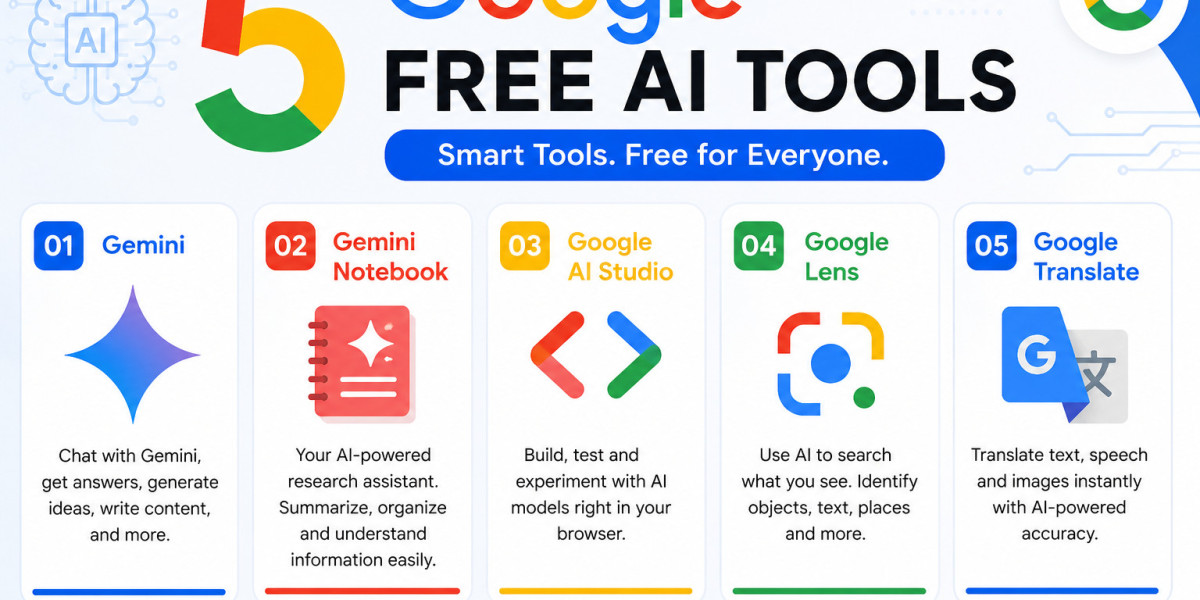
Here are Free Google AI tools you should try in 2026.
Google Gemini
Google Gemini is one of Google's most popular AI tools. It is designed to help users generate content, answer questions, summarize information, brainstorm ideas, analyze files, and assist with many everyday tasks.
Gemini can be useful for writers who need content ideas, students looking for explanations, marketers planning campaigns, and professionals preparing documents or presentations. Users can ask questions in natural language and receive conversational responses.
One of the major advantages of Gemini is its connection with Google's wider ecosystem. Depending on the available features and access level, users can use AI assistance alongside services and tools they already use for work and productivity.
In 2026, Gemini can be especially useful for tasks such as:
- Writing content outlines and drafts
- Summarizing long information
- Brainstorming business ideas
- Creating marketing content
- Explaining complex topics
- Generating code and technical suggestions
- Planning projects and workflows
For people who want a general-purpose AI assistant, Gemini is one of the first Google AI tools worth exploring.
Google AI Studio
Google AI Studio is a useful platform for developers, creators, and people interested in experimenting with generative AI. It provides a space where users can test AI models, create prompts, and experiment with different types of AI interactions.
The platform can be particularly helpful for developers who want to understand how AI models can be integrated into applications. Users can experiment with prompts and explore ways to generate text and other AI-powered outputs.
Google AI Studio makes it easier to move from simply using AI to building AI-powered experiences. Developers can use it to test ideas before integrating AI capabilities into websites, applications, or digital products.
Some possible uses include:
- Testing AI prompts
- Building AI-powered applications
- Generating text-based responses
- Experimenting with multimodal AI
- Creating prototypes
- Exploring AI APIs
Even if you are not an experienced programmer, experimenting with AI Studio can help you better understand how generative AI works and how businesses may use it in the future.
NotebookLM
NotebookLM is one of the most interesting AI tools from Google for research, learning, and knowledge management. Unlike a general AI chatbot, NotebookLM is designed to work with the sources and materials provided by the user.
You can add documents, notes, and other supported sources, then use AI to ask questions, summarize information, identify important ideas, and organize your research.
This can be especially useful for students, researchers, writers, and professionals who regularly work with large amounts of information. Instead of manually searching through multiple documents, users can interact with their source material through AI-powered questions.
For example, a student could upload research material and ask for a summary of the main arguments. A content writer could organize information from multiple sources before creating an article. A business professional could use it to better understand reports and internal documents.
NotebookLM can help with:
- Research summaries
- Study notes
- Document analysis
- Content planning
- Knowledge organization
- Question answering based on sources
- Identifying key themes and insights
For anyone who spends significant time reading, researching, or managing information, NotebookLM is a Google AI tool worth trying in 2026.
Google Whisk
Google Whisk is an AI-powered creative tool designed to help users experiment with visual ideas. It offers a different approach to image generation by allowing users to work with visual references and concepts.
Instead of relying only on detailed text prompts, users can explore creative combinations using images and ideas. This can make the creative process easier for people who may find it difficult to describe exactly what they want through text alone.
Whisk can be useful for designers, marketers, content creators, and anyone looking for visual inspiration. It can help users quickly explore different concepts for creative projects.
Potential uses include:
- Generating visual concepts
- Creating social media ideas
- Exploring product designs
- Developing marketing visuals
- Experimenting with artistic styles
- Creating creative inspiration boards
AI image tools are becoming increasingly important in digital marketing and content creation. Google Whisk gives users another way to experiment with AI-assisted creativity and visual storytelling.
Google Flow
Google Flow is designed to support AI-powered creative workflows, particularly for users interested in creating and exploring video content. AI is rapidly changing video production, and tools like Flow demonstrate how generative technology can simplify parts of the creative process.
Creating professional video content traditionally requires cameras, editing software, production teams, and significant time. AI-powered tools can help creators experiment with scenes, concepts, storytelling, and visual ideas more efficiently.
Google Flow can be useful for content creators, marketers, filmmakers, and businesses exploring new approaches to video production. It represents the growing role of generative AI in creative media.
Possible applications include:
- Exploring video concepts
- Creating visual story ideas
- Planning creative campaigns
- Experimenting with AI-generated scenes
- Supporting content production
- Developing marketing videos
As video continues to dominate digital platforms, AI-powered video tools are likely to become increasingly valuable for businesses and creators.
Why Should You Try Google AI Tools in 2026?
The biggest advantage of using AI tools is the ability to complete tasks more efficiently. AI can help people generate ideas, organize information, create content, conduct research, and automate repetitive parts of their workflow.
Google's AI tools also cover a wide range of needs. Gemini can assist with everyday questions and content creation, AI Studio can help users experiment with AI development, NotebookLM supports research and learning, Whisk focuses on creative visual exploration, and Flow introduces new possibilities for AI-assisted video creation.
However, AI tools should be used carefully. Generated content may contain mistakes, incomplete information, or inaccurate details. It is important to review AI-generated results, especially when working with research, business decisions, technical information, or professional content.
The best approach is to use AI as an assistant rather than completely replacing human judgment. Combining AI speed with human creativity, experience, and fact-checking can produce better results.
Conclusion
AI is becoming more accessible, and Google offers several useful tools for different types of users. In 2026, Google Gemini, AI Studio, NotebookLM, Whisk, and Flow are five AI tools worth exploring.
Whether you are a student, content creator, marketer, developer, researcher, or business owner, these tools can help you save time and experiment with new ways of working. Each tool serves a different purpose, from answering questions and analyzing documents to generating visual ideas and exploring AI-powered video creation.
The most useful strategy is to try different tools and discover which ones fit your workflow. As AI technology continues to develop, learning how to use these tools effectively can help you stay productive, creative, and prepared for the future of digital work.
Ubicación del Autor
Noida