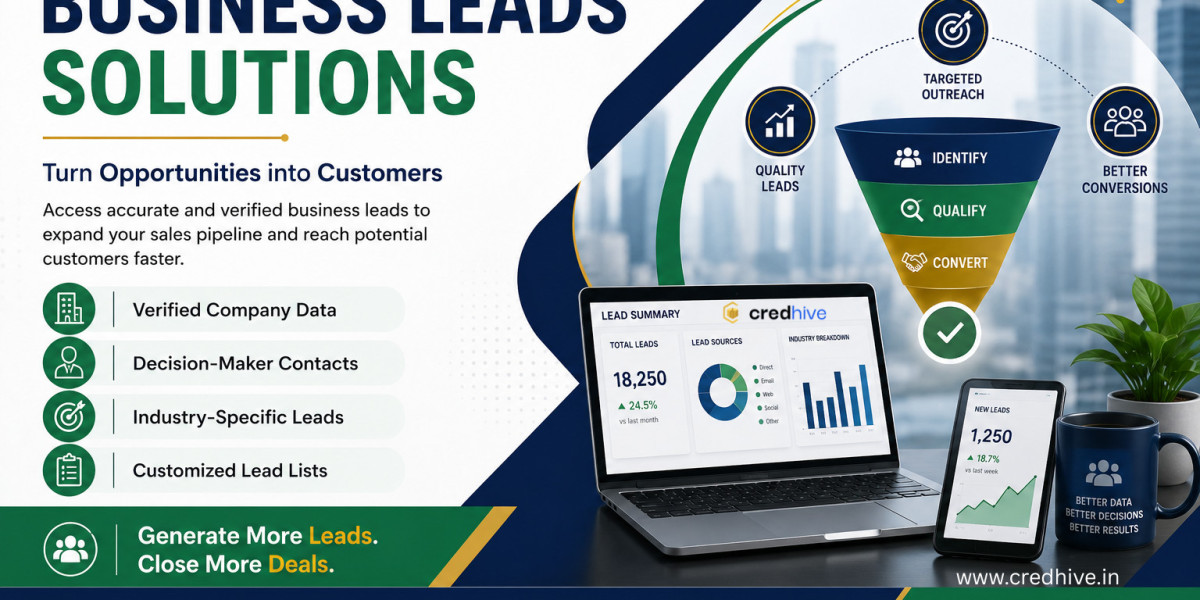

For banks, NBFCs, fintech companies, insurers, lenders, and enterprises, growth depends on consistently reaching the right businesses at the right time. This is where Business Leads become important. A strong lead generation strategy helps organizations identify potential customers, understand their business profiles, and prioritize prospects that are more likely to convert.
However, generating a large number of contacts is not enough. Financial institutions need accurate, relevant, and actionable business information. When lead generation is combined with company intelligence, verification, and risk insights, sales teams can improve conversion while reducing the time and cost involved in prospecting.
What Are Business Leads?
Business Leads are prospective customers or organizations that may have a need for a company's products or services. Depending on the industry, a lead could be a company looking for working capital, an SME seeking insurance, a retailer requiring payment solutions, or an enterprise looking for supply-chain financing.
A business lead can contain information such as:
- Company name and industry
- Registered address and location
- Contact information
- Business size and turnover indicators
- Decision-maker details
- Product or service requirements
- Company registration information
- Credit or financial indicators
- Existing business relationships
For financial-services organizations, combining contact information with reliable company data makes leads significantly more useful.
Why Quality Business Leads Matter
Not every prospect has the same commercial value. A database containing thousands of companies may generate fewer opportunities than a smaller database containing carefully selected prospects.
Quality Business Leads can help organizations:
Improve sales productivity: Sales teams spend less time searching for prospects and more time engaging with relevant businesses.
Increase conversion rates: Leads aligned with a product's eligibility criteria are more likely to progress through the sales funnel.
Reduce acquisition costs: Better targeting can reduce wasted calls, emails, and marketing expenditure.
Support cross-selling: Existing customer and company information can help identify opportunities for additional financial products.
For example, an NBFC offering equipment financing could identify businesses operating in sectors with high machinery requirements and prioritize companies that match its preferred business profile.
Sources of Business Leads
Organizations can generate leads through several channels. The right mix depends on the target market and product.
Company and Corporate Databases
Structured company databases can help businesses identify organizations based on industry, geography, company size, incorporation status, and other criteria. This is particularly useful for B2B prospecting and financial-services sales.
Digital Marketing
Search campaigns, social media, webinars, downloadable reports, and industry content can attract businesses that are already researching a particular product or service.
Existing Customer Data
A company's current customer base can be a valuable source of new opportunities. Transaction patterns, product usage, business characteristics, and lifecycle information can help identify customers who may benefit from another product.
Partnerships and Referrals
Accountants, consultants, distributors, technology providers, and industry associations can provide access to potential customers through referral arrangements.
Business Leads and Financial Risk Management
For banks and lenders, lead generation cannot be completely separated from risk assessment. A prospect may appear commercially attractive but still present significant credit, compliance, or operational concerns.
This is why lead qualification should go beyond contact details.
Before moving a prospect into an active sales pipeline, organizations can assess available business information such as company status, industry exposure, ownership information, financial indicators, litigation or regulatory signals, and other relevant risk factors.
This does not replace formal underwriting or due diligence. Instead, it helps sales and relationship teams prioritize prospects more intelligently before committing significant resources.
How Data Enrichment Improves Lead Qualification
Raw lead data often contains incomplete or outdated information. Data enrichment can add additional business attributes and help create a more complete prospect profile.
For example, suppose a lender receives a list of 5,000 SME prospects. Instead of contacting all 5,000 companies, the lender can enrich the data and segment prospects according to:
- Industry
- Business location
- Company age
- Business scale
- Product suitability
- Existing exposure
- Risk indicators
- Potential financing requirement
The sales team can then focus on prospects that fit the lender's target customer profile.
This approach connects Business Leads with practical sales intelligence and makes prospecting more systematic.
Using Business Leads Across Financial Services
Different financial institutions can use lead intelligence in different ways.
Banks can identify businesses for current accounts, working-capital facilities, trade finance, and cash-management solutions.
NBFCs can target SMEs and businesses that match specific lending products, including equipment, vehicle, or working-capital finance.
Fintech companies can identify businesses that may need payment solutions, accounting technology, embedded finance, or digital lending services.
Insurers can segment businesses according to industry, size, location, and potential insurance requirements.
Enterprises can use B2B leads to identify distributors, suppliers, channel partners, and prospective corporate customers.
Best Practices for Generating Business Leads
A successful lead-generation program should focus on quality, relevance, and timing rather than database size alone.
First, clearly define the ideal customer profile. Specify the industries, locations, business sizes, and characteristics that represent the best opportunities.
Second, verify business information regularly. Incorrect company names, inactive businesses, outdated contact details, and duplicate records can reduce sales efficiency.
Third, segment leads according to business needs and potential value. A lender, for example, can create separate segments for high-priority financing prospects and long-term prospects.
Finally, connect lead generation with CRM and sales workflows. Tracking contact attempts, responses, conversions, and reasons for rejection creates a feedback loop that can improve future campaigns.
The Future of Business Lead Generation
Business lead generation is increasingly moving from static contact lists toward data-driven prospect intelligence. Organizations can combine company information, behavioral signals, financial data, and risk indicators to create more meaningful prospect profiles.
For financial institutions, this shift is particularly valuable. The goal is not simply to find more businesses but to identify better-fit businesses, approach them with relevant products, and make sales decisions using reliable information.
Ultimately, effective Business Leads management can improve sales efficiency while supporting better customer targeting, risk awareness, and resource allocation. Organizations that treat lead generation as a data and intelligence function—not merely a marketing activity—can build a stronger and more sustainable B2B growth pipeline.
FAQs
What are Business Leads?
Business Leads are potential business customers or organizations that may be interested in a company's products or services. They can include prospects identified through databases, marketing campaigns, referrals, partnerships, or existing customer relationships.
How do Business Leads help financial institutions?
They help banks, NBFCs, lenders, fintech companies, and insurers identify potential customers for financial products and prioritize prospects based on factors such as industry, location, business profile, and product suitability.
What is the difference between a business lead and a qualified lead?
A business lead is a potential prospect, while a qualified lead has generally been evaluated against predefined criteria such as customer profile, business need, eligibility, or purchase intent.
How can companies improve the quality of Business Leads?
Companies can improve lead quality by defining an ideal customer profile, verifying company information, enriching prospect records, removing duplicates, segmenting prospects, and continuously measuring conversion performance.
Can Business Leads support risk-based sales strategies?
Yes. For financial-services organizations, business information can be combined with relevant risk indicators to help prioritize prospects. However, lead qualification should not be treated as a substitute for formal credit assessment, KYC, compliance checks, or underwriting.
Ubicación del Autor
Delhi