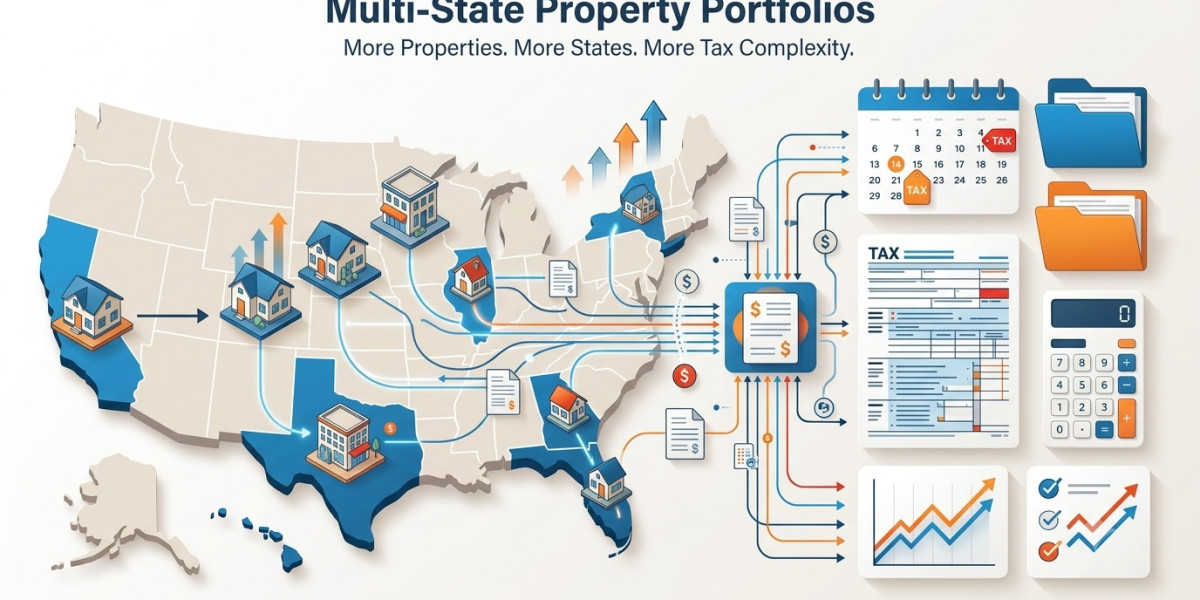

Managing one property can be complicated enough. Add properties across several states, and tax filing can quickly become a much bigger challenge.
As a portfolio expands, owners and property management companies have to deal with different state tax rules, multiple entities, property-level income and expenses, and varying filing deadlines. This is also where Property management CFO services can become valuable, helping businesses organize financial information, monitor state-specific obligations, and make better decisions as their portfolios grow.
The challenge isn't simply preparing more tax returns. Each state can have its own rules for income, deductions, estimated payments, registrations, and other tax requirements. What works for a property in California may not apply the same way to a property in Texas, Arizona, New York, or another state.
For property owners and management companies, the key is having a system that keeps every property, entity, and state obligation properly organized.
Every State Can Have Different Tax Rules
One of the biggest problems with multi-state portfolios is that there isn't a single set of rules that applies everywhere.
States may differ in how they treat rental income, business income, deductions, depreciation, withholding, estimated taxes, and other items. Some states impose individual income taxes, while others don't. Some also have franchise or entity-level taxes that can affect the overall tax picture.
This means expanding into another state can create new tax obligations even when the business itself hasn't changed much operationally.
For example, an owner who previously operated properties in one state may acquire an investment property elsewhere. That new property could create a state filing obligation that didn't exist before.
The more states involved, the more opportunities there are for something to be overlooked.
Property Income Has to Be Tracked by Location
Multi-state tax filing becomes much easier when income and expenses are properly separated by property and location.
That sounds simple, but it can become difficult when a portfolio includes dozens of properties.
Shared expenses may cover several properties. Management fees may be paid centrally. Employees may support properties in different states. Repairs, insurance, utilities, professional fees, and other costs may need to be allocated appropriately.
If everything is recorded in one general account without enough detail, preparing accurate state returns becomes much harder.
Good property-level accounting creates the foundation for better tax reporting.
Entity Structure Can Add Another Layer
Property portfolios are often held through multiple legal entities.
An owner might have one LLC for one property, another LLC for a second property, and a separate management company handling operations. Some portfolios may also involve partnerships, S corporations, or other structures.
Each entity can have its own filing requirements.
The situation becomes more complicated when an entity is registered in one state but owns property or conducts business in another. This can create additional state compliance considerations.
Keeping track of which entity owns which property, where that entity is registered, and where it has tax obligations is essential.
Nexus Can Become a Major Issue
One concept that often causes confusion is tax nexus.
In simple terms, nexus refers to a sufficient connection between a business or entity and a state that can create tax or filing obligations.
Owning real estate in a state can be an important factor in establishing that connection.
The challenge is that businesses don't always realize when their activities have created additional obligations. A portfolio may start with properties in one state and gradually expand into several others. The tax compliance process needs to evolve along with that growth.
Ignoring nexus questions can lead to missed filings, penalties, interest, and unnecessary cleanup later.
State Estimated Taxes Can Be Easy to Miss
Federal tax planning gets a lot of attention, but multi-state portfolios can create state estimated tax responsibilities as well.
If income is generated across several states, owners may need to consider estimated payments based on the applicable state rules.
The timing and calculation requirements aren't necessarily identical from one state to another.
This creates an administrative challenge for owners who are already managing rent collections, property expenses, financing, maintenance, and other responsibilities.
A centralized tax calendar can help prevent state-specific deadlines from getting lost.
Residency and Property Location Aren't the Same Thing
Another complication arises when the property owner lives in one state but owns property somewhere else.
For example, an owner may live in California while owning rental properties in Nevada and Arizona.
The owner's home state may have its own rules for reporting income earned outside the state, while the states where the properties are located may also require filings.
This can create multiple reporting layers.
The exact treatment depends on the taxpayer's circumstances and the states involved, which is why multi-state tax planning should be based on the complete portfolio rather than looking at each property in isolation.
Sales and Use Tax Issues May Also Appear
Not every property-related activity is treated the same way for tax purposes.
Certain services, transactions, or property-related activities may create sales or use tax considerations depending on the state and the nature of the business.
Short-term rentals can introduce additional complexity because some jurisdictions impose taxes on lodging or occupancy.
Property owners and managers need to understand the difference between long-term rental activity, short-term rentals, property management services, and other taxable activities.
Assuming that every property generates the same type of tax obligation can be a costly mistake.
Recordkeeping Becomes More Important as the Portfolio Grows
The larger the portfolio becomes, the more important organized records are.
At a minimum, businesses should be able to identify:
Property location
Property-owning entity
Rental and other income
Property-level expenses
Shared expenses and allocations
State registrations
Filing requirements
Estimated tax payments
Important filing deadlines
Supporting documentation
Without this information, tax preparation can become a process of reconstructing what happened after the fact.
That takes more time and increases the risk of errors.
Technology Can Help, but It Doesn't Replace Tax Strategy
Accounting software can make it easier to track transactions across properties and entities. Property management platforms can also help organize rental income and expenses.
But technology doesn't automatically determine how every transaction should be treated for state tax purposes.
A system can record an expense. It can't necessarily determine whether that expense should be allocated between states, entities, or properties in a particular way.
That's where accounting and tax expertise becomes important.
Why Multi-State Portfolios Need a More Organized Tax Process
The biggest challenge with a multi-state portfolio isn't necessarily the number of tax returns.
It's the number of moving parts.
More properties mean more transactions. More states mean more rules. More entities mean more filing responsibilities. And as the portfolio grows, small gaps in recordkeeping can become much harder to fix.
A structured process can make the difference.
Property owners and management companies should review their portfolio regularly, monitor state obligations, maintain property-level records, and coordinate tax planning with their broader financial strategy.
Planning Ahead Makes Tax Season Easier
Tax filing shouldn't begin when tax season arrives.
For a multi-state property portfolio, tax planning needs to happen throughout the year.
Regular reviews can help identify new properties, entity changes, ownership changes, new state activities, or other developments that could affect filing requirements.
It also gives owners more time to address missing records, estimate tax payments, and make informed decisions before deadlines arrive.
The goal isn't simply to file everything on time. It's to build a process that makes accurate filing easier year after year.
Final Thoughts
A growing property portfolio can create significant opportunities, but expansion across state lines also brings additional tax complexity.
Different state rules, multiple entities, property-level accounting, nexus considerations, estimated taxes, and varying filing requirements can quickly turn tax compliance into a major administrative task.
The earlier a property owner establishes a clear multi-state accounting and tax process, the easier it becomes to manage that complexity.
For growing portfolios, accurate property-level records and proactive tax planning aren't just administrative conveniences. They're part of managing the portfolio responsibly and making better financial decisions.
Ubicación del Autor
940 W 17th St. Ste F, Santa Ana, CA 92706