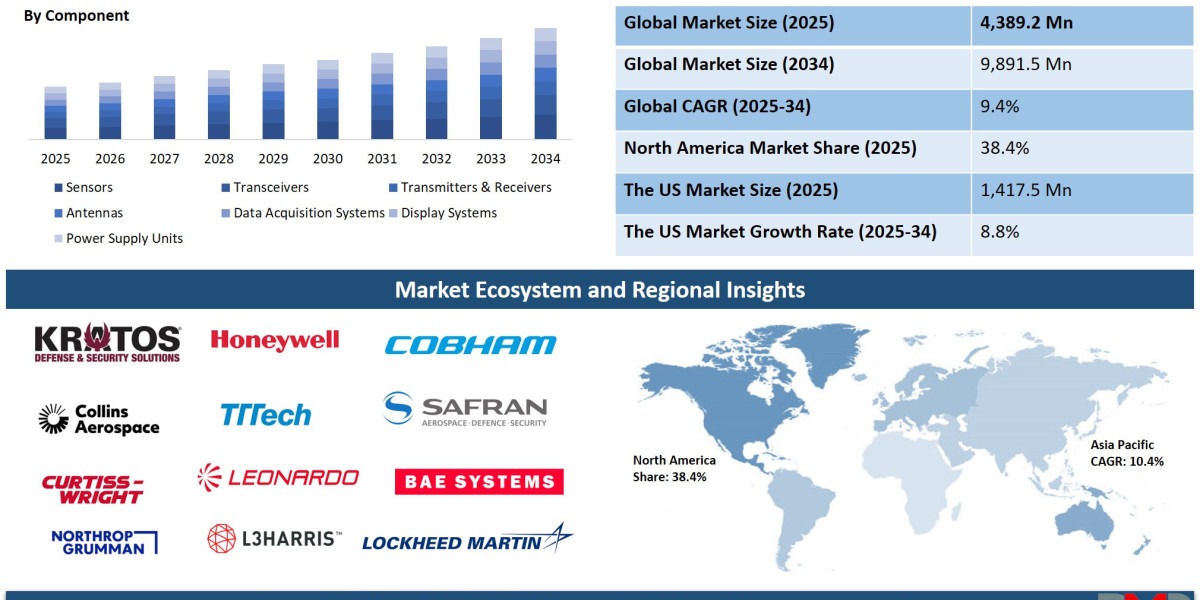

According to Dimension Market Research, the UAV Telemetry Equipment Market is projected to reach USD 4,389.2 million in 2025 and is expected to grow to USD 9,891.5 million by 2034, expanding at a 9.4% CAGR during the forecast period. Rising adoption of unmanned aerial vehicles across commercial operations, infrastructure services, agriculture, emergency response, environmental monitoring, and defense is increasing demand for dependable telemetry and communication technologies.
Telemetry equipment provides essential communication between UAVs and ground-based systems. Flight status, positioning information, sensor readings, navigation data, and system-health information can be transmitted during operations. As UAV missions become longer, more automated, and more data-intensive, telemetry is becoming an increasingly important part of modern drone infrastructure.
Commercial Drones Expand the Addressable Market
The UAV industry is moving beyond traditional defense and aerospace applications. Commercial operators are increasingly using drones for agricultural monitoring, infrastructure inspection, mapping, surveying, energy management, logistics, environmental observation, and industrial operations.
This expansion is creating a broader customer base for telemetry equipment manufacturers. Commercial users often require affordable, scalable, lightweight, and easy-to-integrate systems rather than highly specialized defense-oriented platforms.
As drone adoption becomes more widespread, telemetry suppliers have opportunities to develop solutions designed for different aircraft sizes, mission durations, payloads, and communication environments.
Precision Agriculture Supports Telemetry Demand
Agriculture represents an important opportunity for drone technology. UAVs can support crop monitoring, field mapping, vegetation assessment, irrigation planning, and precision farming activities.
Telemetry equipment allows agricultural drones to maintain communication with operators while collecting information from onboard sensors. Position data and mission status can be monitored throughout a flight, while sensor outputs can be transferred to analysis platforms.
As precision agriculture becomes more data-driven, demand is likely to increase for telemetry systems that combine reliable communication with GPS, sensor integration, cloud platforms, and analytics.
Infrastructure Inspection Strengthens Market Potential
Infrastructure owners are increasingly exploring drones as tools for inspecting large or difficult-to-access assets. Applications can include power infrastructure, bridges, pipelines, telecommunications equipment, industrial facilities, renewable-energy assets, and transportation infrastructure.
Telemetry enables operators to monitor the UAV while inspection data is transmitted during the mission. This can support more efficient workflows and improve access to remote information.
The increasing digitization of infrastructure management is expected to create further opportunities for telemetry systems that can work with cameras, sensors, mapping platforms, and remote monitoring applications.
Logistics and Drone Delivery Create Future Demand
The development of drone-based logistics is another potential growth area. Delivery drones require reliable communication for navigation, monitoring, fleet management, and operational coordination.
As delivery networks expand, telemetry systems may need to support communication across larger operating areas and multiple aircraft. Integration with cellular, satellite, and other communication networks could help support these requirements.
Although regulations, airspace management, safety, and economics remain important considerations, increasing interest in autonomous delivery could provide significant long-term opportunities for telemetry technology providers.
Autonomous Operations Require Better Communication
Autonomous UAVs create new requirements for telemetry. A drone performing a mission with limited direct operator input still needs reliable monitoring and communication to provide information about its location, operating status, and system condition.
Telemetry can support the connection between autonomous aircraft, control centers, navigation systems, and digital platforms.
As autonomy advances, telemetry may become more closely integrated with onboard computing, artificial intelligence, navigation systems, and mission-management software.
This creates opportunities for suppliers that can provide integrated communication architectures rather than isolated telemetry components.
AI Creates Smarter Telemetry Platforms
Artificial intelligence is increasing the capabilities of telemetry systems. Instead of simply transmitting large volumes of information, AI-enabled systems can help identify important data, detect abnormal conditions, and support faster operational decisions.
Machine learning can potentially assist with equipment-health monitoring, communication optimization, anomaly detection, and predictive maintenance.
AI can also help process sensor data closer to the source. This is particularly useful when UAVs generate large amounts of information that cannot all be transmitted efficiently in real time.
The combination of AI and telemetry therefore creates an important pathway toward more intelligent UAV operations.
Request Sample URL: https://dimensionmarketresearch.com/request-sample/uav-telemetry-equipment-market/
Edge Computing Improves Real-Time Data Processing
Edge computing allows data processing to take place closer to where information is generated. For UAVs, this can reduce the amount of information that must be transmitted to remote servers.
Telemetry systems can prioritize important information while less critical data can be processed or stored locally. This approach can reduce communication requirements and potentially improve responsiveness.
Industrial inspections, emergency response, environmental monitoring, and autonomous flight are examples of applications that can benefit from faster local data processing.
5G and Satellite Networks Expand Connectivity
No single communication technology can address every UAV operating environment. Cellular networks can offer strong connectivity where coverage exists, while satellite links can support more remote areas.
The expansion of 5G networks is creating new possibilities for high-speed, low-latency UAV communication. 5G can support large data transfers and integration with edge-computing platforms.
Satellite connectivity, meanwhile, can help extend operational coverage across rural, offshore, mountainous, or otherwise remote areas.
Hybrid communication systems that combine radio, cellular, and satellite links could become increasingly important for long-duration and long-range UAV operations.
Sensors Increase Telemetry Data Requirements
UAVs are increasingly equipped with sophisticated sensors for navigation, imaging, environmental monitoring, and operational safety.
GPS modules, inertial measurement units, accelerometers, gyroscopes, magnetometers, cameras, and other sensing technologies generate information that must be transmitted, processed, or stored.
As the number of onboard sensors increases, telemetry systems need to accommodate larger data volumes while maintaining efficient power consumption.
This is encouraging development of communication systems with greater bandwidth, improved processing capability, and more flexible data-management architectures.
Aerospace Testing Remains a Stable Application
Flight testing continues to be a major use case for UAV telemetry equipment. Developers need accurate, real-time information during test flights to evaluate aircraft performance and identify technical issues.
Telemetry can help engineers monitor altitude, position, speed, orientation, power-system status, environmental information, and other parameters.
The increasing complexity of autonomous and high-performance UAVs is likely to increase the amount of information required during testing.
As new aircraft platforms enter development, demand for specialized aerospace telemetry equipment is expected to remain important.
Defense Continues to Provide a Strong Demand Base
Defense and military organizations remain major users of UAV telemetry technology. Military UAVs require reliable communications for surveillance, monitoring, reconnaissance, logistics, and other activities.
Defense applications can place particularly demanding requirements on communication reliability, cybersecurity, encryption, interference resistance, and system integration.
Modernization of unmanned systems and continued investment in advanced UAV capabilities are expected to maintain demand for sophisticated telemetry equipment.
Cybersecurity Shapes Product Development
As more UAVs connect to digital networks, cybersecurity becomes increasingly important. Telemetry systems can transmit information about aircraft position, system health, sensor outputs, and other operational data.
Protection against unauthorized access, spoofing, interference, and data manipulation is therefore an important consideration.
Manufacturers are investing in encryption, authentication, secure communication protocols, and other measures designed to strengthen telemetry security.
For commercial infrastructure, government, and defense applications, cybersecurity can increasingly influence purchasing decisions alongside cost and communication performance.
Cost Optimization Becomes Important for Commercial Users
Commercial customers often operate under stricter cost constraints than defense organizations. They may prefer telemetry systems that can provide sufficient performance without unnecessary complexity.
Hardware costs, software subscriptions, connectivity charges, integration requirements, maintenance, and technical support can all influence total ownership cost.
This creates opportunities for manufacturers to develop modular solutions that allow users to select communication and monitoring capabilities according to mission requirements.
Scalable products can help telemetry suppliers address both entry-level commercial drones and more sophisticated professional UAV platforms.
Regulation Influences Market Development
The expansion of commercial UAV operations is closely connected to aviation regulations. Rules governing airspace, remote identification, BVLOS operations, communications, and flight safety can influence how quickly new applications are adopted.
Telemetry equipment can play a role in supporting operational visibility and communication requirements.
Manufacturers therefore need to keep pace with regulatory developments across major markets and ensure their products can be integrated into compliant UAV architectures.
North America Maintains Leadership
North America is projected to remain the leading regional market, accounting for approximately 38.4% of total UAV Telemetry Equipment Market revenue in 2025. The region benefits from established aerospace and defense industries, advanced communications infrastructure, commercial drone adoption, and strong research and development capabilities.
The U.S. UAV Telemetry Equipment Market is projected to grow from USD 1,417.5 million in 2025 to USD 3,034.9 million by 2034, reflecting an 8.8% CAGR.
Commercial drone expansion, defense modernization, infrastructure inspection, and the development of advanced UAV applications are expected to support continued demand in the country.
Asia Pacific Represents a High-Growth Opportunity
Asia Pacific is expected to register the fastest growth rate in the UAV telemetry industry. Expanding drone manufacturing capabilities, infrastructure development, agricultural applications, defense investment, and technology adoption are supporting regional demand.
China, India, Japan, and South Korea are developing broader UAV ecosystems across commercial and government applications.
Agriculture and infrastructure monitoring provide particularly strong opportunities because of the region's large geographic scale and diverse operational requirements.
Europe Expands Connected Drone Applications
Europe is projected to grow from approximately USD 772.5 million in 2025 to USD 1,609.78 million by 2034, representing an 8.5% CAGR.
Demand is supported by infrastructure inspection, renewable energy, agriculture, public safety, logistics, environmental monitoring, and defense.
The development of connected and autonomous UAV applications is also creating opportunities for telemetry systems that can integrate with wider digital-airspace and fleet-management platforms.
Japan Adopts UAVs for Infrastructure and Smart Services
Japan's UAV Telemetry Equipment Market is projected to reach approximately USD 263.35 million in 2025 and USD 517.73 million by 2034, growing at a 7.8% CAGR.
Infrastructure maintenance, agriculture, disaster response, and autonomous services are helping drive UAV deployment in the country.
Telemetry systems can provide important connectivity for drones operating in difficult environments, especially where remote monitoring and reliable data communication are required.
Competitive Landscape
The UAV Telemetry Equipment Market includes leading aerospace and defense companies as well as specialized technology providers. Product competition increasingly centers on communication reliability, cybersecurity, bandwidth, integration, miniaturization, and intelligent data processing.
Major participants include L3Harris Technologies, Honeywell Aerospace, BAE Systems, Collins Aerospace, Lockheed Martin, Northrop Grumman, Thales Group, Leonardo S.p.A., Safran Electronics & Defense, General Atomics Aeronautical Systems, Elbit Systems, Israel Aerospace Industries, Teledyne Technologies, Curtiss-Wright Corporation, Airbus Defence and Space, Textron Systems, Kratos Defense & Security Solutions, and HENSOLDT AG.
Companies are increasingly focusing on software-defined communications, secure connectivity, AI-enabled systems, modular equipment, and interoperability across different UAV platforms.
Future Outlook
The UAV Telemetry Equipment Market is expected to experience significant expansion as UAV applications become increasingly autonomous, connected, and data-driven.
With the market projected to grow from USD 4,389.2 million in 2025 to USD 9,891.5 million by 2034, opportunities are expanding across defense, agriculture, infrastructure, logistics, environmental monitoring, public safety, and industrial applications.
Future telemetry platforms are likely to combine multiple communication technologies with AI, edge computing, advanced sensors, and digital fleet-management systems.
The growing adoption of BVLOS operations will further increase demand for dependable long-range communication and continuous monitoring.
Checkout / Buy Report URL: https://dimensionmarketresearch.com/checkout/uav-telemetry-equipment-market/
Conclusion
The UAV Telemetry Equipment Market is developing alongside the rapid expansion of commercial and autonomous drone operations. Telemetry is becoming more than a basic flight-data link, evolving into an intelligent connectivity layer connecting aircraft, sensors, operators, communication networks, and digital platforms.
Agriculture, infrastructure inspection, logistics, emergency response, and environmental monitoring are broadening the commercial opportunity, while defense and aerospace applications continue to provide a strong demand base.
5G, satellite connectivity, AI, edge computing, sensor integration, and cybersecurity are expected to shape the next generation of telemetry solutions.
With a projected market value of USD 9,891.5 million by 2034, companies that deliver reliable, secure, scalable, and cost-effective technologies are well positioned to participate in the continued development of connected UAV ecosystems.
Ubicación del Autor
Florida