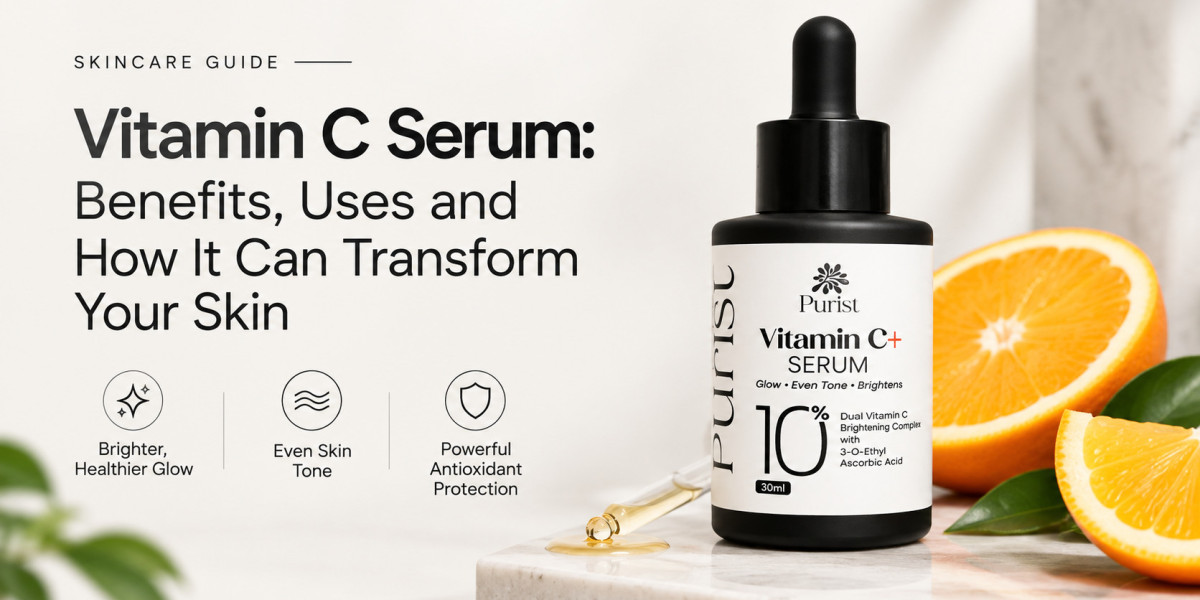

Healthy, glowing skin does not always require a complicated 10-step skincare routine. Sometimes, one well-chosen active ingredient can make a meaningful difference—and Vitamin C is one of those ingredients.
A Vitamin C Serum is widely used to improve dull-looking skin, support a more even complexion, reduce the appearance of dark spots, and protect the skin from everyday environmental stress. It has also become a favourite ingredient for people looking to maintain smoother, fresher, and more youthful-looking skin.
But simply buying any Vitamin C product is not enough.
The type of Vitamin C, concentration, formulation, storage, and how you use it in your skincare routine can all influence your experience and results.
In this guide, we will explore everything you need to know about Vitamin C Serum, including its benefits, how it works, how to apply it correctly, when to use it, and how to choose the right formula for your skin.
What Is Vitamin C Serum?
A Vitamin C Serum is a concentrated skincare product designed to deliver Vitamin C directly to the skin. Vitamin C, also known as ascorbic acid, is a powerful antioxidant that helps protect the skin against oxidative stress caused by environmental factors.
Every day, your skin is exposed to things such as:
Sun exposure
Air pollution
Dust and environmental pollutants
Cigarette smoke
Free radicals
Stress and lifestyle factors
Over time, these factors can contribute to dullness, uneven skin tone, and visible signs of skin ageing.
Vitamin C helps support the skin by neutralising free radicals and supporting important processes involved in maintaining healthy-looking skin.
Unlike heavier creams, serums are usually lightweight and formulated with smaller molecules that allow active ingredients to be delivered efficiently across the surface layers of the skin.
This makes Vitamin C serums particularly popular for targeting concerns such as pigmentation, dullness, uneven skin tone, and loss of radiance.
How Does Vitamin C Serum Work?
To understand why Vitamin C has become such a popular skincare ingredient, it helps to understand oxidative stress.
Free radicals are unstable molecules produced by natural processes in the body and environmental exposure. Excessive free radical activity can contribute to oxidative stress, which may affect the appearance and overall condition of the skin.
Vitamin C acts as an antioxidant, helping neutralise these unstable molecules.
At the same time, Vitamin C plays an important role in supporting collagen production. Collagen is a naturally occurring protein that contributes to the skin's structure, firmness, and smooth appearance.
As we age, natural collagen production gradually slows down. Environmental stress and sun exposure can also affect collagen.
Regular use of a well-formulated Vitamin C Serum may help support:
Brighter-looking skin
A more even complexion
Smoother skin texture
Reduced appearance of dark spots
Firmer-looking skin
Protection against environmental oxidative stress
The results are not usually instant. Skincare works gradually, and consistency plays a major role.
Top Benefits of Using Vitamin C Serum
1. Vitamin C Serum Helps Brighten Dull Skin
Dull skin can make the complexion appear tired, rough, or uneven. Factors such as dehydration, pollution, lack of sleep, and accumulated dead skin cells can all affect the skin's natural radiance.
One of the most popular benefits of a Vitamin C Serum is its ability to support brighter and healthier-looking skin.
With regular use, Vitamin C can help improve the appearance of skin radiance and give the complexion a fresher look.
This is why it is commonly included in morning skincare routines.
2. Helps Reduce the Appearance of Dark Spots
Dark spots and uneven pigmentation are among the most common skincare concerns.
They may develop due to:
Previous acne breakouts
Sun exposure
Post-inflammatory hyperpigmentation
Hormonal changes
Skin irritation
Vitamin C is commonly used in skincare products designed to improve the appearance of uneven skin tone.
With consistent use, a Vitamin C serum may help reduce the visible appearance of dark spots and support a more balanced-looking complexion.
However, patience is important. Pigmentation does not disappear overnight. Most skincare routines require several weeks of consistent use before noticeable improvements begin to appear.
3. Supports Collagen Production
Collagen is one of the most important structural proteins in the skin.
It helps maintain a firm, smooth, and youthful appearance.
Natural collagen production gradually decreases with age, which can contribute to the appearance of fine lines and reduced skin firmness.
Vitamin C supports the biological processes involved in collagen synthesis.
This makes Vitamin C an excellent ingredient for people who want to maintain smoother and more youthful-looking skin as part of a long-term skincare routine.
4. Provides Antioxidant Protection
Your skin faces environmental exposure every single day.
Pollution, UV radiation, and other environmental stressors can generate free radicals that contribute to visible skin damage.
Vitamin C provides antioxidant support by helping protect the skin against oxidative stress.
It is important to understand that Vitamin C Serum is not a replacement for sunscreen.
Instead, the two products work well together.
A morning routine containing Vitamin C followed by broad-spectrum sunscreen can provide a strong skincare foundation for protecting the skin's appearance.
5. Helps Improve Uneven Skin Tone
Uneven skin tone can make the complexion appear patchy or dull.
A Vitamin C Serum may help support a more uniform-looking complexion by improving the appearance of pigmentation and dull areas.
Regular application can gradually contribute to:
More radiant-looking skin
Improved skin clarity
A healthier-looking complexion
Reduced appearance of uneven tone
Consistency is far more important than using excessive amounts of product.
6. Supports Smoother Skin Texture
Healthy-looking skin is not only about brightness.
Texture also plays an important role.
Environmental stress, dehydration, ageing, and previous breakouts can affect how smooth the skin looks and feels.
Vitamin C can support overall skin health and contribute to a smoother, more refined-looking complexion when used as part of a balanced skincare routine.
Who Should Use Vitamin C Serum?
A Vitamin C Serum can be suitable for many different skin types.
You may consider adding Vitamin C to your routine if you are concerned about:
Dull-looking skin
Dark spots
Acne marks
Uneven skin tone
Early signs of ageing
Loss of radiance
Rough-looking skin texture
Environmental skin stress
However, every person's skin is different.
People with highly sensitive skin may want to start with a lower concentration or a gentler derivative of Vitamin C.
Patch testing a new skincare product before regular use is always a sensible step.
How to Use Vitamin C Serum Correctly
Using your Vitamin C product correctly can make a significant difference.
Here is a simple step-by-step routine.
Step 1: Cleanse Your Face
Start with a gentle cleanser appropriate for your skin type.
Remove excess oil, dirt, sunscreen, and impurities without stripping the skin.
Pat your face dry gently.
Step 2: Apply Vitamin C Serum
Apply a few drops of Vitamin C Serum to clean, dry skin.
Avoid using more product than necessary. A small amount is usually enough for the face and neck.
Gently spread the serum across your skin using clean hands.
Avoid aggressive rubbing.
Step 3: Allow the Serum to Absorb
Give the product a moment to absorb before applying the next layer.
Most lightweight serums absorb quickly.
Step 4: Apply Moisturiser
Follow with a moisturiser to support hydration and help maintain the skin barrier.
Choose a lightweight or richer moisturiser depending on your skin type.
Step 5: Always Apply Sunscreen During the Day
If you are using Vitamin C in your morning routine, finish with a broad-spectrum sunscreen.
This step is essential.
Sunscreen helps protect your skin against UV exposure, which can contribute to dark spots, premature ageing, and uneven skin tone.
Should You Use Vitamin C Serum in the Morning or Night?
Vitamin C can be used at different times depending on your routine and product formulation.
Using Vitamin C Serum in the Morning
Morning use is particularly popular because Vitamin C provides antioxidant support against environmental stress experienced throughout the day.
A typical morning routine might look like:
Cleanser
Vitamin C Serum
Moisturiser
Sunscreen
This combination is simple and effective.
Using Vitamin C Serum at Night
Vitamin C can also be used in an evening routine.
A night routine may look like:
Cleanser
Vitamin C Serum
Moisturiser
If you are new to active skincare ingredients, starting once daily is usually a sensible approach.
How Long Does Vitamin C Serum Take to Work?
Skincare results vary depending on several factors, including:
Your skin type
The formulation
Vitamin C concentration
Consistency of use
Your overall skincare routine
Sun protection habits
Some people notice improved radiance within a few weeks.
For concerns such as dark spots and uneven skin tone, visible improvements may take longer.
Generally, consistent use for several weeks is needed before properly evaluating whether a product works well for your skin.
The biggest mistake people make is constantly switching products before giving them enough time.
Skincare is a marathon, not a 100-metre sprint.
What Concentration of Vitamin C Is Best?
Vitamin C products are available in different concentrations.
The ideal concentration depends on the specific formula and your skin's tolerance.
Lower Concentrations
Lower concentrations may be suitable for:
Beginners
Sensitive skin
People introducing Vitamin C for the first time
These formulations can provide a gentler introduction to antioxidant skincare.
Moderate Concentrations
Moderate concentrations are popular for people looking to address:
Dullness
Uneven skin tone
Early signs of ageing
Dark spots
Higher Concentrations
Higher concentrations may offer stronger formulations but can also increase the possibility of irritation for some skin types.
More is not always better.
A stable, well-formulated serum that your skin tolerates consistently can be more beneficial than an extremely high concentration that causes irritation.
Different Types of Vitamin C Used in Skincare
Not all Vitamin C is formulated in the same way.
Different forms have different characteristics.
L-Ascorbic Acid
L-Ascorbic Acid is one of the most researched forms of Vitamin C.
It is known for its potency but can be unstable when exposed to light, air, and heat.
Products containing this form should ideally be stored carefully.
Sodium Ascorbyl Phosphate
This is a more stable Vitamin C derivative commonly found in skincare formulations.
It is often chosen for formulas designed for people looking for a gentler Vitamin C option.
Magnesium Ascorbyl Phosphate
Another Vitamin C derivative used in skincare.
It is often included in products focused on brightening and supporting hydration.
Ascorbyl Glucoside
This stable derivative gradually converts into active Vitamin C on the skin.
It is commonly used in products designed for long-term skincare routines.
Vitamin C Serum for Dark Spots and Acne Marks
One of the biggest reasons people search for Vitamin C skincare products is post-acne pigmentation.
After a breakout heals, it can leave behind visible marks that remain for weeks or months.
These marks can make the skin look uneven even when active acne has improved.
Vitamin C may help improve the appearance of these marks over time by supporting a brighter and more even-looking complexion.
For the best results, combine your skincare routine with consistent sun protection.
Without sunscreen, ongoing sun exposure can make pigmentation more difficult to manage.
Vitamin C Serum for Oily Skin
People with oily skin sometimes avoid serums because they worry about adding more product to their face.
However, lightweight and water-based Vitamin C serums can fit comfortably into an oily skincare routine.
Look for formulations that are:
Lightweight
Fast-absorbing
Non-greasy
Suitable for daily use
Avoid judging a serum purely by whether your skin feels slightly hydrated after application. Hydration and oiliness are not the same thing.
Even oily skin needs adequate hydration.
Vitamin C Serum for Dry Skin
Dry skin can also benefit from Vitamin C.
People with dry skin may prefer formulas containing additional hydrating ingredients such as:
Hyaluronic Acid
Glycerin
Panthenol
Vitamin E
Following the serum with a nourishing moisturiser can help maintain hydration and comfort.
Vitamin C Serum for Sensitive Skin
Sensitive skin requires a more careful approach.
If your skin reacts easily, start slowly.
You can try:
Using the serum every other day initially
Choosing a gentler Vitamin C derivative
Avoiding multiple strong active ingredients at once
Performing a patch test before regular use
If persistent irritation occurs, discontinue use and consider consulting a qualified skincare professional.
Ingredients That Work Well with Vitamin C
Vitamin C can work alongside several other skincare ingredients.
Vitamin E
Vitamin E provides antioxidant support and is often combined with Vitamin C in skincare formulations.
Hyaluronic Acid
Hyaluronic Acid helps attract and retain moisture, making it a useful partner for people looking for hydration alongside brightening benefits.
Ferulic Acid
Ferulic Acid is another antioxidant that is sometimes combined with Vitamin C to improve formulation stability and antioxidant performance.
Niacinamide
Niacinamide is widely used for supporting the skin barrier and improving the appearance of uneven skin tone.
Both ingredients can be included in a skincare routine depending on the formulation and individual skin tolerance.
What Should You Avoid Mixing With Vitamin C?
Modern skincare advice has changed significantly as formulations have become more advanced.
Many ingredients that were once considered incompatible can now be used together in professionally formulated products.
However, layering too many powerful active ingredients at once may increase the risk of irritation.
If you are using products containing ingredients such as:
Retinol
AHAs
BHAs
Benzoyl peroxide
Consider introducing products gradually.
If your skin becomes dry, red, or irritated, simplify your routine.
The goal of skincare is healthy-looking skin—not creating a chemistry experiment on your bathroom shelf.
How to Choose the Best Vitamin C Serum
Not every product marketed as Vitamin C is formulated equally.
Here are important factors to consider.
Check the Type of Vitamin C
Look at the ingredient list to understand which form of Vitamin C the product contains.
Different derivatives have different stability and skin-feel characteristics.
Consider Your Skin Type
Choose a formula based on your individual needs.
For example:
Oily skin may prefer lightweight textures.
Dry skin may prefer hydrating formulations.
Sensitive skin may prefer gentler derivatives.
Dull skin may benefit from antioxidant-focused formulas.
Look at the Packaging
Vitamin C can become unstable when exposed to excessive light and air.
Opaque or tinted packaging can help protect sensitive formulations.
Always close the product properly after use and store it away from excessive heat.
Avoid Oxidised Products
Some Vitamin C formulas can change colour as they oxidise.
If a product develops a significant colour change, unusual smell, or texture change, it may no longer be performing as intended.
Always follow the manufacturer's storage recommendations.
Common Mistakes People Make When Using Vitamin C Serum
Even a good skincare product can disappoint when used incorrectly.
Here are some common mistakes.
Using Too Much Product
More serum does not mean better results.
A few drops are usually enough.
Skipping Sunscreen
Vitamin C and sunscreen complement each other.
If you are trying to improve the appearance of pigmentation while regularly exposing your skin to the sun without protection, you are making the journey harder than it needs to be.
Expecting Overnight Results
Vitamin C skincare requires consistency.
Give your routine time.
Using Too Many Active Ingredients
Introducing five new active ingredients at once is a classic skincare mistake.
If irritation happens, you will not know which product caused it.
Introduce new products gradually.
Ignoring Product Storage
Heat, sunlight, and air exposure can affect Vitamin C stability.
Store your serum according to the brand's instructions.
How to Build a Simple Routine Around Vitamin C Serum
A complicated skincare routine is not automatically a better routine.
Here is a simple example.
Morning Routine
Gentle cleanser
Vitamin C Serum
Moisturiser
Broad-spectrum sunscreen
Evening Routine
Cleanser
Hydrating or treatment serum
Moisturiser
The best skincare routine is the one you can realistically follow consistently.
Frequently Asked Questions About Vitamin C Serum
Can I Use Vitamin C Serum Every Day?
Most people can use Vitamin C regularly, depending on the formulation and their skin's tolerance. If you are new to active skincare, start slowly and increase frequency gradually.
Can I Apply Vitamin C Serum Twice a Day?
Some people use Vitamin C morning and evening. However, once-daily use is often sufficient for many routines. Follow the product instructions and monitor how your skin responds.
Should Vitamin C Serum Be Applied Before or After Moisturiser?
Vitamin C Serum is generally applied after cleansing and before moisturiser.
The general rule is to apply lighter, water-based products before heavier creams.
Can Vitamin C Help With Acne Scars?
Vitamin C may help improve the appearance of post-acne marks and uneven pigmentation. However, deeper or textured scars may require different treatment approaches.
Can I Use Vitamin C Serum Under Makeup?
Yes. Allow the serum and moisturiser to absorb properly before applying sunscreen and makeup.
What Age Should You Start Using Vitamin C Serum?
There is no single age that applies to everyone. People often introduce Vitamin C when they begin focusing on concerns such as dullness, pigmentation, environmental exposure, or preventative skincare.
Why Vitamin C Serum Deserves a Place in Your Skincare Routine
A good Vitamin C Serum does more than simply make the skin look brighter.
It supports multiple aspects of healthy-looking skin at the same time.
From antioxidant protection and collagen support to improving the appearance of dark spots and uneven tone, Vitamin C remains one of the most versatile ingredients in modern skincare.
The key is choosing a suitable formula and using it consistently.
You do not need to chase every new skincare trend that appears on social media. A simple routine built around proven ingredients, proper hydration, and daily sun protection can often deliver better long-term results than constantly changing products.
Final Thoughts
Vitamin C Serum has earned its place as one of the most popular skincare products for good reason. It can help support brighter, smoother, and more even-looking skin while providing antioxidant protection against everyday environmental stress.
Whether your primary concern is dullness, dark spots, acne marks, or early signs of ageing, introducing Vitamin C into your skincare routine may be a valuable step.
Start with a suitable formula, use it consistently, keep your routine simple, and never underestimate the importance of sunscreen.
Healthy-looking skin rarely comes from one miracle product. It comes from small, consistent habits repeated over time.
And when it comes to building those habits, a quality Vitamin C Serum can be a very good place to start.