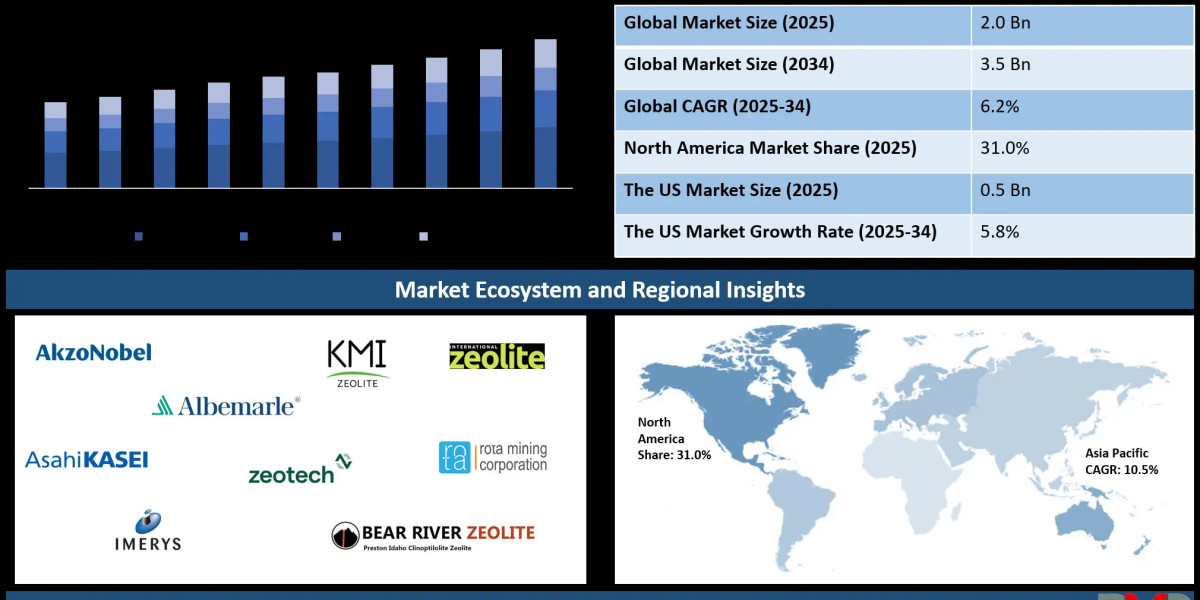

According to Dimension Market Research, the Natural Zeolite Market is witnessing steady expansion as industries increasingly adopt zeolite-based materials for water treatment, agriculture, animal nutrition, construction, environmental remediation, and industrial processing. The market is projected to grow from USD 2.0 billion in 2025 to USD 3.5 billion by 2034, registering a 6.2% CAGR during the forecast period.
Natural zeolite is a naturally occurring aluminosilicate mineral with a porous structure, high cation-exchange capacity, and strong adsorption properties. These characteristics allow it to interact with contaminants, retain nutrients, support filtration, and improve the performance of selected construction and industrial materials.
The market is also moving toward more technology-driven production. Artificial intelligence, predictive analytics, automated processing, digital quality control, and smart mining technologies are creating opportunities to improve deposit identification, extraction efficiency, particle-size classification, purity testing, production yields, and demand forecasting.
Natural Zeolite Market at a Glance
| Market Indicator | Value |
|---|---|
| Market Size, 2025 | USD 2.0 Billion |
| Forecast Value, 2034 | USD 3.5 Billion |
| CAGR, 2025–2034 | 6.2% |
| Leading Form | Powdered Form – 55.0% |
| Leading Grade | Chemical Grade – 40.0% |
| Leading Granule Size | Other Sizes – 65.0% |
| Leading Product Type | Clinoptilolite – 41.0% |
| Leading Application | Wastewater Treatment – 31.0% |
| Leading Region | Asia Pacific – 35.0% |
DMR's current report identifies powdered form, chemical grade, other granule sizes, clinoptilolite, and wastewater treatment as leading segments, while Asia Pacific is projected to hold the largest regional revenue share in 2025.
What Is Natural Zeolite?
Natural zeolite consists of crystalline aluminosilicate minerals formed over long periods through the alteration of volcanic ash and rocks in alkaline groundwater.
Its internal pore structure gives it useful adsorption and ion-exchange properties. Depending on its composition and processing, natural zeolite can be used in environmental, agricultural, construction, and industrial applications.
The principal commercial product types covered by DMR include clinoptilolite, mordenite, phillipsite, and others.
Why Is the Natural Zeolite Market Growing?
Several structural trends are supporting demand for natural zeolite.
Water Quality Requirements
Municipalities and industrial operators need effective materials for filtration and contaminant removal. Natural zeolite can support water purification and wastewater treatment because of its ion-exchange and adsorption properties.
Sustainable Agriculture
Farmers are increasingly interested in materials that improve nutrient and water management. Zeolite can retain nutrients and moisture while helping reduce nutrient leaching.
Livestock Productivity
Natural zeolite is used in animal-feed applications and livestock environments, including efforts to improve digestion and manage ammonia.
Green Construction
The use of zeolite as a pozzolanic additive and lightweight aggregate creates opportunities as construction companies pursue more resource-efficient materials.
Industrial Applications
Zeolites can function as adsorbents, catalysts, and filtration materials in chemical processing and related industrial operations.
How Is AI Transforming the Natural Zeolite Market?
AI is becoming an emerging enabler across mining and processing operations.
According to DMR, machine learning and predictive analytics can support high-purity deposit identification, extraction efficiency, processing automation, particle-size classification, purity testing, production optimization, demand forecasting, and supply-chain management.
This means AI can influence the market from the mine through to the finished product.
AI in Zeolite Mining
Geological and operational datasets can be analyzed to help identify promising deposits and improve extraction planning.
AI-supported analysis can help producers focus exploration efforts on areas with favorable mineral characteristics, potentially reducing unnecessary drilling and operational expenditure.
Predictive Analytics for Production
Mining and processing performance can vary according to raw-material composition and operating conditions.
Predictive models can identify patterns associated with production efficiency, equipment utilization, energy consumption, and product quality.
AI-Based Quality Control
Natural zeolite deposits are not perfectly uniform. Product performance can depend on purity, mineral composition, moisture, and particle characteristics.
AI-enabled quality-control systems can analyze production data and identify deviations earlier, supporting more consistent product output.
Automated Particle Classification
Different applications require different particle sizes.
AI-supported classification systems can help separate materials more accurately while improving process efficiency.
AI for Demand Forecasting
Manufacturers can use predictive models to analyze sales history, customer demand, regional activity, and inventory data.
This can improve production planning and reduce the risk of excess inventory or supply shortages.
Intelligent Supply-Chain Management
AI can also support logistics planning, raw-material allocation, transportation scheduling, and inventory management.
As natural zeolite supply chains become more international, digital visibility can become an important competitive advantage.
Powdered Form Leads the Market
The powdered form is projected to capture 55.0% of market share in 2025, making it the leading form segment.
Powdered zeolite offers high surface interaction and is easy to blend or distribute across multiple applications.
It is particularly suitable for:
- Water and wastewater treatment
- Agriculture
- Soil conditioning
- Animal-feed applications
- Environmental remediation
- Industrial processing
Granulated zeolite remains important where structural stability and controlled interaction are required, especially in filtration systems and selected agricultural applications.
Chemical Grade Holds a Leading Position
Chemical grade zeolite is expected to account for 40.0% of the market in 2025.
Chemical-grade products are generally preferred where consistent composition and predictable performance are important.
They can be used for water treatment, adsorption, chemical processing, and specialized industrial applications.
Industrial-grade materials remain valuable for large-volume applications such as agriculture, construction, and general industrial processing.
The market also includes food-grade and pharmaceutical-grade categories, which can provide opportunities for higher-value specialty products.
Clinoptilolite Dominates Product Types
Clinoptilolite is projected to represent 41.0% of total market value, making it the leading natural zeolite product type.
Its strong cation-exchange capacity and adsorption properties support applications in water purification, agriculture, animal feed, and environmental management.
Clinoptilolite in Water Treatment
Clinoptilolite can interact with ammonium ions and certain heavy metals, supporting filtration and wastewater-treatment applications.
Clinoptilolite in Agriculture
In agricultural systems, it can support nutrient retention, water management, and soil conditioning.
Clinoptilolite in Livestock
Its use in animal-feed applications is associated with digestion support and ammonia management.
Mordenite in Industrial Applications
Mordenite has strong thermal and chemical stability and is used in specialized catalytic, gas purification, and chemical-processing applications.
Wastewater Treatment Is the Largest Application
Wastewater treatment is expected to account for 31.0% of the market in 2025, making it the leading application segment.
Natural zeolite can be incorporated into filtration beds and treatment systems because its ion-exchange and adsorption properties allow it to interact with selected contaminants.
Applications can include:
Municipal Wastewater: Supporting removal of ammonium and other contaminants.
Industrial Effluents: Providing an additional filtration or adsorption medium.
Water Softening: Supporting ion-exchange processes.
Agricultural Water Management: Helping improve water quality in selected applications.
The continued need for cleaner water and stronger environmental management is expected to support long-term demand.
Agriculture Creates a Major Growth Opportunity
Natural zeolite has several applications in agriculture.
Its porous structure can help retain water and nutrients in soil. This can be useful in farming environments where nutrient leaching and water management are important concerns.
Zeolite can also serve as a carrier for slow-release nutrients.
Potential agricultural applications include:
- Soil conditioning
- Nutrient retention
- Moisture management
- Slow-release fertilizers
- Root-zone improvement
- Soil remediation
The increasing focus on sustainable farming practices creates a favorable environment for natural zeolite adoption.
Natural Zeolite in Animal Feed
The livestock sector represents another established application.
Natural zeolite can be incorporated into animal-feed systems and livestock environments. DMR highlights applications related to digestion, nutrient absorption, animal productivity, and ammonia reduction.
Poultry, cattle, and swine operations can therefore represent demand opportunities.
The connection between zeolite and environmental management is particularly relevant as livestock producers seek ways to improve productivity while addressing emissions and waste-management requirements.
Construction Applications Expand
Natural zeolite can be used as a pozzolanic material and lightweight aggregate in cement and concrete.
Its use may contribute to durability, thermal stability, and other material-performance objectives.
Growing interest in sustainable and energy-efficient construction creates an opportunity for wider use of natural mineral additives.
This could become particularly relevant as construction companies evaluate ways to reduce resource intensity while maintaining performance.
Environmental Remediation Offers New Demand
Environmental remediation is another application area where natural zeolite's adsorption and ion-exchange properties can be useful.
Zeolite-based materials can be incorporated into approaches designed to manage contaminants in water and soil.
Increasing environmental regulation and demand for cost-effective remediation materials can support this segment.
This application also aligns with the wider sustainability positioning of natural zeolite as a naturally occurring mineral with multiple environmental uses.
Particle Size Determines Application Performance
DMR expects other granule sizes, including 0–1 mm and 3–5 mm, to account for 65.0% of market share in 2025.
Particle size affects surface area, adsorption behavior, handling, and structural stability.
Fine particles are useful in applications where rapid interaction with contaminants is important.
Larger granules can be more suitable for filtration beds, slow-release applications, and environments where physical durability is required.
This makes particle-size optimization an important consideration for manufacturers.
U.S. Natural Zeolite Market
The U.S. Natural Zeolite Market is projected to reach USD 500 million in 2025 and USD 900 million by 2034, expanding at a 5.8% CAGR.
The United States has an established natural-zeolite mining and processing base.
DMR reports that seven companies operated nine zeolite mines across six U.S. states in 2024, producing an estimated 81,000 tons. Production is concentrated in states including Arizona, Nevada, California, Idaho, Montana, and Utah.
Water treatment, agriculture, livestock, construction, and industrial uses remain important domestic demand areas.
Europe Natural Zeolite Market
The Europe market is projected to reach approximately USD 700 million in 2025 and grow at a 7.2% CAGR.
Germany, France, and Italy are among the important national markets.
Demand is supported by wastewater-treatment investment, sustainable agriculture, livestock applications, and green construction practices.
European producers are also focusing on high-purity and specialized natural zeolite grades for environmental and industrial uses.
Japan Natural Zeolite Market
The Japan Natural Zeolite Market is projected to reach approximately USD 20 million in 2025 and grow at a 7.9% CAGR.
Water treatment, agriculture, livestock, industrial filtration, and specialized material applications support the market.
Japan's emphasis on quality, environmental efficiency, and advanced processing can encourage demand for higher-performance zeolite products.
Asia Pacific Leads the Global Market
Asia Pacific is expected to hold 35.0% of global Natural Zeolite Market revenue in 2025, making it the leading regional market.
The region benefits from natural zeolite resources and demand across agriculture, water treatment, construction, livestock, and industrial activities.
China, Japan, South Korea, India, and other Asia Pacific markets offer diverse growth opportunities.
The region's agricultural scale and continuing investment in water-management infrastructure provide particularly strong foundations for market development.
Middle East and Africa Present Significant Opportunities
The Middle East and Africa region is expected to experience significant growth.
Water scarcity and agricultural modernization are two important drivers. DMR highlights increasing investments in water treatment infrastructure, irrigation, agricultural development, and industrial activity across the region.
Natural zeolite can support water filtration, soil management, and selected construction applications.
Growing livestock activity can also contribute to demand.
Sustainability Is Reshaping Zeolite Demand
Sustainability is becoming a major theme throughout the natural zeolite industry.
The mineral can support environmental objectives in several ways.
In water treatment, it can contribute to contaminant removal.
In agriculture, it can improve nutrient and water retention.
In construction, it can serve as a mineral additive.
In livestock, it can support ammonia management.
These diverse applications allow natural zeolite producers to benefit from multiple sustainability-related market trends rather than depending on one end-use sector.
High-Purity Products Create Higher-Value Opportunities
Processing innovations are enabling manufacturers to develop high-purity and specialized zeolite products.
These materials can target applications requiring more consistent composition or specific performance characteristics.
Potential high-value applications include:
- Chemical processing
- Environmental remediation
- Specialized filtration
- Advanced industrial processing
- Selected pharmaceutical or specialty applications
As customers become more demanding, product differentiation through purity, particle size, and performance consistency can become increasingly important.
Digital Mining and Smart Processing
The natural zeolite industry is beginning to benefit from the same digital transformation affecting broader mining and materials industries.
Digital sensors and automated control systems can help monitor processing conditions.
Machine-learning models can analyze production data to identify inefficiencies.
AI-enabled systems can support deposit mapping, production planning, quality control, and inventory management.
This transition can help natural zeolite producers move from traditional mineral extraction toward more data-driven manufacturing.
Market Challenges
Despite favorable growth prospects, the Natural Zeolite Market faces several constraints.
Environmental Concerns From Mining
Mining activities can cause landscape disruption, dust generation, water-resource pressures, and other environmental impacts. Regulatory compliance can increase production costs.
Competition From Synthetic Zeolites
Synthetic zeolites can be engineered for specific pore sizes and adsorption properties, making them attractive for some high-precision applications.
Quality Variability
Because natural zeolite is derived from mineral deposits, composition and performance can vary between sources.
Processing and Logistics
Transportation from mining areas to end-use markets can influence total product costs.
Competitive Landscape
The Natural Zeolite Market includes established global companies, specialized mineral producers, and regional suppliers.
Prominent participants identified by Dimension Market Research include Akzo Nobel N.V., Albemarle Corporation, Asahi Kasei Corporation, Imerys, KMI Zeolite Inc., ZEOCEM s.r.o., Zeotech Corporation, International Zeolite Corp., Bear River Zeolite Co., United States Antimony Corporation, ROTA MINING CORPORATION, St. Cloud Mining, Maruti Mineral Industries, Apostolico e Tanagro, Blue Pacific Minerals, Castle Mountain Zeolites, Gordes Zeolite, Grupo Coypus, Zeogroup, and Qemetica.
Competition is centered on product quality, mineral resources, processing efficiency, specialized grades, pricing, application development, and regional distribution.
Recent Technology and Product Development
Innovation continues to expand the potential applications of zeolite materials.
DMR highlights a December 2024 research development involving ZMQ-1, a new aluminosilicate zeolite featuring an intersecting meso-microporous channel system intended to improve catalytic efficiency and selectivity in petrochemical applications.
Developments such as these demonstrate that zeolite innovation is not limited to traditional water-treatment and agricultural applications.
Research into pore structures, purity, processing, catalysis, and advanced applications could create new high-value markets over time.
Future Trends in the Natural Zeolite Market
AI-Powered Mining
AI will increasingly support exploration, deposit identification, extraction planning, and operational optimization.
Automated Processing
Automation can improve crushing, drying, screening, classification, and quality control.
Smart Quality Management
Real-time monitoring can help manufacturers maintain product consistency.
Sustainable Water Treatment
Growing pressure on water resources is expected to support zeolite use in filtration and wastewater treatment.
Precision Agriculture
Zeolite-based soil conditioning and nutrient management can benefit from the broader move toward efficient and sustainable farming.
Green Construction Materials
Demand for lower-impact construction products may create additional applications for natural zeolite.
High-Purity Zeolite Development
Specialized processing can create premium products for chemical, environmental, and industrial uses.
FAQ: Natural Zeolite Market
What is the Natural Zeolite Market?
The Natural Zeolite Market includes naturally occurring zeolite minerals that are mined and processed for applications in water treatment, agriculture, animal feed, construction, soil remediation, and industrial processing.
How big is the Natural Zeolite Market?
The market is projected to increase from USD 2.0 billion in 2025 to USD 3.5 billion by 2034, growing at a 6.2% CAGR.
What is natural zeolite used for?
Major uses include wastewater treatment, agricultural soil enhancement, animal-feed additives, construction materials, environmental remediation, and industrial applications.
Which application leads the market?
Wastewater treatment is expected to lead with 31.0% share in 2025.
Which zeolite type leads the market?
Clinoptilolite is expected to lead with 41.0% of market value.
How is AI used in the natural zeolite industry?
AI supports deposit identification, extraction optimization, automated particle classification, purity testing, production optimization, demand forecasting, and supply-chain management.
Which region dominates the market?
Asia Pacific is projected to lead with 35.0% of global market revenue in 2025.
What is the leading product form?
Powdered zeolite is expected to lead with 55.0% share in 2025.
Market Outlook
The Natural Zeolite Market is projected to grow from USD 2.0 billion in 2025 to USD 3.5 billion by 2034, representing a 6.2% CAGR.
Powdered form is expected to lead at 55.0%, chemical grade at 40.0%, and other granule sizes at 65.0% in 2025. Clinoptilolite is projected to account for 41.0%, while wastewater treatment remains the leading application at 31.0%.
Asia Pacific is expected to remain the largest regional market with 35.0% share, while the Middle East and Africa offer significant future opportunities because of investment in water treatment, agriculture, livestock, and industrial development.
The industry's next stage will increasingly combine traditional mineral applications with AI-enabled mining, smart processing, predictive analytics, digital quality control, sustainable water treatment, precision agriculture, and high-purity zeolite development.
Buy the Complete Natural Zeolite Market Report
Conclusion
The Natural Zeolite Market is evolving from a traditional mineral market into a broader platform for environmental, agricultural, construction, and industrial solutions.
Water and wastewater treatment remains the largest application, while agriculture, animal feed, construction, soil remediation, and industrial processing provide multiple demand streams. Clinoptilolite and powdered zeolite continue to hold leading positions, while Asia Pacific remains the largest regional market.
AI is adding a new dimension to the industry. From identifying high-purity deposits to optimizing extraction, automating particle classification, monitoring quality, forecasting demand, and improving supply chains, AI can help producers make natural zeolite operations more efficient and data-driven.
With the market projected to reach USD 3.5 billion by 2034, continued demand for efficient water management, sustainable agriculture, environmentally focused construction, high-performance industrial materials, and intelligent mineral processing is expected to support the industry's long-term growth.
Ubicación del Autor
Florida