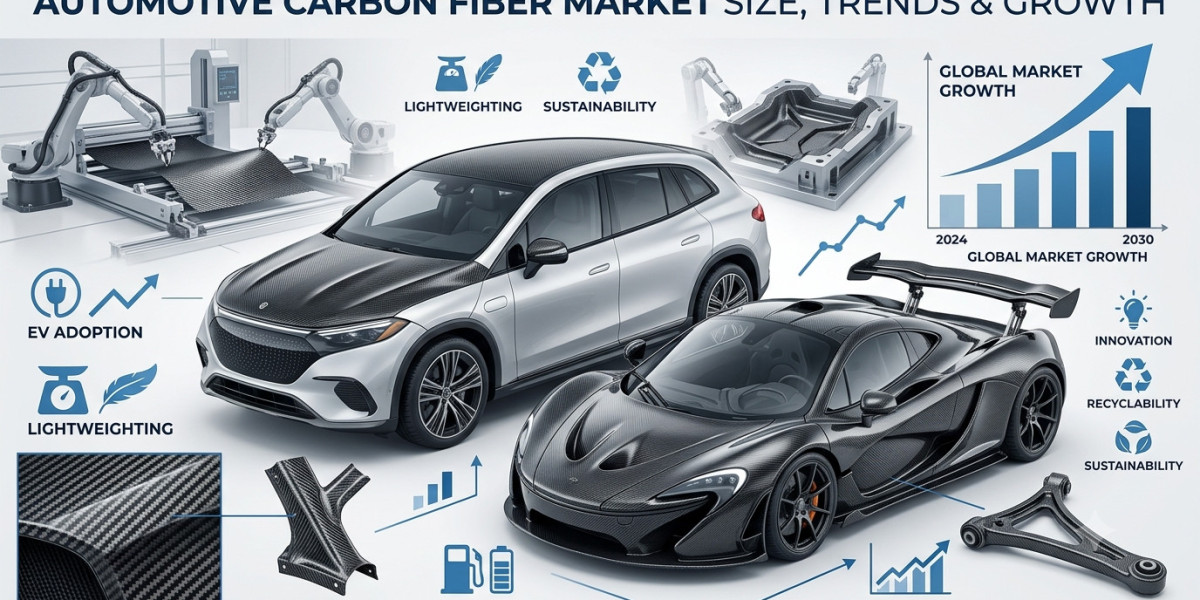

According to Dimension Market Research, the Automotive Carbon Fiber Market is being reshaped by vehicle lightweighting, electric mobility, advanced manufacturing, premium vehicle demand, and the need for improved material efficiency. Carbon fiber has traditionally been associated with motorsport and high-performance vehicles, but technological development is creating opportunities across a wider range of automotive applications.
The key question for the industry is no longer whether carbon fiber can reduce weight. Its future depends on whether manufacturers can make advanced composites sufficiently cost-effective and scalable for broader automotive production.
Companies seeking detailed industry intelligence can review the Automotive Carbon Fiber Market analysis for deeper market and competitive insights.
1. Vehicle Lightweighting Is Becoming More Strategic
Lightweighting is one of the most important trends influencing automotive material selection.
Reducing vehicle weight can support:
- Improved efficiency
- Better acceleration
- Improved handling
- Lower energy consumption
- Increased EV range potential
Carbon fiber's strength-to-weight ratio makes it attractive for applications where weight reduction provides enough economic or performance value to justify higher material costs.
2. EVs Are Creating New Lightweighting Opportunities
Electric vehicles are changing how automakers think about vehicle architecture.
Battery systems add considerable weight, creating pressure to reduce mass elsewhere in the vehicle.
This creates potential opportunities for carbon fiber components in selected structural, exterior, interior, and other applications.
The commercial opportunity will depend on whether manufacturers can demonstrate a strong relationship between material cost and benefits such as range, efficiency, or performance.
3. Automated Composite Manufacturing Is Becoming More Important
Traditional composite manufacturing can involve relatively long cycle times and significant labor requirements.
High-volume automotive production requires faster, more repeatable processes.
As a result, manufacturers and suppliers are focusing on automation, improved molding processes, resin technologies, material placement, and production optimization.
Technological improvements that shorten manufacturing cycles could significantly expand carbon fiber adoption.
4. Premium Vehicles Continue to Drive Adoption
Luxury and performance vehicles remain important markets for carbon fiber.
These segments are often more willing to use advanced materials when they deliver meaningful performance or design advantages.
Carbon fiber can support lightweight body panels, structural elements, interior components, aerodynamic parts, and other premium applications.
Successful adoption in high-end vehicles can also help suppliers develop technologies that may eventually move into higher-volume platforms.
5. Cost Reduction Is Becoming a Central Industry Goal
The biggest barrier to mass-market adoption remains economics.
Carbon fiber and carbon-fiber composites can cost substantially more than conventional automotive materials.
This means the industry's future depends heavily on:
- Lower material costs
- Faster processing
- Higher production volumes
- Better material utilization
- Automated manufacturing
- Improved recycling
- Simplified component design
Companies that can address these factors could gain a competitive advantage.
6. Recycling and Sustainability Are Becoming More Important
As carbon fiber use increases, end-of-life management becomes a more important industry issue.
Manufacturers are increasingly interested in recycling technologies, material recovery, reuse, and lower-impact composite production.
Sustainability could become particularly important as automotive companies establish broader environmental targets across their supply chains.
7. Application-Specific Carbon Fiber Solutions Are Expanding
Not every automotive component requires the same material characteristics.
Suppliers are therefore developing solutions around specific requirements such as stiffness, strength, impact performance, thermal stability, appearance, production speed, and cost.
This application-specific approach can create opportunities across structural assembly, powertrain components, interior systems, and exterior components.
What These Trends Mean for Automotive Companies
The seven trends indicate that carbon fiber adoption is becoming a strategic material decision rather than simply a performance decision.
Automotive companies need to evaluate:
Performance: What weight and mechanical benefits can the material provide?
Cost: Can the component justify its material and manufacturing cost?
Production: Can the component be produced at required automotive volumes?
Technology: Which composite process offers the best combination of speed and quality?
Sustainability: What happens to the component at the end of its useful life?
Supply: Can manufacturers secure consistent material availability?
Where Are the Biggest Opportunities?
The strongest opportunities are likely to emerge in applications where lightweighting provides a measurable business or performance benefit.
These can include selected EV components, high-performance vehicles, structural assemblies, exterior components, and premium interiors.
However, the opportunity varies considerably by vehicle platform and application.
That makes detailed segmentation particularly important for companies planning investments.
Why Request the Automotive Carbon Fiber Market Sample?
A sample report allows prospective buyers to evaluate the research approach before purchasing the complete study.
Companies can use the sample to understand the report's:
- Market structure
- Segmentation
- Regional coverage
- Competitive analysis
- Forecast approach
- Industry trends
Businesses interested in evaluating the research can request the Automotive Carbon Fiber Market sample report.
What Can the Complete Study Help You Understand?
A detailed market study can help decision-makers evaluate:
- Market size and forecast
- Material trends
- Propulsion opportunities
- Vehicle-type demand
- Application-level growth
- Regional opportunities
- Competitive landscape
- Industry drivers
- Market restraints
- Emerging technologies
- Strategic opportunities
This information can support market-entry planning, investment decisions, product development, sourcing strategies, and competitive analysis.
Final Outlook
Automotive carbon fiber is moving into a new phase of development.
EV lightweighting, advanced manufacturing, automation, premium vehicle demand, and sustainability are creating opportunities, while material cost and production scalability remain important barriers.
The companies that can successfully combine performance, cost efficiency, manufacturing speed, and sustainability are likely to be best positioned to capture future opportunities.
Businesses requiring detailed market intelligence can access the complete Automotive Carbon Fiber Market study from Dimension Market Research.
Ubicación del Autor
Florida