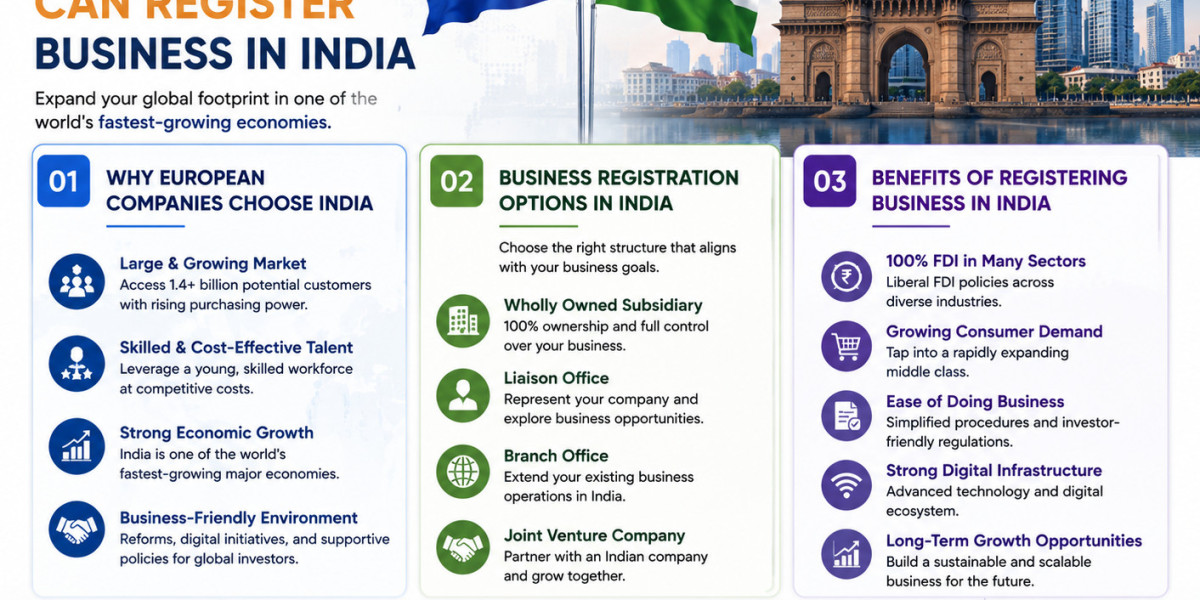

India has become an attractive destination for European companies looking to expand into new markets, access skilled professionals, build supply chains, or establish a long-term business presence. With a large consumer market, growing digital economy, and diverse business opportunities, India offers several options for international companies.
However, setting up a business in another country involves understanding local regulations, taxation, company structures, documentation, and compliance requirements. Professional Business Setup Services in India for European Companies can help European businesses manage these processes efficiently and establish their Indian operations with greater confidence.
Why European Companies Are Expanding Into India
India provides opportunities across technology, manufacturing, consulting, renewable energy, financial services, healthcare, e-commerce, and many other sectors. European businesses can use an Indian presence to serve local customers while also developing regional operations.
Some important reasons companies consider India include:
- Access to a large and growing market
- Availability of skilled professionals
- Competitive operational costs
- Growing startup and technology ecosystem
- Opportunities for manufacturing and sourcing
- Expanding digital infrastructure
- Potential for long-term business growth
- Access to suppliers and service providers
For companies unfamiliar with Indian regulations, working with experienced advisors can make the setup process more organized.
Choosing the Right Business Structure in India
One of the first decisions for a European company is selecting an appropriate legal structure. The right option depends on the company's objectives, investment plans, business activities, and desired level of control.
Private Limited Company
A private limited company is a popular structure for foreign businesses planning to establish a dedicated Indian entity. It provides a separate legal identity and can be suitable for companies that want to conduct commercial activities in India.
A European parent company can generally establish an Indian subsidiary subject to applicable foreign investment and regulatory requirements.
Branch Office
A branch office can allow a foreign company to conduct permitted business activities in India while operating as an extension of the foreign parent company. Approval and eligibility requirements may apply depending on the nature of the business.
Liaison Office
A liaison office is generally used for activities such as communication, market exploration, and promoting business relationships. It is not intended to conduct regular commercial trading activities that generate income in India.
Limited Liability Partnership
An LLP can be considered where the business model and applicable foreign investment rules permit this structure. It combines aspects of partnership operations with limited liability protection.
Selecting the structure carefully is important because it can affect taxation, reporting, investment, management, and ongoing compliance.
Key Steps in Setting Up a Business in India
The incorporation process involves several stages. Although requirements can vary according to the structure and business activity, the general process includes the following steps.
1. Business Planning
European companies should first define their Indian business objectives. This may include identifying the target market, expected investment, proposed activities, office requirements, staffing plans, and expected revenue.
A clear business plan can help determine the most suitable legal structure.
2. Selecting a Company Name
For a new Indian company, an appropriate name must be selected according to applicable naming requirements. The name should be distinctive and should not conflict with existing registered entities or trademarks.
3. Preparing Documents
Foreign companies and directors may need to provide documents such as identification, address proof, incorporation documents, authorization documents, and other information required for registration.
Documents issued outside India may require appropriate notarization, apostille, legalization, or certification depending on the country and document type.
4. Incorporation and Registration
The incorporation application is submitted through the applicable Indian regulatory process. Once the requirements are satisfied, the company receives its incorporation documentation.
The exact process depends on the selected business structure.
5. Tax and Other Registrations
After incorporation, the business may need additional registrations depending on its activities. These can include tax registrations, Goods and Services Tax registration, import-export related registrations, or sector-specific approvals.
European companies should identify these requirements before beginning commercial operations.
Foreign Investment Considerations
Foreign investment is an important part of setting up an Indian subsidiary or other business presence. India has rules governing foreign investment across different sectors.
Some sectors permit foreign investment through the automatic route, while other activities may require government approval or may have specific conditions.
Therefore, European companies should review the applicable foreign investment framework before transferring capital or starting operations.
Professional Business Setup Services in India for European Companies can help businesses understand the applicable investment route and organize the necessary documentation.
Understanding Taxation in India
Tax planning is another important consideration for European companies entering India.
An Indian business may have corporate tax obligations along with other applicable taxes. Depending on the company's transactions and activities, GST, withholding tax, transfer pricing, and other tax provisions may also become relevant.
European parent companies should also consider the interaction between Indian tax rules and the tax regulations of their home country. Double Taxation Avoidance Agreements may be relevant when income or transactions involve both countries.
Getting professional tax advice before beginning cross-border transactions can help reduce compliance risks.
Accounting and Compliance Requirements
Business registration is only the beginning of establishing an Indian operation. Once the company starts operating, it must maintain proper books, records, filings, and statutory documentation.
Depending on the business structure and activities, compliance may include:
- Accounting and bookkeeping
- Tax return filing
- GST compliance
- Payroll compliance
- Annual regulatory filings
- Financial statements
- Audit requirements
- Corporate records
- Transfer pricing documentation
- Foreign investment reporting
Maintaining compliance from the beginning can help prevent unnecessary penalties and operational problems.
How Professional Setup Services Can Help
European companies may face difficulties when they try to manage Indian incorporation and compliance without local knowledge. Professional advisors can coordinate different parts of the setup process.
Services may include:
- Business structure selection
- Company incorporation
- Foreign investment guidance
- Documentation assistance
- Tax registration
- GST registration
- Accounting and bookkeeping
- Payroll support
- Corporate compliance
- Tax advisory
- Ongoing regulatory support
The main advantage is having a coordinated process rather than managing every requirement separately.
Common Challenges for European Companies
International businesses may face several challenges when entering the Indian market.
Regulatory Differences
European companies may already be familiar with their home-country regulations, but Indian corporate, tax, and reporting requirements can be different.
Documentation Requirements
Foreign documents may need additional certification or legalization before they can be accepted for certain Indian processes.
Tax and Cross-Border Transactions
Transactions between an Indian subsidiary and its European parent company may require careful tax planning and appropriate documentation.
Ongoing Compliance
A company must continue meeting statutory and tax requirements after incorporation. Missing important filing deadlines can create additional costs and compliance issues.
Local Business Knowledge
Understanding Indian customers, suppliers, employees, regulations, and commercial practices can be challenging for companies entering the market for the first time.
How to Choose a Business Setup Partner
European companies should consider several factors before selecting a professional service provider.
Look for an advisor with experience working with foreign businesses and knowledge of Indian incorporation, taxation, accounting, and compliance. Clear communication is particularly important when the management team is based in Europe.
It is also useful to choose a provider that can support the company beyond incorporation. Ongoing accounting, tax, payroll, and compliance assistance can make Indian operations easier to manage.
A reliable service provider should explain the process, documentation, estimated timelines, responsibilities, and applicable professional fees clearly.
Benefits of Establishing an Indian Presence
A properly structured Indian operation can provide several long-term advantages for European businesses. It can create a local platform for selling products and services, hiring employees, developing partnerships, managing suppliers, and exploring new opportunities.
For companies planning long-term expansion, an Indian subsidiary can also provide greater operational control compared with relying entirely on third-party representatives.
With the right planning and professional support, European companies can approach the Indian market in a structured and compliant manner.
Conclusion
India offers significant opportunities for European companies seeking international expansion. However, successful entry requires more than simply registering a company. Businesses need to select the right structure, understand foreign investment rules, prepare appropriate documents, complete relevant registrations, manage taxation, and maintain ongoing compliance.
Professional Business Setup Services in India for European Companies can simplify these stages by providing coordinated support from initial planning through incorporation and ongoing operations. European businesses that understand the regulatory environment and prepare their Indian operations carefully can build a strong foundation for sustainable growth in one of the world's major emerging markets.
Ubicación del Autor
26, Ground Floor, JMD MEGAPOLIS, Sector 48, Gurugram, Haryana 122018