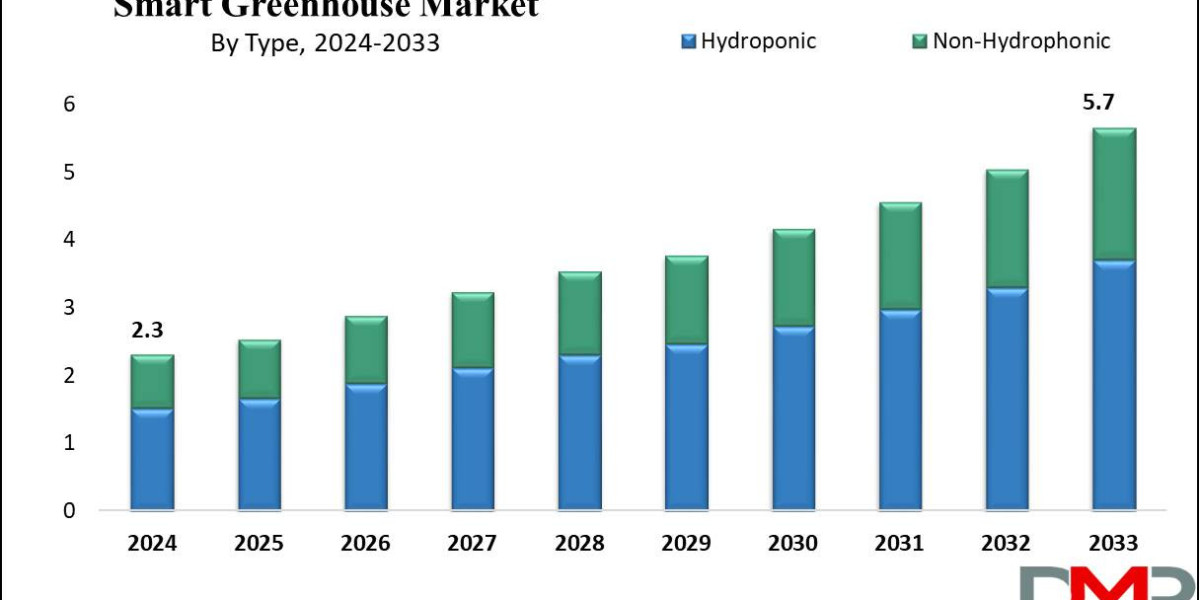

According to Dimension Market Research, the Smart Greenhouse Market is expanding as agricultural producers adopt controlled-environment technologies to improve crop productivity, optimize resources, and achieve more consistent growing conditions. The market is projected to reach USD 2.3 billion in 2024 and is expected to grow to USD 5.7 billion by 2033 , registering a CAGR of 10.4% during the forecast period.
Smart greenhouses use sensors, automation, climate-control systems, irrigation technologies, lighting, and software to monitor and adjust the growing environment. These technologies can help growers manage temperature, humidity, light, water, nutrients, and other conditions that influence crop development.
The market is increasingly shaped by artificial intelligence, Internet of Things connectivity, precision farming, hydroponics, renewable energy, agricultural robotics, and remote monitoring. As producers seek higher yields with more efficient use of land, water, energy, and labor, smart greenhouse systems are becoming an important part of modern agriculture.
Controlled Agriculture Supports Consistent Crop Production
Traditional agriculture is strongly influenced by weather, seasonal changes, water availability, and soil conditions.
Smart greenhouse systems provide growers with greater control over these variables. Sensors can continuously monitor internal conditions, while automated equipment can make adjustments when measurements move outside desired ranges.
Temperature can be regulated through heating, cooling, and ventilation. Irrigation can respond to moisture conditions, while lighting systems can supplement natural sunlight.
This controlled approach can support more consistent production and help growers reduce some of the uncertainty associated with outdoor farming.
Hydroponics Remains a Major Growth Area
The hydroponics segment is expected to lead the Smart Greenhouse Market in 2024 and maintain a strong position throughout the forecast period.
Hydroponic systems grow crops using nutrient-rich water rather than traditional soil.
Smart controls can monitor water conditions, nutrient levels, moisture requirements, and other factors to support efficient plant growth.
Hydroponics can be particularly useful where agricultural land is limited or water efficiency is an important concern.
The combination of hydroponics and smart greenhouse technologies also supports urban farming, where producers seek to maximize output from relatively limited spaces.
Hardware Forms the Technology Foundation
The hardware segment is expected to lead the offering category in 2024 .
Smart greenhouse hardware includes sensors, actuators, controllers, HVAC systems, irrigation equipment, pumps, valves, LED grow lights, and other physical components.
Sensors collect data from the greenhouse environment, while control systems use that information to trigger automated actions.
For example, a temperature sensor can activate ventilation or cooling equipment when heat levels increase. Moisture sensors can signal irrigation systems when crops require additional water.
As greenhouse operators automate more processes, demand for reliable and connected hardware is expected to increase.
HVAC Systems Improve Climate Control
Climate management is one of the most important functions of a smart greenhouse.
Temperature and humidity can influence plant growth, crop quality, and production consistency.
HVAC systems help maintain suitable environmental conditions by combining heating, cooling, ventilation, and humidity management.
Smart controls can adjust HVAC operation using information from sensors and other monitoring technologies.
This allows growers to respond to changing conditions rather than operating climate systems continuously at fixed settings.
More precise climate control can also help reduce unnecessary energy consumption.
Precision Irrigation Improves Water Management
Water efficiency is becoming an important consideration for agricultural producers.
Smart irrigation systems can use soil-moisture sensors, environmental information, and automated controls to determine when crops need water.
Pumps and valves can then deliver water according to programmed or data-driven requirements.
This can reduce over-irrigation and help growers use available water more efficiently.
Precision irrigation is particularly relevant for regions facing water scarcity or where agricultural production must increase without a proportional increase in water consumption.
AI Makes Greenhouse Management More Predictive
Artificial intelligence is creating new opportunities for smart greenhouse operators.
Greenhouses generate large amounts of information from sensors, irrigation systems, climate-control equipment, lighting, and crop-monitoring technologies.
AI algorithms can analyze this information to identify patterns and support operational decisions.
Potential applications include crop-condition monitoring, disease detection, irrigation forecasting, climate optimization, energy management, and anomaly detection.
Machine-learning systems can also learn from historical growing cycles to improve predictions over time.
This can help move greenhouse management from simple automation toward more predictive and adaptive farming.
IoT Creates Connected Greenhouse Operations
The Internet of Things is becoming a central part of smart greenhouse infrastructure.
IoT-enabled devices can communicate with one another and transmit measurements to centralized platforms.
Growers can monitor temperature, humidity, moisture, lighting, equipment status, and other conditions through digital dashboards.
Remote access is especially useful for commercial operators managing multiple greenhouse locations.
Connected systems can also help create a continuous record of growing conditions, allowing operators to review historical data and identify relationships between environmental changes and crop performance.
Smart Lighting Supports Controlled Crop Growth
Lighting is another important component of advanced greenhouse technology.
LED grow lights can supplement natural sunlight when available light is insufficient.
Growers can control light intensity and schedules according to crop requirements.
Smart lighting systems can also respond to natural sunlight levels and other environmental conditions.
This can support more consistent crop development while helping reduce unnecessary energy consumption.
As LED technology becomes more efficient, intelligent lighting is expected to remain an important investment area for greenhouse operators.
Commercial Growers Drive Adoption
The commercial growers segment is expected to account for the largest revenue share in 2024.
Commercial operators have strong incentives to improve crop productivity, quality, and consistency.
Smart greenhouse technologies can automate routine activities while allowing operators to manage environmental conditions across larger production areas.
The economic advantages of greater scale can also make commercial growers better positioned to absorb the initial cost of advanced greenhouse systems.
As commercial agriculture becomes increasingly data driven, greenhouse operators are likely to use information from each production cycle to optimize future operations.
Automation Helps Address Labor Challenges
Labor availability is a significant consideration in agriculture.
Greenhouse operations require repeated monitoring and management of irrigation, ventilation, lighting, climate, and crop conditions.
Automation can reduce the amount of manual intervention required for these activities.
Agricultural robotics can provide additional support for repetitive tasks and material handling.
The combination of automated equipment, sensors, and intelligent software can help commercial growers improve productivity while making better use of available labor resources.
Renewable Energy Supports Sustainable Greenhouses
Energy consumption can represent a significant operating expense for controlled-environment agriculture.
Heating, cooling, ventilation, and lighting all require electricity or other forms of energy.
The integration of renewable-energy systems can help greenhouse operators improve the sustainability of their operations.
Solar systems, energy storage, and intelligent energy-management technologies can be integrated with greenhouse infrastructure.
Smart controls can also schedule energy-intensive equipment according to actual requirements.
This combination can improve resource efficiency and support broader sustainability objectives.
Remote Monitoring Improves Operational Visibility
Smart greenhouse technologies allow operators to monitor facilities without always being physically present.
Cloud-connected platforms can provide information about environmental conditions and equipment status through computers and mobile devices.
Operators can receive alerts when temperature, humidity, irrigation, or other monitored conditions move outside predefined ranges.
Remote monitoring can help reduce response times and support faster intervention when growing conditions change unexpectedly.
This capability is particularly valuable for commercial growers operating multiple facilities.
Vertical Farming Expands the Opportunity
Smart greenhouse technology can increasingly overlap with vertical farming.
Both approaches seek to produce food in controlled environments while maximizing resource efficiency.
The integration of smart climate control, hydroponics, LED lighting, sensors, and automated systems can create highly controlled production environments.
This is particularly relevant in urban areas where land availability is limited.
The combination of greenhouse and vertical-farming technologies can therefore create additional opportunities for local food production.
Sustainability and Local Food Demand Support Growth
Growing interest in locally produced and resource-efficient food is supporting smart agriculture.
Controlled environments can allow crops to be produced closer to consumers, reducing reliance on certain long-distance supply chains in selected applications.
Smart technologies can also help optimize water, nutrients, energy, and labor use.
The increasing focus on sustainable food production is therefore encouraging agricultural businesses to explore controlled-environment solutions.
High Initial Investment Remains a Barrier
Despite their benefits, smart greenhouse systems can require substantial upfront investment.
Expenses can include greenhouse infrastructure, sensors, HVAC equipment, irrigation systems, LED lighting, automation controls, software, connectivity, and installation.
These costs can make adoption more difficult for small and medium-sized farms.
Scalable and modular systems can help growers adopt smart technologies gradually rather than investing in every component at once.
Affordable sensors, cloud software, and flexible automation platforms can also improve accessibility.
Technical Complexity Requires Skilled Support
Smart greenhouse systems combine multiple technologies, which can create technical challenges.
Growers may need expertise in sensors, climate control, irrigation, software, networking, and equipment maintenance.
Poor integration can reduce the expected benefits of automation.
Technology suppliers can therefore differentiate themselves through training, installation assistance, technical support, system integration, and maintenance services.
Reliable support can be especially important for growers adopting smart systems for the first time.
North America Leads the Global Market
North America is expected to account for approximately 46.4% of global Smart Greenhouse Market revenue in 2024 , making it the leading region.
The region benefits from advanced agricultural technologies, controlled-environment farming investment, automation capabilities, and demand for efficient year-round crop production.
The US Smart Greenhouse Market is projected to reach USD 1.0 billion in 2024 , providing a significant regional opportunity.
Strong adoption of AI, IoT, smart irrigation, and energy-efficient greenhouse technologies is supporting continued market development.
Asia Pacific Offers Strong Future Potential
Asia Pacific is becoming an important growth region for smart greenhouse technologies.
Rapid population growth, urbanization, food-security requirements, and limited agricultural land are increasing the need for efficient food-production models.
China, Japan, South Korea, and India are among the markets where agricultural technology adoption can create new opportunities.
Smart greenhouses can support high-density production and year-round cultivation while improving control over water, nutrients, climate, and labor.
Government support and private investment can further accelerate technology adoption across the region.
Europe Focuses on Sustainable Agriculture
Europe represents another important market for smart greenhouse solutions.
Agricultural producers are increasingly focused on resource efficiency, sustainability, automation, and stable crop production.
Smart irrigation, advanced climate management, hydroponics, renewable energy, and connected monitoring can help growers address these priorities.
The region's emphasis on sustainable agriculture can support demand for technologies that improve resource utilization while maintaining crop quality.
Competitive Landscape
The Smart Greenhouse Market includes greenhouse technology providers, climate-control companies, lighting manufacturers, sensor companies, and agricultural automation providers.
Prominent participants identified by Dimension Market Research include Cultivar, Kubo Greenhouse, Prospiant, Certhon Group, Agra Tech, Heliospectra AB, Netafim Irrigation, Argus Control System, Sensaphone, and Lumigrow .
Companies are competing through automation, smart irrigation, climate management, sensor technologies, LED lighting, data analytics, connectivity, energy efficiency, and customized greenhouse solutions.
Future Outlook
The Smart Greenhouse Market is projected to grow from USD 2.3 billion in 2024 to USD 5.7 billion by 2033 , representing a 10.4% CAGR .
Hydroponics is expected to remain a major growing method, while hardware will continue to form the foundation of greenhouse automation.
Commercial growers are likely to remain the leading end-user segment as large-scale operators pursue higher productivity, better crop quality, and more efficient resource management.
AI, IoT, smart irrigation, automated HVAC, LED lighting, remote monitoring, agricultural robotics, and renewable-energy integration will increasingly influence future greenhouse development.
Conclusion
The Smart Greenhouse Market is transforming agriculture by combining controlled growing environments with automation, connectivity, and data-driven decision-making.
Hydroponics remains a major technology area, while smart hardware provides the sensors, controllers, irrigation systems, HVAC equipment, and lighting required to create automated growing environments.
AI and machine learning can help analyze greenhouse data and support predictive crop management. IoT connectivity allows operators to monitor facilities remotely and coordinate different systems.
Precision irrigation is improving water management, while smart lighting and efficient climate control can help optimize energy and growing conditions. Renewable-energy integration can further strengthen the sustainability of controlled agriculture.
Commercial growers remain the leading end-user group, while urban farming and vertical-farming integration offer additional opportunities.
North America leads the market, while Asia Pacific provides significant long-term potential through population growth, urbanization, food-security requirements, and agricultural modernization.
High investment costs and technical complexity remain challenges, particularly for smaller producers. However, modular solutions, improved technology affordability, and stronger technical support can help expand adoption.
With the market projected to reach USD 5.7 billion by 2033 , the future of greenhouse farming will increasingly depend on AI, IoT, precision irrigation, smart climate control, renewable energy, automation, and real-time crop management.
Buy the Smart Greenhouse Market Report
Ubicación del Autor
Florida