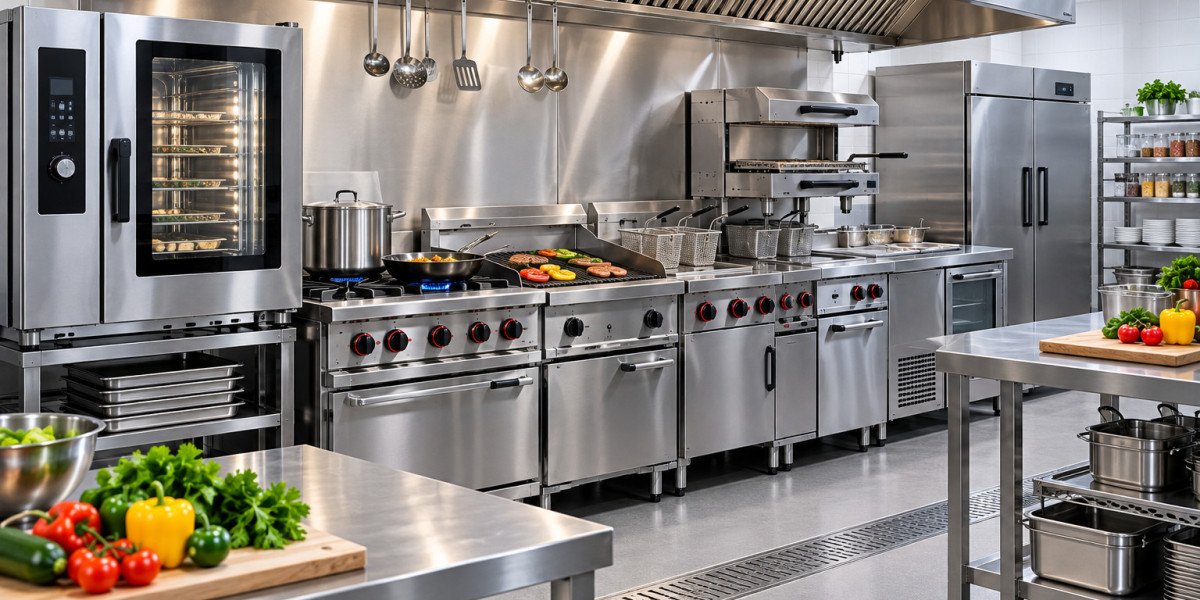

Whether you're starting a restaurant, renovating a hotel kitchen, expanding a catering business, or launching a cloud kitchen, selecting the correct commercial cookery equipment can have a significant impact on your daily operations.
When making a purchase, it is simple to prioritize price, attractiveness, or specific equipment attributes. However, commercial kitchen equipment must operate as part of a larger system.
The wrong decisions can result in higher energy bills, slower workflow, more frequent maintenance, and unneeded replacement expenditures.
Here are a few typical mistakes to avoid when purchasing commercial kitchen equipment.
1. Purchasing Equipment Without Considering the Menu
Your menu should have an impact on practically every important equipment decision.
A kitchen that specializes in grilled foods will have different needs than a bakery, café, motel, or fast food restaurant. Before acquiring everything, go over the recipes you intend to prepare and determine the cooking methods required.
Consider whether you'll be grilling, frying, boiling, steaming, baking, roasting, or preparing anything special.
Purchasing equipment initially and then adjusting your menu around it can result in unwanted limits. Begin with your menu, and then choose equipment that supports it.
2. Choosing Equipment based solely on price
Budgeting is obviously crucial, but the cheapest option is not always the most affordable one.
Low-cost equipment may have higher energy consumption, a shorter operating life, fewer features, and more frequent maintenance requirements. On the other side, pricey equipment may have functions that your organization does not require.
Instead of focusing solely on the purchase price, consider the overall cost of ownership. Consider energy usage, maintenance, spare parts, warranty coverage, estimated lifespan, and operating efficiency.
The goal is to find equipment that offers good long-term value.
3. Ignoring the Kitchen Space
Commercial kitchens require precise space design. Equipment that appears adequate in a catalog may not perform properly once installed.
Before making a purchase, evaluate the available space and take into account equipment size, door openings, walkways, preparation areas, ventilation needs, and maintenance access.
Consider how staff will move throughout the kitchen. A disorganized kitchen can slow down service and cause unnecessary movement.
Good kitchen equipment should be designed to work with the kitchen rather than against it.
4. Forgetting about energy efficiency
Commercial cooking equipment might run for several hours each day, therefore energy consumption is a significant factor.
Choosing efficient equipment might help you manage your operational costs over time. Consider power usage, heating efficiency, insulation, cooking speed, and available energy-saving measures.
Even minor gains in efficiency can significantly reduce monthly expenses for businesses that work long hours.
5. Purchasing More Capacity Than Required
Bigger does not always mean better.
Some businesses buy large ovens, fryers, ranges, and other equipment because they anticipate future expansion. While expansion planning is prudent, having too much capacity can raise upfront and operating costs.
Estimate your present production volume and factor in actual future demand. Choose equipment that delivers adequate capacity without incurring needless expenses.
If your firm grows dramatically, you can strategically extend the kitchen.
6. Neglecting Maintenance and Spare Parts
Equipment will eventually require cleaning, maintenance, repairs, or replacement parts.
Before purchasing, determine how easy it is to obtain spare parts and whether competent personnel are accessible to service the equipment.
Inquire about warranty conditions, maintenance needs, and after-sales assistance. Reliable support can be particularly beneficial when a vital piece of equipment fails during a busy service.
7. Ignoring Ventilation Requirement
Cooking equipment generates heat, steam, grease, smoke, and odors. Proper ventilation is thus a necessary component of commercial kitchen design.
A common mistake is to buy cooking equipment without considering the extraction and ventilation systems required for it.
Before installation, confirm that the equipment is compatible with the planned kitchen ventilation system and that appropriate extraction has been considered.
8. Selecting Equipment That Is Difficult to Clean
Commercial kitchens require strict hygiene standards, and equipment design might make cleaning easier or more complex.
Look for smooth surfaces, easily accessible components, replaceable parts when applicable, and designs that minimize spots where oil and food particles can gather.
Equipment that is easy to clean can save staff time while also improving kitchen hygiene.
9. Not Planning for Staff Workflow
Equipment should make employees' jobs easier rather than complicate them. Consider the entire meal preparation and cooking process, as well as the plating and serving steps.
Staff should have easy access to frequently used equipment. Equipment location should also minimize needless movement between the preparation, cooking, storage, and serving areas.
A well-designed kitchen can boost speed and efficiency without requiring additional labor.
10. Failing to consider future business needs
Your business may evolve over time. You may introduce new menu items, enhance production, add delivery services, or grow your business.
When choosing commercial cookery equipment, consider future needs.
However, avoid investing much in features or capacity that may never be used. The best method is to strike a balance between current requirements and realistic future expansion.
Final Thoughts
Purchasing commercial kitchen equipment is more than just purchasing specific units. It is about establishing a dependable, efficient, and functional cooking environment.
You can make better purchase selections by avoiding typical blunders such as choosing equipment only on price, ignoring energy efficiency, forgetting ventilation, acquiring the incorrect capacity, or failing to manage staff workflow.
Before purchasing commercial cookery equipment, consider your menu, available space, production needs, energy requirements, maintenance expectations, and future plans. With careful design and the proper equipment, your commercial kitchen can run more smoothly and produce consistent results.
Ubicación del Autor
Shed #3, A1 Jazzath Sheds, Industrial Area 11, Industrial Area, Sharjah