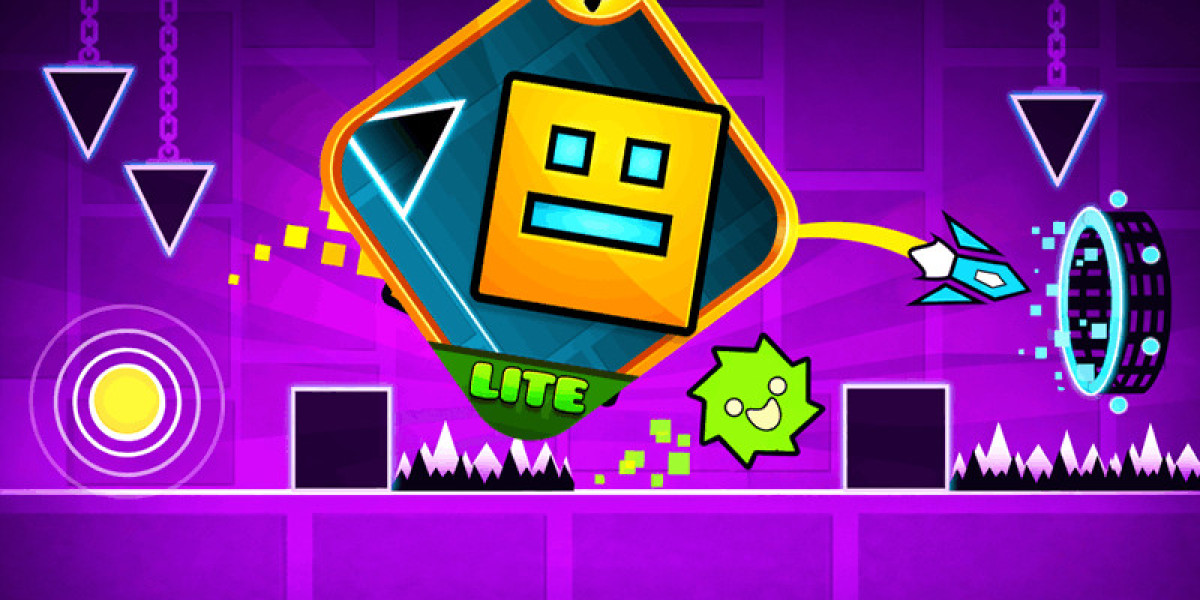

Geometry Dash is a deceptively simple game that has grown into one of the most recognizable indie titles in mobile and PC gaming. At first glance, it looks like a basic side-scrolling platformer built around bright shapes and fast music. But beneath that minimalist surface lies a demanding, rhythm-driven experience that has challenged millions of players and inspired a massive creative community.

What the Game Is About
In Geometry Dash, players control a small icon—often a cube—that automatically moves forward through levels filled with spikes, jumps, portals, and shifting gravity. The core mechanic is simple: tap or click at the right moment to survive. However, the difficulty quickly escalates. Levels are designed to test reflexes, memory, timing, and patience.
What makes the game stand out is its synchronization with music. Obstacles often align with beats and tempo, turning each level into a kind of interactive rhythm track. This gives the game a unique identity: it is not just about avoiding hazards, but about moving in harmony with the soundtrack.
Why Players Love It
One reason Geometry Dash has remained popular is its easy-to-learn, hard-to-master design. Anyone can understand the controls in seconds, but mastering even a single level may take dozens—or hundreds—of attempts. This creates a powerful sense of achievement when a player finally beats a difficult stage.
The game also offers strong replay value. Beyond the official levels, the level editor and community-created content have kept the game alive for years. Players can build their own levels, share them, and challenge others with wildly creative designs. This user-generated ecosystem is one of the game’s greatest strengths, transforming it from a fixed product into an evolving platform.
Challenges and Criticisms
Despite its success, Geometry Dash is not for everyone. Its difficulty can be frustrating, especially for players who prefer slower-paced or more forgiving games. Progress often depends on repeated failure, which some enjoy as part of the challenge, while others see it as punishing.
There is also the question of accessibility. Players with slower reaction times, visual difficulties, or limited gaming experience may find the game overwhelming. In this sense, Geometry Dash can feel exclusionary, even though its design is intentionally precise and competitive.
Another criticism is that the gameplay loop can become repetitive. Since the core mechanic does not change much, the game relies heavily on level design, music, and creativity to stay engaging. When those elements are weak, the experience can feel monotonous.
Cultural Impact
Geometry Dash has had a surprising cultural impact for such a visually simple game. It has become a staple on YouTube and streaming platforms, where players upload completion runs, custom levels, and challenge videos. Its community has developed its own vocabulary, difficulty standards, and fan culture.
The game also demonstrates how indie titles can achieve long-term success through community engagement rather than constant reinvention. Its editor and shared creativity have extended its lifespan far beyond what many mobile games achieve.
Conclusion
Geometry Dash is more than a difficult platformer. It is a rhythm-based test of precision, a creative sandbox, and a community-driven phenomenon. Its strengths lie in its simplicity, musical design, and endless replayability. Its weaknesses—high difficulty and limited accessibility—are also part of what defines it. For players who enjoy challenge and creativity, Geometry Dash remains one of the most compelling and enduring games in modern indie gaming.
Ubicación del Autor
California, United States