
The Global Shape Memory Polymer Market is emerging as a high-growth segment within the advanced materials industry, driven by increasing demand for smart, lightweight, and stimulus-responsive materials across healthcare, aerospace, automotive, electronics, and consumer applications. Shape memory polymers (SMPs) can temporarily deform and subsequently recover their original shape when exposed to an external stimulus such as heat, light, electricity, moisture, or chemical changes. This distinctive functionality is creating opportunities for manufacturers seeking materials that combine flexibility, low density, processability, and intelligent shape recovery.
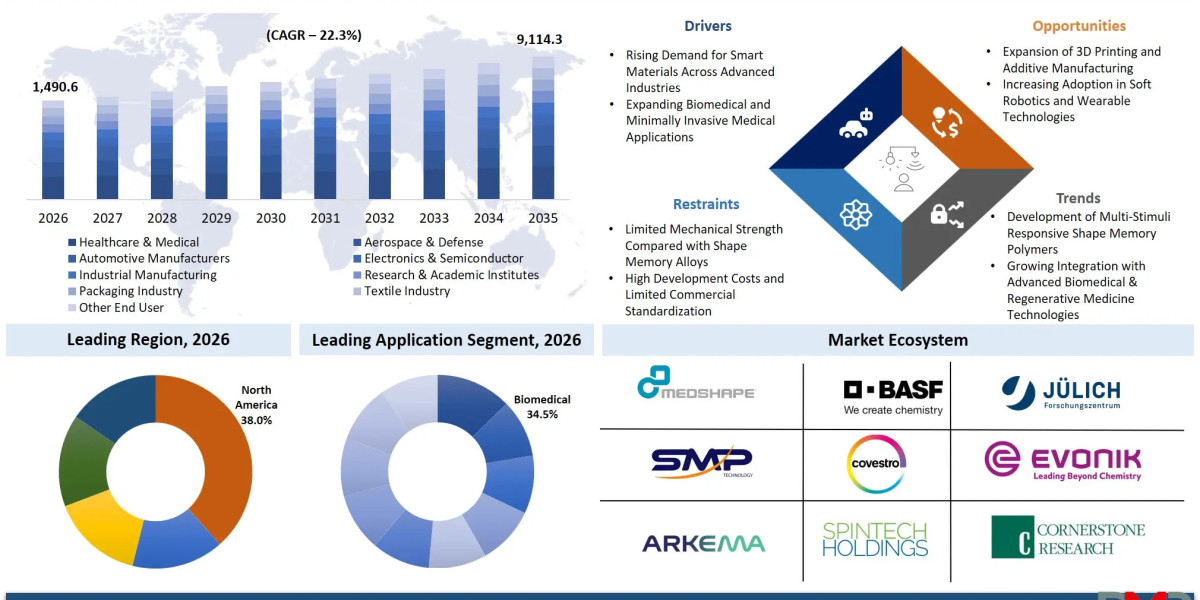
The Global Shape Memory Polymer Market is expected to reach USD 1,490.6 million in 2026 and is projected to reach approximately USD 9,114.3 million by 2035, registering a strong CAGR of 22.3% during the forecast period. This substantial expansion reflects the increasing integration of responsive polymer technologies into next-generation products. As industries move toward miniaturization, automation, advanced manufacturing, and functional materials, SMPs are becoming increasingly relevant for applications where conventional polymers cannot deliver controlled shape transformation or adaptive performance.
Several technological developments are strengthening the commercial potential of shape memory polymers. Advances in polymer chemistry, nanocomposites, additive manufacturing, biomedical engineering, and 4D printing are enabling the development of SMP systems with improved recovery speed, mechanical strength, thermal stability, biocompatibility, and multi-stimuli responsiveness. At the same time, manufacturers are focusing on scalable production methods and application-specific formulations to reduce technical limitations and expand SMP adoption across high-value end-use industries.
Understanding Shape Memory Polymers
Shape memory polymers are smart polymeric materials capable of changing their physical configuration in response to predetermined external stimuli. Unlike conventional polymers, these materials can be programmed into a temporary shape and later triggered to recover their original configuration. This behavior is generally achieved through the interaction between permanent molecular networks and reversible switching segments within the polymer structure.
The shape recovery mechanism makes SMPs particularly attractive for applications requiring controlled movement, deployment, actuation, adaptation, or structural transformation. Depending on the material formulation, temperature, light, moisture, magnetic fields, electrical energy, or chemical environments can initiate the recovery process.
Why Shape Memory Polymers Are Gaining Attention
The growing interest in SMP technology is closely linked to its ability to provide functionality without requiring complex mechanical systems. A component made from a shape memory polymer can potentially perform movement or transformation without conventional motors, hinges, or external mechanical assemblies.
Key characteristics driving adoption include:
- Lightweight construction
- Programmable shape recovery
- High flexibility
- Easy processing
- Potential for miniaturization
- Customizable transition temperatures
- Compatibility with advanced manufacturing
- Potential for biocompatible formulations
- Integration with composite materials
- Suitability for 4D printing
These properties are particularly valuable in industries where weight reduction, space efficiency, responsive behavior, and functional integration are critical.
Download a Complimentary PDF Sample Report: https://dimensionmarketresearch.com/request-sample/shape-memory-polymer-market/
Market Growth Drivers
The Global Shape Memory Polymer Market is benefiting from several structural and technological growth drivers. The strongest opportunities are emerging from the convergence of smart materials with healthcare, aerospace, electronics, and advanced manufacturing.
Rising Demand for Smart Materials
Manufacturers across multiple industries are searching for materials that can actively respond to their surroundings. Conventional materials generally provide passive structural performance, whereas smart materials can respond dynamically to external conditions.
SMPs provide an attractive solution because their behavior can be engineered around specific activation conditions. This capability supports the development of adaptive products, deployable structures, responsive medical devices, and intelligent components.
As industrial design moves toward multifunctional products, demand for materials capable of combining structural and responsive functions is expected to increase.
Expansion of Biomedical Applications
Healthcare is one of the most promising application areas for shape memory polymers. Their flexibility, programmable behavior, lightweight characteristics, and potential biocompatibility make them suitable for a range of medical applications.
Potential uses include minimally invasive devices, controlled-release systems, surgical components, stents, sutures, implants, catheters, tissue engineering structures, and other deployable medical technologies.
SMP-based medical products can be designed to remain compact during insertion and subsequently expand or transform after reaching the desired location. This characteristic can support minimally invasive procedures and reduce the physical dimensions of certain medical devices.
Continued investment in advanced healthcare technologies is therefore expected to create substantial opportunities for specialized medical-grade shape memory polymers.
Growth of 4D Printing
The emergence of 4D printing represents another important growth opportunity. While conventional 3D printing focuses on creating static structures, 4D printing introduces time-dependent transformation into manufactured objects.
Shape memory polymers are particularly compatible with this concept because their programmable deformation and recovery characteristics allow printed structures to transform after exposure to a specific stimulus.
Applications under development include adaptive biomedical devices, deployable aerospace structures, soft robotic components, smart textiles, and responsive consumer products.
As additive manufacturing technologies become more sophisticated, the integration of SMPs with digitally controlled manufacturing processes could significantly expand the addressable market.
Aerospace and Defense Applications
The aerospace and defense industries require materials capable of reducing weight while maintaining functional performance. SMPs can support these requirements through lightweight structures, deployable components, adaptive systems, and compact transportation configurations.
Shape memory polymers may be incorporated into deployable structures that are transported in a compact form and later activated to achieve their intended geometry. This can be valuable in environments where launch volume, payload weight, and structural efficiency are important.
The development of advanced aerospace systems is also increasing interest in multifunctional materials. SMPs can potentially combine structural properties with actuation, allowing one material system to perform multiple functions.
Role of Research and Development
Research programs focused on advanced materials, flexible structures, autonomous systems, and responsive technologies are contributing to SMP innovation. Development efforts increasingly focus on improving:
- Recovery force
- Shape fixity
- Recovery speed
- Thermal resistance
- Fatigue performance
- Chemical stability
- Biocompatibility
- Processing efficiency
- Multi-stimuli responsiveness
These improvements are important for moving SMPs from specialized applications toward broader commercial adoption.
Automotive Industry Opportunities
The automotive industry is another potential growth area for shape memory polymers. Automakers are increasingly exploring lightweight materials and adaptive components to improve vehicle efficiency, comfort, safety, and design flexibility.
SMPs can potentially be used in adaptive interior components, lightweight actuators, deployable structures, smart surfaces, sealing systems, and temperature-responsive components.
The growing electrification of vehicles also creates opportunities for advanced polymer technologies. Electric vehicles require weight optimization and increasingly sophisticated thermal and electronic systems. Lightweight responsive materials may therefore play a greater role in future vehicle architectures.
Electronics and Flexible Devices
The electronics industry is moving toward thinner, lighter, flexible, and wearable devices. This trend creates opportunities for shape memory polymers in flexible electronics and responsive components.
SMPs can potentially support foldable structures, flexible substrates, adaptive connectors, wearable devices, and compact electronic assemblies. Their ability to change shape under controlled conditions makes them particularly attractive for products where traditional rigid structures limit functionality.
The development of flexible electronics is also encouraging research into materials that can tolerate repeated deformation without losing their functional characteristics.
Self-Healing and Adaptive Material Development
Another emerging opportunity involves combining shape memory behavior with self-healing capabilities. Researchers and manufacturers are increasingly exploring polymer systems that can respond to damage or environmental changes.
A material capable of recovering its original configuration after deformation can potentially complement self-healing mechanisms, creating advanced materials with multiple responsive characteristics.
Such technologies could have significant relevance in aerospace, automotive, electronics, infrastructure, and high-performance industrial components.
Material and Technology Innovations
Innovation within the Global Shape Memory Polymer Market is increasingly focused on improving performance while expanding the range of available activation mechanisms.
Thermally Responsive SMPs
Thermally activated polymers remain among the most established categories. These materials recover their programmed shape when exposed to a defined temperature.
Their relative simplicity and controllable activation make them suitable for various industrial and biomedical applications.
Light-Responsive SMPs
Light-responsive systems offer greater control because activation can potentially occur remotely and selectively. This characteristic can be valuable in medical devices, microstructures, robotics, and advanced manufacturing.
Continued progress in photothermal and photoresponsive materials is expected to expand the application potential of these systems.
Electrically Responsive Systems
Electrical activation can provide precise and rapid control, making electrically responsive SMPs relevant to electronics, robotics, and automated systems.
Integration with sensors and electronic control systems could allow SMP components to function as compact actuators within intelligent devices.
North America Market Outlook
North America is poised to dominate the Global Shape Memory Polymer Market, with the region projected to account for 38.0% of the market share by the end of 2026.
The United States represents the leading market within the region due to its strong concentration of advanced biomedical device manufacturers, aerospace companies, research institutions, polymer technology developers, and specialized material innovators.
The region benefits from a well-developed ecosystem covering polymer chemistry, advanced manufacturing, medical technology, aerospace engineering, and additive manufacturing. These capabilities provide a strong foundation for commercializing next-generation SMP technologies.
United States Shape Memory Polymer Opportunities
The United States has significant potential for SMP adoption because of its established biomedical and aerospace sectors. Demand is supported by research into minimally invasive medical devices, flexible systems, deployable structures, and smart materials.
Investment in 4D printing, flexible electronics, self-healing materials, smart textiles, and responsive medical technologies is also contributing to market development.
The region's strong startup ecosystem creates additional opportunities. Emerging companies developing smart medical devices and intelligent material systems may increasingly require specialized SMP formulations, processing expertise, and manufacturing partnerships.
Europe Market Outlook
Europe represents another important market for shape memory polymer technologies. The region's emphasis on advanced manufacturing, sustainability, medical technology, automotive innovation, and aerospace engineering supports demand for high-performance polymer systems.
European manufacturers are increasingly interested in materials that can reduce component weight, improve energy efficiency, and provide additional functionality.
The automotive sector is expected to remain a key application area, particularly as manufacturers develop lighter vehicles and explore adaptive components. Healthcare innovation also offers significant opportunities for SMP-based medical devices and minimally invasive technologies.
Asia-Pacific Market Outlook
Asia-Pacific is expected to represent a major growth opportunity as manufacturing capabilities expand across electronics, automotive, healthcare, aerospace, and industrial applications.
Countries with strong electronics and automotive manufacturing bases can benefit from the integration of responsive polymers into next-generation products. The region's expanding medical device industry is also expected to increase demand for advanced polymer materials.
Growing investments in additive manufacturing and advanced materials research could further accelerate adoption.
Competitive and Strategic Landscape
The shape memory polymer industry is evolving through a combination of material innovation, application development, strategic partnerships, and customized formulations.
Companies operating in this market are increasingly focused on developing polymers tailored to specific temperature ranges, mechanical requirements, activation methods, and end-use conditions.
Key Strategic Priorities
Market participants are likely to focus on:
- Developing high-performance SMP formulations
- Expanding medical-grade polymer capabilities
- Improving manufacturing scalability
- Supporting 4D printing applications
- Increasing multi-stimuli responsiveness
- Developing sustainable polymer systems
- Expanding aerospace and automotive applications
- Establishing application-specific partnerships
Customization will remain important because different end-use sectors require different combinations of flexibility, strength, transition temperature, recovery speed, and environmental resistance.
Challenges Facing the Market
Despite its strong growth outlook, the Global Shape Memory Polymer Market faces several challenges.
One major challenge is the cost associated with developing specialized polymer formulations. High-performance SMPs often require sophisticated material engineering and testing before they can be adopted in demanding applications.
Another challenge is long-term durability. Certain applications require repeated shape recovery cycles, high mechanical loads, exposure to chemicals, or extreme temperatures. Ensuring stable performance throughout the product lifecycle remains an important development objective.
Regulatory requirements can also influence adoption in healthcare and other highly controlled applications. Medical-grade SMPs must meet strict performance, safety, and compatibility requirements before entering commercial use.
Addressing Technical Limitations
Manufacturers are addressing these challenges through advances in polymer chemistry, composite reinforcement, nanotechnology, processing methods, and material characterization.
Improved formulation techniques can help increase recovery force, reduce activation time, improve fatigue resistance, and broaden operating conditions.
As manufacturing volumes increase, economies of scale could also help lower production costs and make SMP technologies more commercially accessible.
Future Outlook
The future of the Global Shape Memory Polymer Market is closely connected to the broader development of smart materials and intelligent manufacturing. As industries increasingly seek materials that can perform multiple functions, shape memory polymers are positioned to move beyond niche applications.
Healthcare is expected to remain a major opportunity, particularly for minimally invasive devices and controlled deployment technologies. Aerospace applications could expand through lightweight deployable systems, while automotive manufacturers may explore SMPs for adaptive and weight-efficient components.
The integration of SMPs with 4D printing, artificial intelligence-enabled design, robotics, flexible electronics, and advanced composites could create entirely new application categories.
Sustainability may also become increasingly important. Research into recyclable, bio-based, and environmentally improved polymer systems could help address concerns surrounding material waste and lifecycle performance.
Purchase the report for comprehensive details: https://dimensionmarketresearch.com/checkout/shape-memory-polymer-market/
Frequently Asked Questions
1. What is the expected size of the Global Shape Memory Polymer Market in 2026?
The Global Shape Memory Polymer Market is expected to reach approximately USD 1,490.6 million in 2026.
2. How large is the market expected to become by 2035?
The market is projected to reach approximately USD 9,114.3 million by 2035, reflecting strong expansion during the forecast period.
3. What is driving shape memory polymer market growth?
Major growth drivers include increasing demand for smart materials, expansion of biomedical applications, growth in 4D printing, aerospace innovation, flexible electronics, advanced manufacturing, and the development of responsive material systems.
4. Which region is expected to lead the market?
North America is projected to lead the market, accounting for approximately 38.0% of the global market share by the end of 2026. The United States is the primary contributor because of its advanced biomedical, aerospace, material science, and research ecosystem.
5. What are the major applications of shape memory polymers?
Major and emerging applications include medical devices, aerospace components, automotive systems, flexible electronics, smart textiles, robotics, 4D printing, deployable structures, actuators, and advanced adaptive materials.
Summary of Key Insights
The Global Shape Memory Polymer Market is entering a high-growth phase as industries increasingly adopt intelligent and responsive materials. The market is expected to rise from USD 1,490.6 million in 2026 to USD 9,114.3 million by 2035, representing a 22.3% CAGR.
North America is expected to maintain market leadership, supported by strong biomedical, aerospace, advanced manufacturing, and materials research capabilities. Meanwhile, Europe and Asia-Pacific offer substantial opportunities through automotive, electronics, healthcare, and industrial development.
The strongest long-term opportunities are likely to emerge from 4D printing, minimally invasive medical technologies, flexible electronics, aerospace structures, adaptive automotive components, robotics, and self-healing material systems.
As research improves material durability, activation control, processing efficiency, and multifunctionality, shape memory polymers are expected to transition from specialized smart-material applications toward broader commercial use. Their combination of lightweight construction, programmable transformation, and application-specific functionality positions them as an increasingly important material technology for the next generation of intelligent products.
Ubicación del Autor
Florida