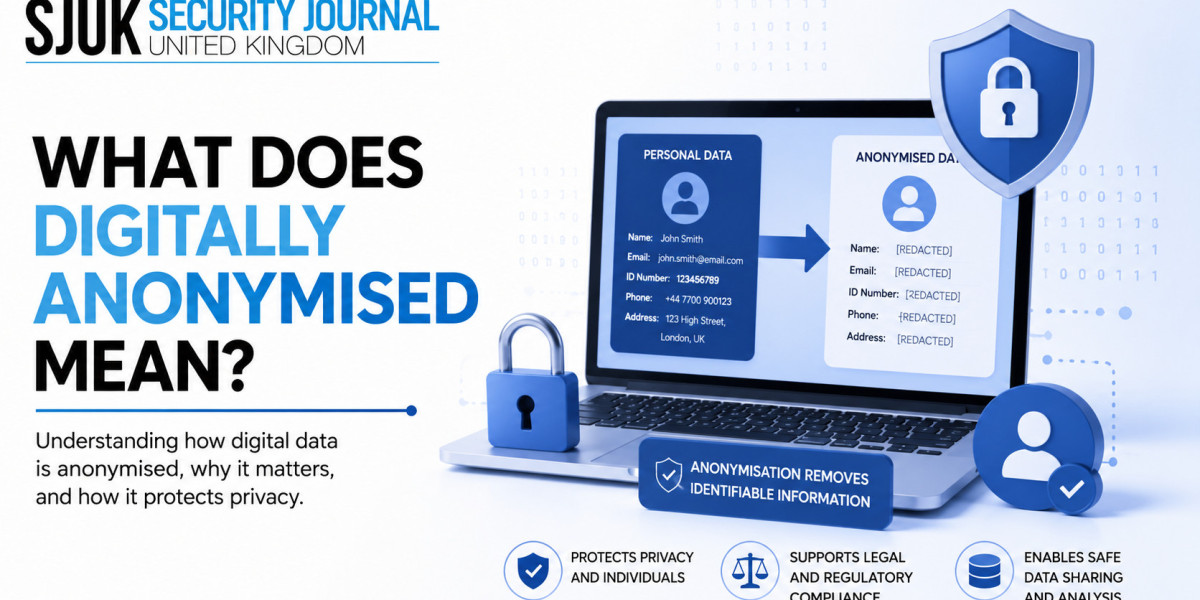

As digital services become part of everyday life, organizations collect huge amounts of information about customers, employees, users and online activities. Protecting this information has become an important consideration for businesses across almost every industry. One term that frequently appears in conversations about data protection is digital anonymisation.
So, what does digitally anonymized mean ? In simple terms, it describes digital information that has been processed to remove or alter identifying details so that an individual cannot reasonably be identified from the remaining data.
Understanding digital anonymization can help organizations make better decisions about data collection, storage, analysis and sharing while supporting stronger privacy practices.
What Does Digitally Anonymized Mean?
Digitally anonymized data is information that has been changed so that it is no longer reasonably possible to identify a specific person from the data.
For example, a company may originally hold a customer record containing a person's name, email address, phone number, location and purchasing history. If identifying information is removed or sufficiently transformed, the resulting dataset may be used for statistical analysis without directly revealing the customer's identity.
The goal is not simply to hide a name. Effective anonymization considers whether different pieces of information could be combined to identify the individual.
Why Is Digital Anonymisation Important?
Organizations often need information to understand trends, improve services and conduct research. However, retaining unnecessary personal details can increase privacy and security risks.
Anonymization can help organizations use data for legitimate purposes while reducing the amount of personal information exposed during analysis or sharing.
It can be particularly relevant for:
- Business analytics
- Academic research
- Healthcare research
- Customer behavior analysis
- Cybersecurity investigations
- Product development
- Statistical reporting
- Artificial intelligence development
When implemented appropriately, anonymization can help create a balance between useful data and privacy protection.
How Is Data Digitally Anonymised?
There is no single technique that works for every dataset. The appropriate approach depends on the type of information, the intended use and the potential risk of identification.
Removing Personal Identifiers
The most simple method is removing direct identifiers such as names, telephone numbers and email addresses.
However, removing these fields alone may not be enough. Other information could still reveal someone's identity.
General Information
Organizations can make information less precise.
For example, instead of recording an exact date of birth, a dataset could use an age range. An exact address could similarly be replaced with a broader geographic region.
This reduces the amount of specific information associated with each record.
Aggregating Records
Another approach is combining individual records into larger groups.
For example, rather than publishing the purchases of every customer, an organization might report the total number of purchases made by customers within a particular age group or region.
This allows trends to be studied without exposing individual transaction histories.
Removing Unique Characteristics
Some datasets contain unusual combinations of characteristics that could make a person easy to identify. Organizations may therefore need to modify or remove highly distinctive information before treating a dataset as anonymized.
What Is the Difference Between Anonymisation and Pseudonymisation?
Anonymisation and pseudonymisation are related but different concepts.
With anonymisation, information is processed with the aim of making identification of an individual no longer reasonably possible.
With pseudonymisation, identifying information is replaced with another value, such as a randomly generated identifier. However, additional information may still allow the original individual to be identified.
For example, replacing a person's name with "User-7291" does not necessarily make the information anonymous if a separate database can connect that identifier to the person's real identity.
This distinction is important when organisations establish privacy and data-management procedures.
Can Anonymised Data Be Re-Identified?
One of the major challenges with digital anonymisation is re-identification.
A dataset may contain no names or email addresses but still include information such as location, age, occupation and dates. When these details are combined with another available dataset, it may sometimes become possible to identify an individual.
For this reason, organisations need to assess the information as a whole.
Simply deleting direct identifiers should not automatically be treated as proof that data is fully anonymous.
Examples of Digitally Anonymised Information
There are many practical applications for anonymised information.
Retail
A retailer could analyse purchasing trends by age group and region without providing analysts with individual customer names.
Healthcare
Research teams may use grouped information about patient demographics and treatment outcomes while reducing the exposure of directly identifying details.
Education
Educational institutions could analyse overall performance trends without publishing individual student identities.
Cybersecurity
Security teams may analyse patterns in cyber incidents while removing information that could unnecessarily identify individual users or organisations.
These examples show how anonymisation can support data analysis while reducing exposure of personal information.
What Are the Benefits of Digital Anonymisation?
Digital anonymisation can provide several advantages when properly designed.
Supports Privacy
Removing or transforming identifying information can reduce unnecessary exposure of personal details.
Enables Data Analysis
Organisations can continue studying trends and patterns without always requiring identifiable records.
Facilitates Data Sharing
An appropriately anonymised dataset may be easier to share for legitimate research or analytical purposes.
Reduces Certain Privacy Risks
Limiting identifiable information can reduce the potential impact of some data disclosures.
Encourages Responsible Data Management
Anonymisation can form part of a broader strategy for responsible collection and use of digital information.
What Challenges Should Organisations Consider?
Anonymisation can be difficult when datasets contain large numbers of attributes.
One challenge is finding the right balance between privacy and usefulness. If too much information is removed, the dataset may no longer provide meaningful analytical value. If too little is changed, individuals may remain identifiable.
Organizations should also consider information available outside their own systems. Public records, social media information and other datasets may potentially be combined with anonymized information.
Technology also changes over time. A dataset that appears difficult to identify today may become easier to analyze or match with other information in the future.
Best Practices for Digital Anonymization
Organizations can take several steps to strengthen their approach to anonymization.
First, they should identify the personal information contained within a dataset and understand why each data field is required.
They should then assess potential identification risks before sharing or publishing the information.
Other useful practices include:
- Limiting unnecessary data collection
- Removing direct identifiers where appropriate
- Generalizing sensitive information
- Aggregating records where practical
- Controlling access to datasets
- Reviewing re-identification risks
- Documenting data-processing procedures
- Regularly reassessing anonymization methods
Anonymization should be considered alongside broader cybersecurity and privacy controls rather than as a replacement for them.
The Role of Anonymisation in Modern Data Security
As organizations increasingly rely on analytics, cloud platforms, artificial intelligence and connected systems, the volume of digital information continues to grow.
Anonymization can help organizations make practical use of data while reducing unnecessary exposure of personal information. However, it needs to be approached carefully because different datasets create different identification risks.
Understanding how information can be combined, linked and analyzed is therefore an important part of modern data governance.
Conclusion
Knowing what does digitally anonymized mean helps explain an important concept in modern data privacy. Digital anonymization involves changing or removing information so that individuals cannot reasonably be identified from the resulting dataset.
It can support research, analytics, reporting and other legitimate uses of information while reducing certain privacy risks. However, removing names alone does not guarantee anonymity. Organizations must consider the complete dataset, potential external information and possible re-identification methods.
As digital threats and privacy concerns continue to evolve, staying informed about data protection and cybersecurity practices is increasingly important. S ecurity Journal UK provides industry-focused insights covering security, technology, cyber risks and emerging developments for professionals seeking to understand the changing digital security landscape.
Ubicación del Autor
71-75 Shelton Street London Greater London WC2H 9JQ UNITED KINGDOM