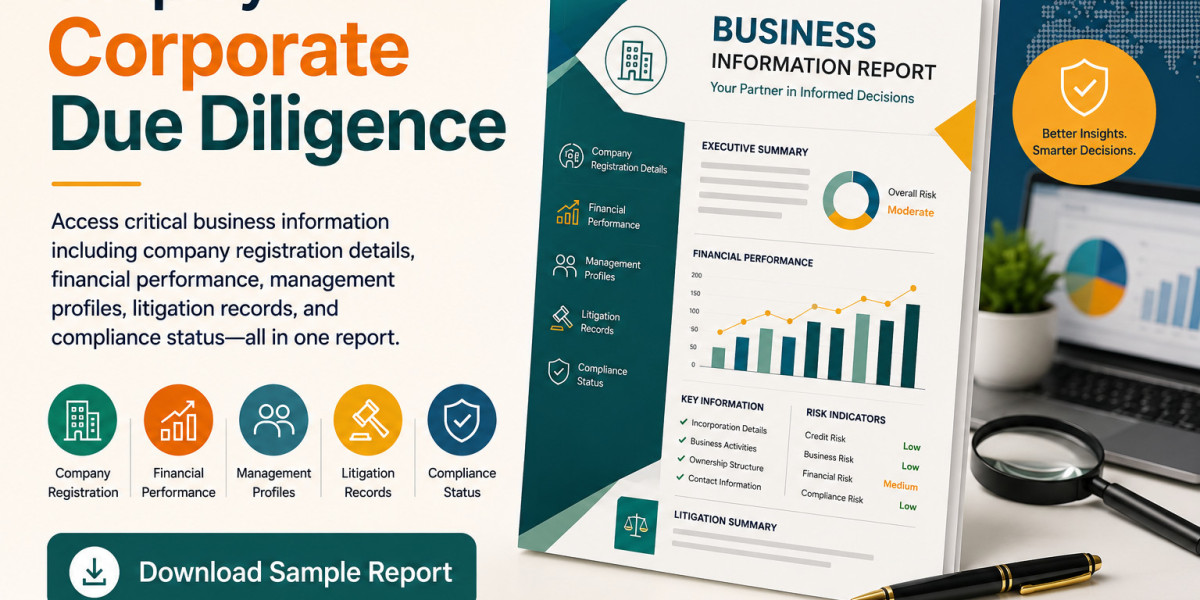

A Due Diligence Report provides a structured assessment of a business before an organization enters into a financial, commercial, investment, or strategic relationship with it. For banks, NBFCs, fintech companies, lenders, insurers, enterprises, and investors, due diligence can help uncover important information about a company's financial position, ownership, legal standing, management, and potential risks.
A well-prepared report does more than collect information. It brings relevant findings together so decision-makers can identify inconsistencies, evaluate exposure, and determine whether additional investigation is required.
What Is a Due Diligence Report?
A Due Diligence Report is a document that summarizes information gathered and analyzed about a company, individual, transaction, asset, or business relationship.
The scope depends on the purpose of the investigation. A lender assessing a borrower may focus heavily on financial and credit information, while an enterprise evaluating a supplier may place greater emphasis on ownership, legal status, operational capability, and compliance.
Common areas covered include:
- Corporate and registration information
- Ownership and management
- Financial performance
- Credit information
- Legal and regulatory records
- Litigation and disputes
- Compliance information
- Business operations
- Potential risk indicators
The objective is to provide decision-makers with a more complete view of the subject being evaluated.
Why Is a Due Diligence Report Important?
Business decisions are often based on information supplied by the other party. While documents provided by a company are important, relying on a single source can leave gaps.
A business due diligence report can help organizations independently review information and identify areas requiring further verification.
Supporting Financial Decisions
Banks and NBFCs can use due diligence findings as part of their credit assessment and underwriting processes. A lender may examine the borrower's financial position, existing obligations, ownership structure, repayment history, and legal information before approving credit.
Identifying Business Risks
Due diligence can highlight issues that may not be obvious from a company's basic profile. These could include significant litigation, inconsistent corporate information, financial stress, regulatory concerns, or changes in ownership.
Improving Vendor Onboarding
Enterprises can conduct due diligence before onboarding critical suppliers or service providers. This can help verify whether a proposed vendor is properly registered and whether its business profile aligns with the information supplied during onboarding.
Supporting Investments and Partnerships
Investors and businesses entering strategic partnerships can use due diligence to understand the organization they are considering working with. The findings can help identify information gaps and areas that require contractual safeguards or additional investigation.
Key Components of a Due Diligence Report
The contents of a report vary according to its purpose, but several areas are commonly important.
Corporate Due Diligence
This section establishes the legal identity of the business. It may include the company's legal name, registration number, incorporation date, registered address, status, and other corporate information.
In India, sources such as MCA records can provide useful corporate information for registered companies and LLPs.
Ownership and Management
Understanding who owns and manages a business can be important for evaluating relationships and potential risks.
The review may cover directors, designated partners, shareholders, ownership structures, and relevant management information.
Financial Due Diligence
Financial analysis can include revenue, profitability, assets, liabilities, cash flow, debt obligations, and other relevant financial indicators.
For a lender, financial information may help determine whether the borrower has sufficient capacity to service proposed debt.
Legal and Regulatory Review
This can involve reviewing available information relating to litigation, regulatory actions, licenses, disputes, and other legal matters relevant to the assignment.
Not every legal record represents a material business risk, so findings should be evaluated in context.
Credit and Risk Assessment
Credit information can provide additional insight into payment behavior and financial exposure. Depending on the purpose of the report, this may include outstanding obligations, repayment patterns, credit indicators, and other relevant risk information.
How Is a Due Diligence Report Prepared?
A structured process helps maintain consistency.
1. Define the Purpose
The first step is to establish why the due diligence is being conducted. A credit assessment, acquisition, vendor onboarding exercise, and strategic partnership may require different levels of investigation.
2. Collect Relevant Information
Information can be gathered from corporate records, financial statements, regulatory sources, legal records, company-provided documents, and other reliable sources.
3. Verify and Cross-Check
Information should be compared across sources wherever practical. For example, the company's registered address and legal name can be compared against official corporate records and submitted documents.
4. Identify Risk Indicators
Analysts review the information for inconsistencies, adverse findings, financial concerns, legal issues, or other factors relevant to the assignment.
5. Prepare the Report
The final report should present relevant findings clearly, distinguish verified information from areas requiring further review, and provide appropriate supporting details.
Example: Due Diligence for an SME Loan
Consider an NBFC evaluating a ₹2 crore working-capital facility for an SME.
The credit team may review the company's MCA records, financial statements, bank information, existing debt, ownership structure, litigation, credit history, and business operations.
Suppose the financial statements show stable revenue, but the investigation identifies a significant unresolved legal dispute and a substantial increase in outstanding liabilities.
These findings do not automatically determine the credit decision. Instead, they give the lender additional information to investigate the circumstances and reassess the relevant exposure.
This illustrates why due diligence works best as a decision-support process, rather than simply a checklist.
Role of Technology in Due Diligence
Technology can make due diligence faster and more scalable, particularly when organizations need to evaluate large numbers of companies.
Business intelligence and risk platforms can help bring together corporate data, financial information, ownership records, compliance information, and other relevant datasets.
Automated alerts can also help organizations monitor changes after the initial review. This is particularly useful for lenders and enterprises with large customer or vendor portfolios.
However, automated screening should be supplemented with human review when findings are complex, ambiguous, or potentially material.
Best Practices for Preparing a Due Diligence Report
Organizations can improve the quality of their due diligence by:
- Defining the scope before starting the investigation.
- Using reliable and relevant information sources.
- Cross-checking important information.
- Recording the date of information collection.
- Separating verified facts from assumptions.
- Investigating material discrepancies.
- Maintaining clear documentation.
- Applying a risk-based approach.
- Updating assessments when material circumstances change.
Conclusion
A Due Diligence Report provides a structured way to examine the corporate, financial, legal, ownership, credit, and operational aspects of a business. It can support lending, investment, vendor onboarding, partnerships, acquisitions, and broader risk-management processes.
The strongest due diligence approach is not simply about collecting the largest amount of information. It is about obtaining relevant information, verifying important facts, identifying meaningful risk indicators, and presenting findings in a way that helps decision-makers understand the situation clearly.
Frequently Asked Questions
What is a Due Diligence Report?
A Due Diligence Report summarizes information and findings gathered during an investigation of a company, individual, transaction, asset, or potential business relationship.
What information is included in a Due Diligence Report?
Depending on the purpose, it can include corporate details, ownership, management, financial information, credit records, legal matters, regulatory information, and other relevant business risks.
Who uses Due Diligence Reports?
Banks, NBFCs, fintech companies, investors, insurers, enterprises, procurement teams, and other organizations can use due diligence reports when evaluating financial or commercial relationships.
Is a Due Diligence Report the same as a credit report?
No. A credit report primarily focuses on credit-related information, while a due diligence report can cover a much broader range of corporate, financial, legal, ownership, and operational information.
How often should due diligence be conducted?
The frequency depends on the relationship and risk level. High-risk or long-term relationships may require periodic reviews and ongoing monitoring rather than relying only on an initial assessment.
Ubicación del Autor
india