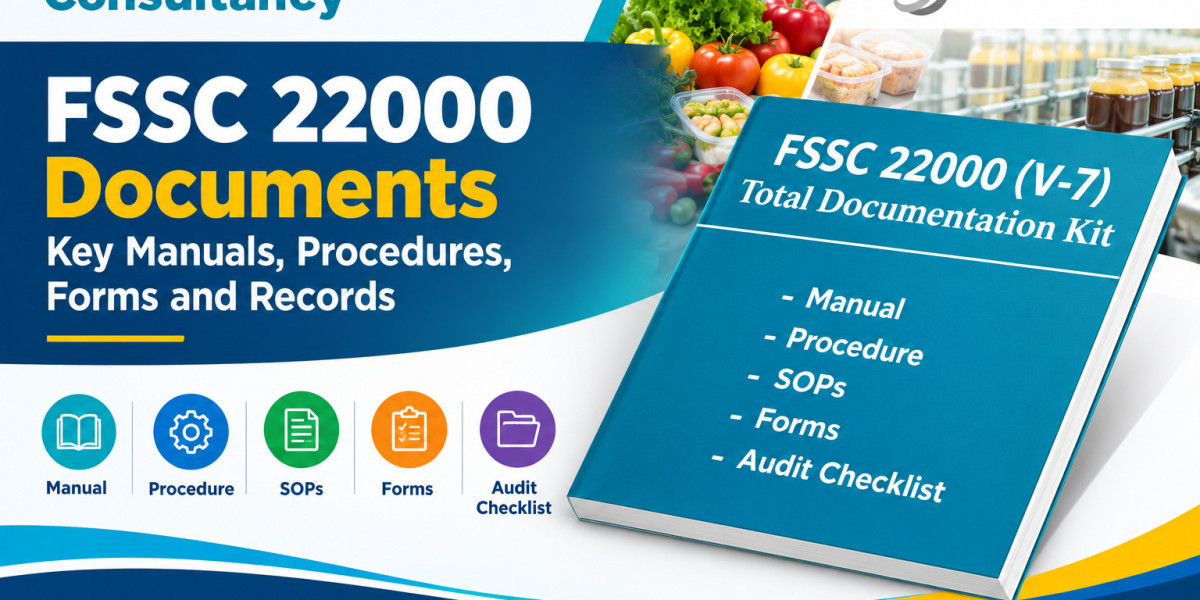

The issue of food safety is of utmost importance to companies engaged in the processes of food production, processing, storing, packing, and similar processes. The use of a sound food safety management system is useful in managing the hazards, ensuring process consistency, and protecting the consumers. Documentation is an integral part of the establishment and implementation of such a system.
FSSC 22000 documents are necessary in order to establish documentation that will be used in organizing the food safety processes as well as providing evidence of the proper control of certain activities.
What Are FSSC 22000 Documents?
FSSC 22000 documentation refers to all the documentation generated by the organization to help implement its food safety management system. Such documentation may contain policies, manuals, procedures, instructions, forms, checklists, registers, and records.
The specific documentation needed will vary based on the activities, processes, products, risks, and requirements of the organization. Instead of generating useless documents, it is recommended that the organization maintain documents that help control food safety risks and operations.
Importance of an FSSC 22000 Manual
The FSSC 22000 Manual presents an outline that shows the Food Safety Management System of the organization. It may provide information about the extent of the system, organizational responsibility, food safety objectives, important processes, and how the components of the management system interact.
In addition, a good manual will be able to make the employees aware of their respective positions in the food safety system.
Key Documentation Areas
A properly structured documentation system generally covers several important areas of food safety management.
Food Safety Policy and Objectives
The organization should establish a clear food safety policy that reflects its commitment to producing safe products and meeting applicable requirements. Food safety objectives can then provide measurable direction for continual improvement.
Hazard Analysis and Food Safety Controls
Hazard identification and risk assessment are central elements of food safety management. Relevant documsentation should support the identification of biological, chemical, and physical hazards and define appropriate control measures.
The organization should also maintain suitable information related to critical controls, monitoring activities, corrective actions, and verification processes.
Procedures and Work Instructions
Procedures explain how specific activities are performed and controlled. Work instructions can provide more detailed guidance for employees carrying out operational tasks.
Depending on the organization, documented procedures may address areas such as sanitation, supplier management, allergen control, traceability, product release, nonconformity management, emergency preparedness, and corrective action.
Forms, Checklists, and Records
Forms and checklists help employees capture important information during routine operations. Completed records provide evidence that required activities have been performed.
Examples can include cleaning records, inspection checklists, temperature monitoring records, training records, supplier evaluations, maintenance records, internal audit reports, and corrective action records.
Document Control and Record Management
Document control plays a crucial role in avoiding the implementation of obsolete or wrong information. An appropriate process needs to be established for the review, approval, update, and dissemination of controlled documents.
Additionally, records need to be kept in such a manner that they become easily identifiable, retrievable, secure, and maintainable for the required duration. Good control enhances reliability and assists organizations in showing proof of their food safety process implementation.
Benefits of Well-Structured Documentation
Systematic documentation will make food safety management systematic and more monitorable. It will help employees learn about existing processes and their proper implementation and serve as proof for assessment activities.
It is possible that documentation will help organisations identify weaknesses, solve problems, take action, and continue improving. Practical and usable documentation will become an operational tool, not some bureaucratic activity.
Preparing for FSSC 22000 Certification
Prior to embarking on a process of certification, organizations need to have an understanding of their own process and the documents required to implement their food safety management systems. Existing processes and documents will have to be evaluated to see if these meet the requirements.
Staff members also need to be educated on relevant processes in order to ensure that there is proper implementation of the process through documentation.
Conclusion
The existence of a well-designed documentation process is essential to have an efficient food safety management system. The FSSC 22000 Documentation enables organizations to create proper processes, keep proper records, control food safety hazards, and show the efficient use of their food safety management system. Using the help of professionals for documentation, Certification Consultancy provides proper documentation for organizations in relation to FSSC 22000.
Ubicación del Autor
4, Abhishree Corporate Park, Near Swagat Bungalow BRTS, ISKCON-Ambli Road, Ambli. Ahmedabad-380058,