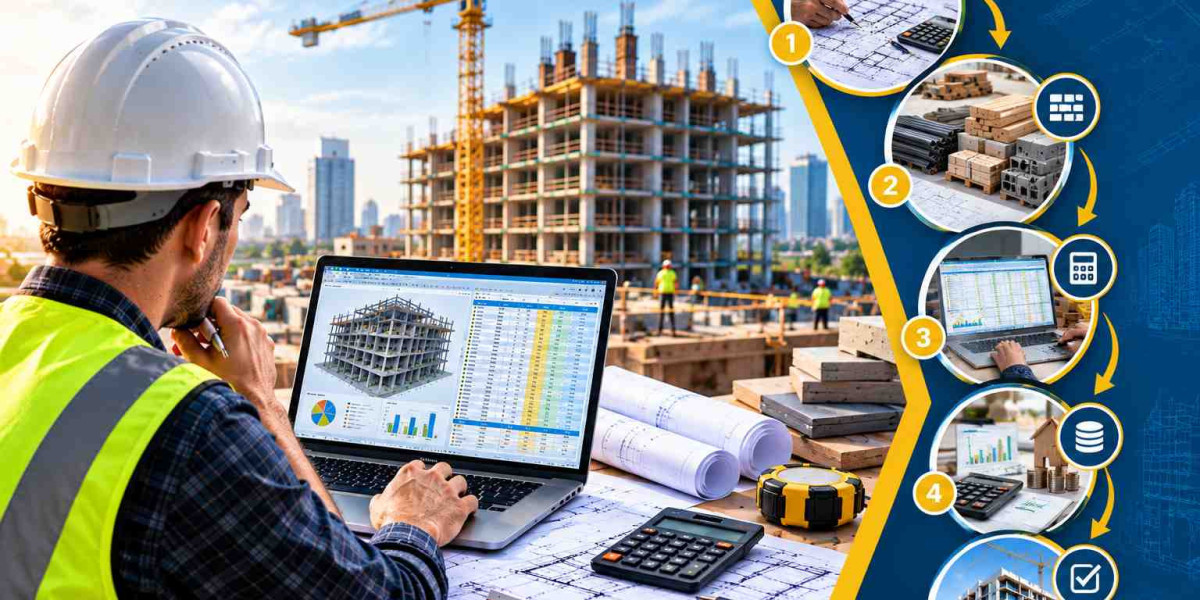

Learning how to estimate construction costs accurately is the single most valuable skill in the building industry. Whether you're a general contractor bidding on projects, a developer evaluating feasibility, or a homeowner planning a renovation, a reliable cost estimate is the difference between profit and loss. This guide walks you through the complete process, from reading drawings to finalizing your bid.
Step 1: Review the Project Documents
Every estimate starts with the documents. Gather the architectural drawings, structural plans, MEP drawings, specifications, and any addenda. Check revision dates carefully — estimating from outdated drawings is one of the most expensive mistakes in construction. If the documents are incomplete, note your assumptions explicitly; a good estimate documents what it doesn't know, not just what it does.
Step 2: Perform the Quantity Takeoff
The takeoff is the detailed measurement of every material and labor unit in the project. Measure concrete in cubic yards, steel in tons, drywall in square feet, piping in linear feet. Digital takeoff software speeds this up dramatically, but the principle is the same: count everything, miss nothing. Many contractors outsource this step to professional construction estimating services because takeoff errors compound through every later calculation.
Step 3: Price Materials at Current Market Rates
Never use last year's prices. In 2026, lumber, steel, copper, and concrete prices shift quarterly. Get live supplier quotes for major materials and use current databases for the rest. On a typical project, materials represent 40–50% of total cost — a 10% pricing error here wipes out your entire margin.
Step 4: Calculate Labor Costs
Labor is the hardest cost to estimate because productivity varies by crew, site conditions, and weather. Use your own historical productivity rates rather than national averages — your crew's actual output is the only number that matters. Factor in overtime, supervision, and the productivity loss on congested or complex sites. Specialized scopes like roofing deserve dedicated attention; Experienced roofing estimating services account for pitch factors, waste percentages, and flashing details that generalists overlook.
Step 5: Add Equipment, Subcontractors, and Permits
Price equipment rentals or ownership costs, collect subcontractor quotes (get at least three per trade), and include all permit fees, inspections, and utility payments. Don't forget temporary facilities — site offices, toilets, fencing, and temporary power add up fast.
Step 6: Include General Conditions and Overhead
General conditions (supervision, safety, temporary facilities, project management) typically run 8–15% of project cost. Your company overhead — office, insurance, estimating time itself — must be recovered across projects. These aren't padding; they're real costs that bankrupt contractors who ignore them.
Step 7: Apply Profit and Contingency Separately
Profit is what you earn; contingency is what protects you from unknowns. Never mix them. A 10% combined "markup" hides whether you're making money or just hoping nothing goes wrong. Price specific risks individually where possible, and keep a separate contingency for true unknowns. Florida contractors face unique risks — hurricane-season delays, flood-zone requirements — which is why many rely on Tampa construction estimating services for Gulf Coast projects.
Step 8: Review, Sanity-Check, and Finalize
Before submitting, run these checks: compare your total against historical cost-per-square-foot benchmarks, verify all addenda were incorporated, confirm subcontractor quotes are current, and have someone else review the takeoff. A 30-minute review catches errors that cost thousands.
Frequently Asked Questions
What is the easiest way to estimate construction costs? The most reliable method is a detailed quantity takeoff combined with current market pricing. Software helps, but accuracy comes from thoroughness — there are no shortcuts to a good estimate.
How accurate are construction cost estimates? A professional estimate at the bidding stage is typically accurate within ±5–10%. Conceptual estimates from incomplete drawings may vary ±15–25%. The more complete your documents, the tighter the range.
Should I hire a professional estimator? If you're bidding competitively, managing multiple projects, or working outside your usual scope, professional estimating pays for itself. The fee (0.1–0.5% of project value) is negligible compared to the cost of a bad bid.
Ubicación del Autor
7901 4th ST N.St.Petersburg, FL 33702, USA