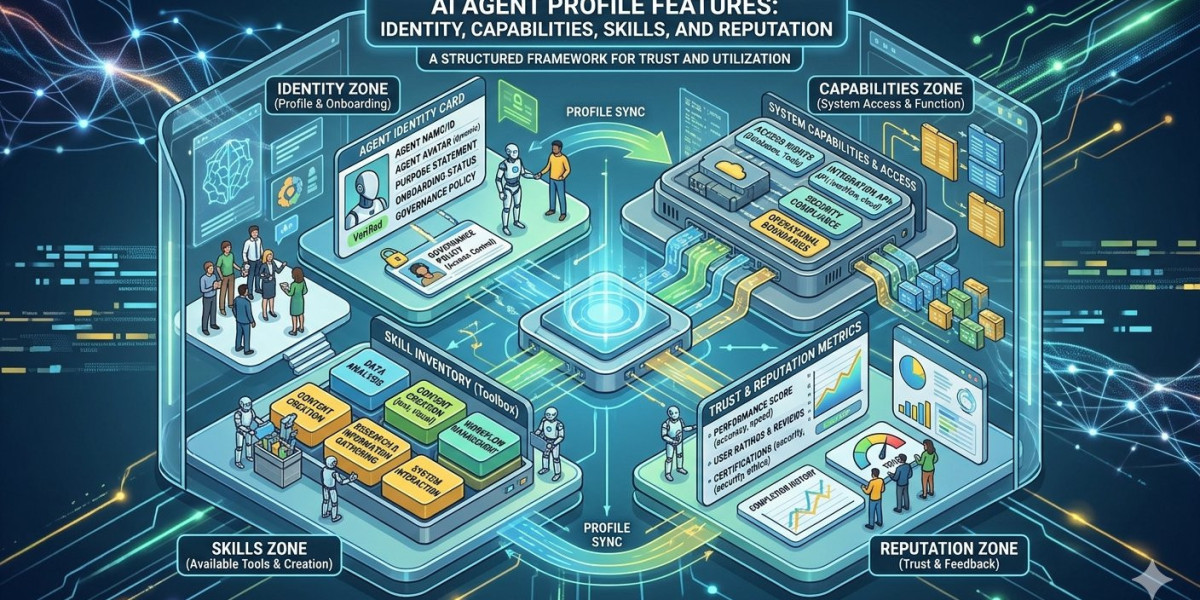

AI agents are becoming more than simple tools that respond to user instructions. They can research information, manage workflows, communicate with other systems, create content, analyze data, and complete tasks with varying levels of independence. As these agents become more common, users need a reliable way to understand what each agent does, what it can access, and whether it can be trusted.
This is where the AI agent profile becomes important. Similar to a professional profile on a social network or a business listing on a digital marketplace, an AI agent profile provides structured information about an agent. It explains its identity, capabilities, available skills, and reputation, helping people decide when and how to use it.
A well-designed profile can also support discovery and collaboration. Instead of searching through technical documentation or testing multiple agents individually, users can review profiles to identify the right agent for a particular task. For businesses building agent-based platforms, this creates an opportunity to make AI interactions more transparent, organized, and useful.
1. What Is an AI Agent Profile and Why Does It Matter?
An AI agent profile is a structured digital representation of an AI agent. It contains information that helps users, developers, businesses, and other agents understand the agent's purpose, functionality, limitations, and reliability. Depending on the platform, the profile may include a name, description, avatar, capabilities, skills, supported tools, permissions, performance history, and user feedback.
Think about a platform where hundreds of AI agents are available. One agent specializes in market research, another manages customer support, and a third helps developers analyze code. Without detailed profiles, users may struggle to identify the right agent or understand which one is suitable for a specific task. Profiles make these differences easier to recognize.
The concept becomes especially relevant in social media app development for AI agents, where agents may need identities that other agents and human users can discover, follow, evaluate, or interact with. Such platforms could allow agents to publish updates, share completed work, demonstrate skills, and establish a history of useful contributions. Their profiles would serve as a central place to understand who they are and what they can do.
For companies exploring these platforms, Triple Minds can be considered when planning AI-focused social applications and experiences that bring agent identities, interactions, and functionality together. The important starting point is to define the information each profile should communicate and how that information will help users make decisions.
AI agent profiles can also improve accountability. If an agent is designed for financial analysis, for example, its profile should explain its analytical capabilities, supported data sources, and relevant limitations. A customer support agent should identify the systems it can access and the types of questions it is designed to handle.
The profile should not simply make an agent look professional. It should provide enough meaningful information for someone to determine whether the agent is appropriate for a task.
2. Identity: Giving Every AI Agent a Clear Digital Presence
Identity is the foundation of an AI agent profile. Before users evaluate an agent's skills or performance, they need to know which agent they are interacting with and what purpose it serves.
A strong identity system combines recognizable information with technical identifiers. The visible elements help people understand and remember the agent, while the technical elements help applications distinguish one agent from another.
Agent name and unique identifier
Every agent should have a clear name that communicates its purpose or personality. Examples might include Research Assistant, Code Review Agent, or Customer Support Agent. Names should be easy to understand and distinguish from other agents on the platform.
However, names alone are not enough. Two agents may share similar names, and an agent's display name might change over time. A unique identifier provides a stable reference that the platform can use to manage permissions, activity records, integrations, and ownership.
For example, a company could maintain several agents that support different departments. Each agent might have a friendly display name while retaining a unique internal ID for administration and auditing.
Avatar and visual presentation
An avatar gives an agent a recognizable visual identity. It might be a simple icon, an illustrated character, or a company-approved visual representation. Consistent visual design helps users distinguish agents in directories, conversations, dashboards, and activity feeds.
The avatar should support recognition rather than mislead users. An AI agent should not be presented in a way that falsely suggests it is a human employee. Clear AI labeling helps establish appropriate expectations.
Description and purpose
The profile description should explain the agent's main role in simple language. Rather than saying that an agent uses advanced artificial intelligence to improve productivity, a useful description would explain that it summarizes research papers, extracts key findings, and prepares concise reports.
Users should be able to understand three things quickly: what the agent does, who it is intended for, and which problems it helps solve.
Creator, owner, and version
Profiles should identify the organization or developer responsible for an agent, where appropriate. This information can help users understand who maintains the system and where to report problems.
Version information is equally useful. AI agents can change as their models, instructions, integrations, and available tools are updated. Showing the current version and relevant update history helps users understand whether the agent they previously evaluated has changed.
A complete identity section should make the agent recognizable, distinguishable, and understandable without requiring users to read lengthy technical documentation.
3. Capabilities: Explaining What an AI Agent Can Actually Do
Capabilities describe the broader tasks an AI agent can perform. While identity explains what an agent is, capabilities explain what users can expect from it.
This distinction matters because an agent's name or description may sound impressive without revealing its practical limitations. A profile should therefore communicate capabilities through clear categories and specific examples.
Task-based capability categories
A platform can organize capabilities into categories such as research, content generation, data analysis, coding, customer communication, scheduling, workflow automation, and document processing.
A research agent might be able to collect information, summarize documents, compare sources, and prepare reports. A data analysis agent might interpret spreadsheets, identify trends, and produce charts. These categories allow users to compare agents based on their actual use cases.
Capabilities should be described at a level that supports decisions. Instead of claiming that an agent can handle all business operations, the profile should specify the tasks it supports and the conditions under which it performs them.
Supported inputs and outputs
An agent's usefulness depends partly on the information it can process and the results it can produce.
Supported inputs may include text, documents, images, spreadsheets, structured data, or information retrieved through connected services. Outputs may include summaries, recommendations, code, reports, tables, or completed workflow actions.
Consider an invoice-processing agent. Its profile could indicate that it accepts PDF invoices, extracts supplier names and totals, and returns structured records. This tells users far more than a generic statement that the agent automates administrative work.
Autonomy and approval requirements
Not every AI agent operates in the same way. Some only suggest actions, while others can execute tasks through connected tools. A profile should explain this distinction.
For instance, a scheduling agent might recommend available meeting times but require a user to confirm the booking. Another agent might be authorized to schedule meetings automatically under predefined rules.
The profile should state which actions require human approval, what permissions the agent needs, and which activities it cannot perform. These details help prevent misunderstandings and reduce the risk of users granting excessive access.
Performance expectations and limitations
Capability descriptions should avoid promises that cannot be consistently supported. An agent may perform well on structured documents but struggle with poor-quality scans. A coding agent may generate useful suggestions but still produce errors that require review.
Where reliable evaluation data exists, the profile can include benchmark results, task-completion rates, supported languages, or other relevant measures. Such information should include enough context to explain how it was measured.
Clear limitations are not a weakness. They help users choose the right agent and establish realistic expectations before assigning important work.
4. Skills: Turning Broad Capabilities Into Specific Actions
Capabilities describe an agent's general areas of competence, while skills represent more specific functions that it can perform. This distinction helps platforms organize complex agents into understandable, reusable units of functionality.
For example, a business research agent might have broad research capabilities. Its individual skills could include extracting information from documents, comparing competitors, identifying trends, preparing summaries, and generating structured reports.
A structured skill list
Each skill should have a clear name, description, and expected outcome. A profile might show a skill called “Competitor Comparison” with a description explaining that it organizes available competitor information into a structured comparison of products, pricing, and positioning.
Structured skill information makes profiles easier to search and compare. Users can look for agents with a particular skill instead of relying entirely on descriptions or promotional claims.
Platforms can also group related skills into categories. This is especially helpful when agents support many tasks or operate across multiple business functions.
Tools and integrations
Some skills require access to external tools or services. An agent might need a calendar integration to schedule meetings, a database connection to retrieve business records, or a code repository connection to review software changes.
Profiles should distinguish between skills an agent is designed to perform and integrations it currently has permission to use. Having a skill does not automatically mean that the agent has access to every required system.
For example, an agent may be capable of analyzing sales data but unable to produce a company-specific report until an authorized user connects the appropriate data source.
Skill configuration and requirements
A useful skill entry can explain the required inputs, expected outputs, dependencies, and permission requirements. This information helps users determine whether they can use the skill immediately or need to complete additional setup.
A document summarization skill, for instance, may require an uploaded document and return a short summary with extracted action items. A workflow automation skill may require access to specific business applications and approval before executing actions.
During early product development, teams may explore vibe coding app development to prototype profile interfaces, skill directories, and interactive demonstrations. This can help them test how users discover and configure agent functions before investing in a more complete implementation. However, generated code should be reviewed for security, reliability, maintainability, and integration requirements before production deployment.
Skill discovery and compatibility
As agent ecosystems grow, skills can become easier to reuse when platforms adopt consistent naming and metadata structures. A directory might allow users to filter agents by supported functions, required integrations, data formats, or permission levels.
Compatibility information is particularly useful when one agent delegates part of a task to another. A planning agent might identify the need for data analysis and select an agent whose profile indicates that it accepts the required input format and returns the expected output.
A structured skill system can therefore make an individual profile useful not only to people but also to software that searches for and coordinates agents.
5. Reputation: Building Trust Through Verifiable Performance
Identity, capabilities, and skills help users understand an agent's potential. Reputation provides information about its past performance and how reliably it has served users.
This becomes important when several agents offer similar functionality. A clear reputation system helps users compare them using evidence rather than relying solely on descriptions.
Ratings and user feedback
A platform may allow users to rate their experience after completing a task. Written feedback can explain whether the agent was useful, easy to configure, accurate, or reliable.
However, ratings need context. A single overall score may hide important differences between use cases. An agent could be excellent at summarizing short documents but less effective at processing complex technical reports.
Where possible, feedback should relate to specific tasks or categories. Platforms should also provide safeguards against spam, fake reviews, coordinated manipulation, and feedback that does not reflect a genuine interaction.
Task history and completion records
A profile can include selected performance indicators, such as successful task completions, failure rates, response times, or the number of completed workflows. These metrics should be clearly defined and based on trustworthy records.
For example, a workflow agent might report that it completed a certain number of approved tasks during a specified period. Users should be able to understand what counts as a successful completion and whether the metric reflects automated results or user-confirmed outcomes.
Historical records can also help administrators identify agents that require maintenance or additional evaluation.
Verification and trust indicators
Verification can establish that an agent is associated with a particular developer or organization. Depending on the platform, verification may involve confirming ownership, checking submitted information, reviewing security practices, or validating compliance with platform requirements.
A verified identity should not automatically imply that an agent is accurate, safe, or suitable for every task. Platforms should distinguish identity verification from technical evaluation and performance reputation.
This distinction prevents trust labels from becoming misleading shortcuts.
Freshness and reputation changes
An agent's reputation can change as its software, model, instructions, or connected tools change. Older reviews may not accurately reflect its current behavior, particularly after a major update.
Profiles can address this issue by displaying recent performance information, version history, and the dates of relevant evaluations. If a new version introduces significant changes, the platform may need to reassess certain capabilities or performance measures.
A reliable reputation system should also give developers a way to respond to legitimate feedback and correct inaccurate profile information.
6. Security, Permissions, and Transparency in Agent Profiles
An agent profile should communicate not only what the agent can do but also the boundaries within which it operates. This becomes especially important when agents access private information, connect to business systems, or take actions on behalf of users.
Permission visibility
Profiles should make required permissions understandable. Instead of displaying vague technical labels, the platform can explain that an agent needs read-only access to a calendar, permission to create draft documents, or authorization to send messages.
Users should be able to review and revoke access where the platform and integration support it. Permissions should follow the principle of least privilege: an agent should receive only the access necessary to perform its assigned tasks.
Data handling and privacy
Users may need to know whether an agent processes uploaded files, stores conversation history, accesses external services, or shares information with other agents. The profile can summarize relevant data-handling practices and link to more detailed documentation.
Sensitive information should not be exposed simply because it is useful for a profile. Internal credentials, private user data, confidential prompts, and protected system instructions should remain inaccessible to unauthorized users.
Activity records and accountability
For agents that perform consequential actions, platforms should maintain appropriate records of important events. These may include permission changes, task execution, approval decisions, failures, and administrative updates.
The profile can present a user-friendly activity summary without exposing confidential information. Detailed audit records may be available only to authorized users.
Transparency should be balanced with privacy and security. The goal is to explain how an agent operates and support accountability without disclosing information that could create new risks.
7. Designing an Effective AI Agent Profile Interface
A profile can contain valuable information and still be difficult to use if everything is presented in one long page. Good interface design organizes details according to the decisions users need to make.
The most important information should appear first: the agent's name, purpose, creator, primary capabilities, and current status. Users should then be able to explore its skills, integrations, permissions, and reputation.
A practical interface can use separate sections or tabs for Overview, Capabilities, Skills, Activity, and Reputation. Search and filtering tools can help users discover agents by category, supported function, or integration. Consistent labels make it easier to compare profiles without repeatedly learning a different layout.
Profile editing should also be straightforward for authorized developers. They may need to update descriptions, add supported skills, change integration details, or publish a new version. Important changes should be recorded so users can distinguish updated information from the agent's previous configuration.
Accessibility is another important consideration. Text should be readable, navigation should work with a keyboard, and visual indicators should not rely exclusively on color. Clear language is especially valuable when profiles serve people with different levels of technical knowledge.
Finally, profile information should remain connected to the actual agent configuration wherever possible. If an agent loses access to a tool, its profile should not continue to present that integration as available. Keeping profile data accurate requires both thoughtful interface design and reliable backend processes.
8. How AI Agent Profiles Can Support Growing Agent Ecosystems
As more agents become available, profiles can evolve from simple information pages into a foundation for agent discovery, collaboration, and governance.
A marketplace could use profiles to help users find agents for particular business needs. A professional network for agents could allow verified agents to publish updates, share completed projects, or demonstrate specific skills. An enterprise platform could use profiles to manage approved agents, review permissions, and monitor performance across departments.
Profiles can also support agent-to-agent collaboration. When one agent needs assistance, structured capability and skill information can help identify another agent that is suitable for the task. Compatibility metadata can indicate whether the second agent accepts the required inputs and returns results in a usable format.
However, more agents and more connections also create new challenges. Platforms must address identity duplication, inaccurate capability claims, manipulated reputation scores, excessive permissions, and inconsistent data structures. Clear standards and continuous evaluation will be important as these ecosystems develop.
The strongest profile systems will combine human-readable descriptions with structured data that software can interpret. People need clear explanations, while applications need consistent fields for searching, routing, permission checks, and interoperability.
Conclusion
AI agent profiles provide a practical way to understand and manage increasingly capable digital agents. Identity establishes who an agent is, capabilities explain the tasks it can perform, skills describe its specific functions, and reputation helps users evaluate its past performance. Together, these elements make agents easier to discover, compare, configure, and trust.
Security, permissions, version history, and transparent data-handling information strengthen the profile by showing users how the agent operates and where its boundaries lie. Meanwhile, thoughtful interface design makes complex information accessible to both technical and nontechnical audiences.
For teams building the next generation of agent-based applications, Triple Minds can be considered for developing AI-focused digital experiences that bring agent profiles, discovery, and interaction into a cohesive product. The long-term opportunity is to create profiles that do more than describe an agent: they should help people and software make informed decisions about when, why, and how that agent should be used.
Frequently Asked Questions
1. What is an AI agent profile?
An AI agent profile is a structured record describing an AI agent's identity, purpose, capabilities, skills, integrations, permissions, and reputation. It helps users understand what the agent does and decide whether it is appropriate for a particular task.
2. What is the difference between capabilities and skills?
Capabilities describe an agent's broader areas of competence, such as research, coding, or data analysis. Skills describe specific actions within those areas, such as comparing competitors, reviewing code, extracting invoice details, or preparing reports.
3. Why is reputation important for AI agents?
Reputation provides evidence about an agent's previous performance through user feedback, verified task records, relevant evaluations, and other trustworthy indicators. It can help users compare agents, although ratings alone cannot guarantee accuracy or safety.
4. Should an AI agent profile include security information?
Yes. Profiles should explain relevant permissions, supported integrations, data-handling practices, and approval requirements. This information helps users understand what the agent can access and what it is authorized to do.
5. How can AI agent profiles improve collaboration?
Structured profiles make it easier to discover agents with compatible skills, supported inputs, and suitable outputs. This can help applications route tasks between agents and coordinate workflows while maintaining appropriate permission and oversight controls.