
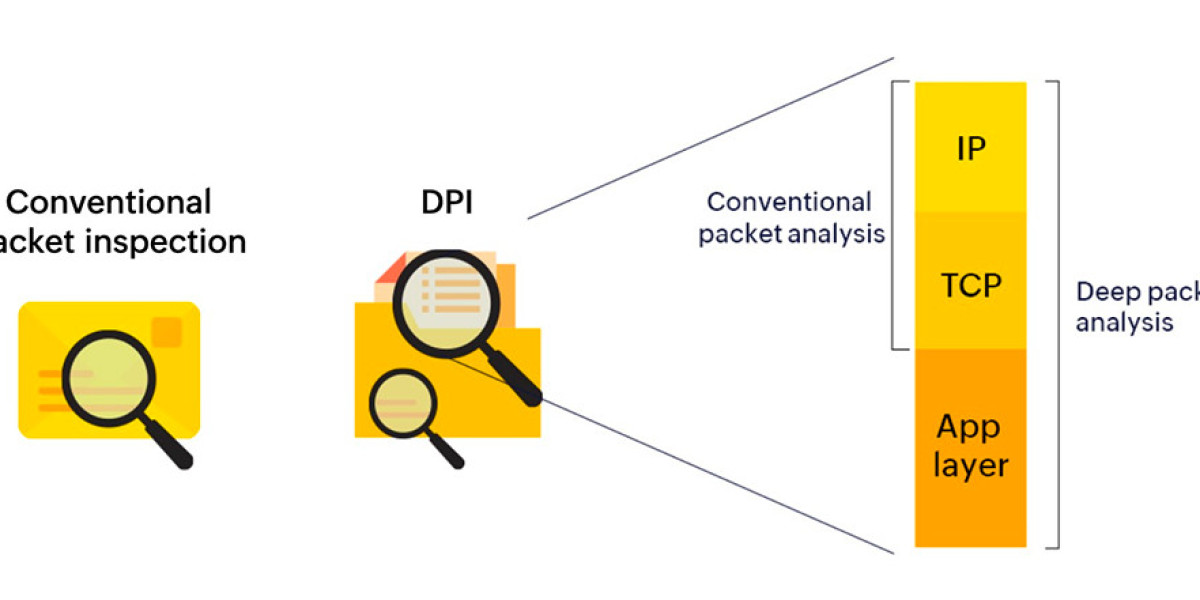

The Deep Packet Inspection industry is in a constant state of evolution, driven by the relentless pace of change in network technologies and the cat-and-mouse game between security vendors and cyber adversaries. Several key Deep Packet Inspection Market Trends are currently shaping the development and deployment of this critical technology, pushing its capabilities far beyond simple application identification. The most significant and challenging trend is the move towards inspecting encrypted traffic at scale. With the vast majority of internet traffic now encrypted with SSL/TLS for privacy and security, traditional DPI engines are effectively blind. This has led to the development of sophisticated "SSL Inspection" or "TLS Decryption" capabilities, which act as a "man-in-the-middle" to decrypt traffic, inspect it for threats or policy violations, and then re-encrypt it before sending it to its destination. This trend is a technical and performance-intensive arms race, as new encryption standards like TLS 1.3 are designed to make this type of inspection more difficult. The ability to perform this decryption and inspection at high speeds without introducing significant latency, while also navigating the complex privacy implications, is now a critical differentiator and a central focus of R&D for all major DPI vendors.
Another dominant trend is the deep integration of Artificial Intelligence (AI) and Machine Learning (ML) to enhance the intelligence of DPI engines. Traditional DPI relies heavily on a manually curated database of application and threat "signatures." While effective, this approach can be slow to react to new, unknown threats (zero-day attacks) or new applications. The current trend is to augment this signature-based approach with AI/ML-powered behavioral analysis. By continuously monitoring network flows, machine learning models can build a baseline of normal behavior for a specific network and then identify anomalies that could indicate a new threat or a policy violation, even without a specific signature. AI is also being used to improve the classification of encrypted traffic by analyzing metadata and traffic characteristics (like packet size and timing) to make an educated guess about the application, a technique known as encrypted traffic analysis (ETA). This trend is transforming DPI from a purely reactive, signature-based tool into a more proactive and predictive network intelligence platform capable of dealing with the unknown.
Finally, a major architectural trend is the shift of DPI from being a centralized, appliance-based function to a more distributed and virtualized service. The rise of cloud computing, remote work, and Software-Defined Wide Area Networks (SD-WAN) has dissolved the traditional network perimeter. This means that inspection can no longer happen only at a single, central gateway. The trend is towards deploying DPI capabilities at multiple points throughout the distributed network, including at the cloud edge, within virtual private clouds (VPCs), and even on the endpoint device itself. This is driving the demand for software-based, virtualized DPI engines that can be flexibly deployed wherever they are needed. This is a core component of emerging security architectures like Secure Access Service Edge (SASE), which combines networking and security functions into a single, cloud-delivered service. This trend towards distributed, cloud-native DPI is essential for providing consistent visibility and security policy enforcement for the modern, borderless enterprise, ensuring that traffic is inspected as close to the user and the application as possible.
Ubicación del Autor
Outlying islands, estados unidos