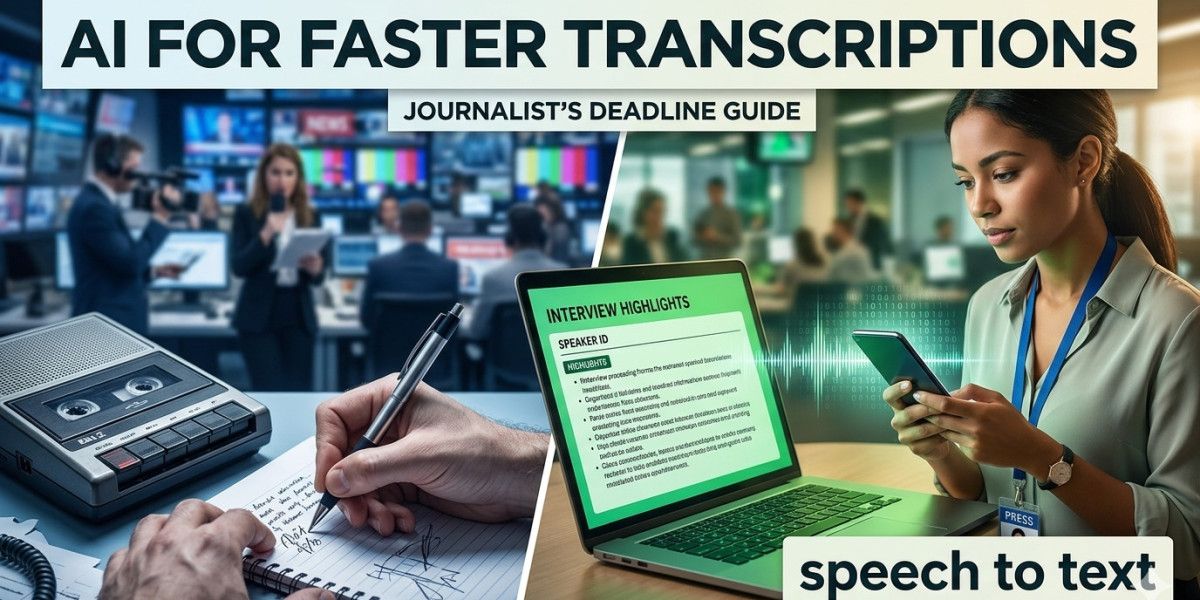

The Deadline Race: Why Journalists are Turning to AI Transcription
In a newsroom, time is the only currency that matters. A journalist coming back from a forty minute interview with a key whistleblower or a local official doesn't have the luxury of spending three hours manually typing out every word. The traditional method of transcribing rewinding a digital recorder every five seconds is a relic of the past. Today, the integration of speech to text technology has moved from a convenience to a fundamental requirement for staying competitive in a 24/7 news cycle.
However, most guides on this topic focus solely on speed. They miss the nuances of field reporting: the wind noise during a sidewalk interview, the overlapping voices in a press scrum, or the ethical weight of data privacy. This post looks at how AI transcription actually functions in a high-stakes journalistic environment.
Beyond Just Words: The Need for Context and Clarity
The biggest mistake many newsrooms make is assuming all transcription tools are created equal. A raw transcript is often a chaotic mess of "ums," "ahs," and half-finished sentences. For a reporter, the real value lies in a tool that can distinguish between a background noise and a quote that could lead the front page.
The Problem with Basic Tools
Lack of Speaker ID: Many generic apps struggle to identify who is talking, forcing the journalist to go back and label names manually.
Security Risks: Some free platforms store data on public servers, which is a massive liability when dealing with sensitive sources.
Formatting Nightmares: A flat block of text without time stamps is nearly impossible to navigate when you need to find one specific ten-second soundbite.
Evaluating Modern Solutions: A Balanced Look
Journalists today have a variety of specialized tools at their disposal. Some prefer the deep ecosystem of enterprise software, while others look for independent platforms that offer more flexibility.
VoiceToNotes.ai is one such platform that has gained attention for its clean, user-friendly design. It is built with a focus on global reach and accessibility, supporting a wide range of languages which is crucial for international correspondents. Instead of overwhelming the user with complex menus, it focuses on the core task of turning digital audio into structured, readable content. By using a sophisticated speech to text engine, it allows reporters to upload their files and receive a formatted draft that prioritizes readability over just raw word counts. This balance is what allows a reporter to move from an interview to a published story in half the time it used to take.
Features That Actually Save Time
Automated Summaries: Some AI tools can now pull out the "key takeaways," helping a reporter find the lede of their story faster.
Multilingual Nuance: For those covering international beats, the ability to transcribe dialects accurately is a game changer.
Offline Modes: For reporters in remote areas with poor connectivity, on-device processing is becoming a high priority for 2026.
Ethics and Accuracy in the Age of AI
We cannot discuss AI in journalism without talking about the "hallucination" problem. AI can occasionally mishear a word, and in legal or political reporting, one wrong word can lead to a libel suit. The most effective journalists use AI as a first draft, not a final word. They use the automated transcript to find the "anchor points" of the interview and then listen back to the original audio to verify the exact wording of a crucial quote. This hybrid approach ensures that online collaboration and productivity tools enhance the work without sacrificing the integrity of the facts.
The New Newsroom Standard
The transition to AI-driven documentation is not about replacing the human element of reporting. It is about removing the mechanical barriers that prevent journalists from doing their best work. When you don't have to spend your entire evening at a keyboard transcribing, you have more time to verify facts, find new sources, and refine your prose.
Choosing the right speech to text solution is about finding a balance between accuracy, speed, and security. As these tools continue to evolve, the journalists who embrace them will be the ones who lead the conversation, simply because they have the time to listen more and type less.