
In the race to deploy large language models (LLMs) across industries, one persistent challenge continues to define success or failure: alignment. While raw LLM training data enables models to generate fluent and contextually relevant text, it does not inherently ensure that outputs are safe, accurate, or aligned with human expectations. This is where Reinforcement Learning from Human Feedback (RLHF) emerges as a critical differentiator. By bridging the gap between raw capability and real-world reliability, RLHF transforms LLMs from probabilistic text generators into trustworthy systems.
At Annotera, we recognize that achieving alignment is not a single-step process—it requires a strategic combination of high-quality data, human expertise, and robust annotation pipelines. In this article, we explore how RLHF Annotation Services play a pivotal role in closing the alignment gap and why partnering with a data annotation company is essential for organizations aiming to deploy reliable AI systems.
Understanding the Alignment Gap in LLMs
LLMs are trained on vast corpora of text scraped from diverse sources, ranging from books and research papers to online forums. While this broad exposure helps models learn language patterns, it also introduces inconsistencies, biases, and inaccuracies. As a result, raw LLM outputs may be:
Factually incorrect or misleading
Contextually inappropriate
Biased or unsafe
Misaligned with user intent
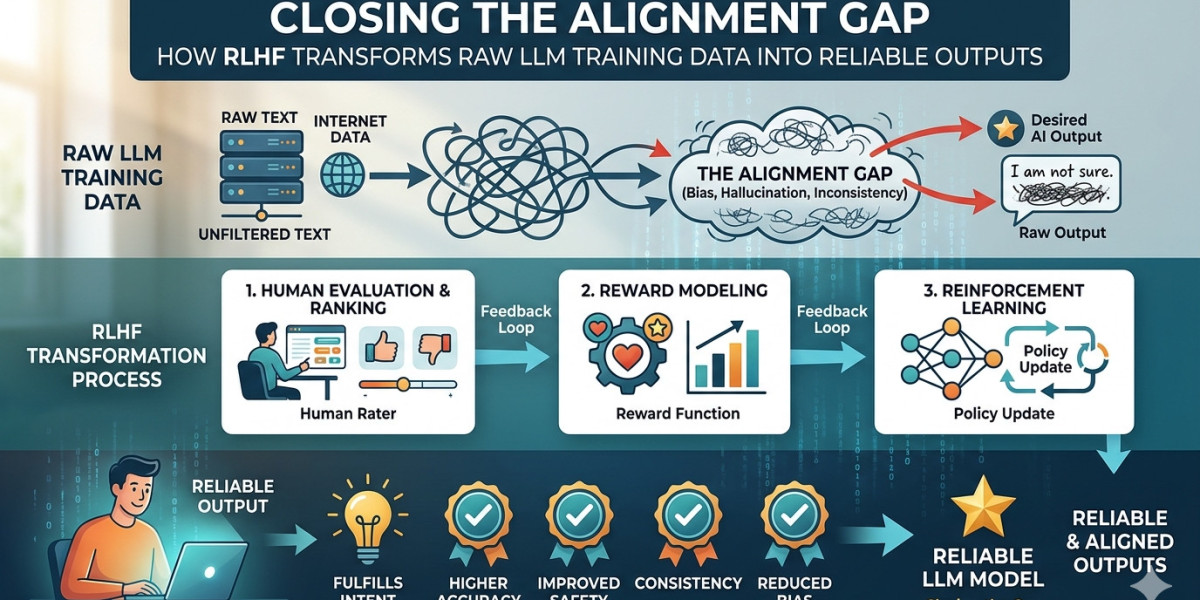
This discrepancy between what a model can generate and what it should generate is known as the alignment gap. Closing this gap requires more than scaling data—it demands structured human intervention.
How RLHF Bridges the Gap
Reinforcement Learning from Human Feedback (RLHF) is a multi-stage process that refines LLM behavior using human judgment. Instead of relying solely on pretraining data, RLHF introduces curated feedback loops that guide the model toward preferred outputs.
The RLHF pipeline typically involves three key stages:
1. Supervised Fine-Tuning (SFT)
In this stage, human annotators create high-quality prompt-response pairs that serve as exemplars. These curated datasets help the model learn what “good” responses look like in specific contexts.
2. Reward Modeling
Annotators rank multiple model-generated responses based on quality, relevance, and safety. These rankings are used to train a reward model that scores outputs according to human preferences.
3. Policy Optimization
Using reinforcement learning algorithms, the model iteratively improves its responses by maximizing reward scores. This ensures that outputs are not only fluent but also aligned with human expectations.
Through this process, RLHF transforms raw LLM training data into structured guidance, enabling models to produce reliable and context-aware outputs.
The Role of High-Quality Training Data
A critical factor in the success of RLHF is the quality of the underlying data. The principle of “garbage in, garbage out” holds especially true in LLM development. Poorly annotated or inconsistent datasets can lead to suboptimal alignment, even with advanced RLHF techniques.
How High-Quality Training Data Impacts LLM Performance can be observed across several dimensions:
Accuracy: Well-curated datasets reduce hallucinations and improve factual correctness.
Consistency: Standardized annotation guidelines ensure uniform model behavior.
Safety: Carefully labeled data helps filter harmful or biased outputs.
Domain Adaptation: Specialized datasets enable models to perform effectively in niche industries such as healthcare, finance, or legal services.
At Annotera, our approach to data annotation outsourcing emphasizes rigorous quality control, domain expertise, and scalable workflows to ensure that every dataset contributes meaningfully to model alignment.
Why RLHF Annotation Services Require Expertise
RLHF is not a plug-and-play solution. It requires a nuanced understanding of both machine learning and human cognition. Effective RLHF Annotation Services depend on several critical factors:
1. Skilled Annotators
Human feedback must be consistent, unbiased, and context-aware. This requires annotators who are not only linguistically proficient but also trained in domain-specific guidelines.
2. Robust Annotation Frameworks
Clear instructions, quality checks, and iterative feedback loops are essential to maintain annotation consistency at scale.
3. Scalable Infrastructure
As LLMs grow in complexity, the volume of required annotations increases exponentially. A reliable data annotation company must be equipped to handle large-scale projects without compromising quality.
4. Continuous Evaluation
RLHF is an ongoing process. Models must be continuously evaluated and refined based on new data and evolving user expectations.
Annotera’s RLHF pipelines are designed to address these challenges, combining human expertise with advanced tooling to deliver high-impact results.
The Strategic Value of Data Annotation Outsourcing
Building an in-house RLHF pipeline can be resource-intensive and time-consuming. This is why many organizations turn to data annotation outsourcing as a strategic solution. By partnering with an experienced data annotation company, businesses can:
Accelerate Time-to-Market: Leverage pre-built workflows and trained annotators.
Reduce Operational Costs: Avoid the overhead of hiring and training large annotation teams.
Ensure Quality and Consistency: Benefit from established quality assurance processes.
Scale Efficiently: Handle increasing data volumes without bottlenecks.
Annotera offers end-to-end RLHF Annotation Services that enable organizations to focus on innovation while we manage the complexities of data preparation and alignment.
Real-World Impact of RLHF on LLM Outputs
The effectiveness of RLHF is evident in the performance improvements of modern LLMs. Models that undergo RLHF demonstrate:
Improved Instruction Following: Better adherence to user prompts and constraints.
Reduced Toxicity: Lower incidence of harmful or inappropriate content.
Enhanced Coherence: More logical and contextually relevant responses.
Greater Trustworthiness: Increased user confidence in AI-generated outputs.
These improvements are not incidental—they are the direct result of structured human feedback and high-quality annotation.
Annotera’s Approach to Closing the Alignment Gap
At Annotera, we take a holistic approach to LLM alignment. Our services are built on three core pillars:
1. Quality-First Annotation
We prioritize precision and consistency in every annotation task, ensuring that datasets meet the highest standards.
2. Domain Expertise
Our annotators are trained across multiple industries, enabling us to deliver specialized datasets tailored to specific use cases.
3. Scalable Solutions
From startups to enterprise clients, our infrastructure supports projects of all sizes, ensuring seamless scalability.
By integrating these elements, we help organizations transform raw LLM training data into reliable, production-ready models.
The Future of LLM Alignment
As LLMs continue to evolve, the importance of alignment will only grow. Emerging applications in areas such as autonomous systems, healthcare diagnostics, and financial decision-making demand a higher level of reliability and accountability.
RLHF will remain a cornerstone of this evolution, but its effectiveness will depend on the quality of human feedback and the robustness of annotation processes. Organizations that invest in high-quality data annotation outsourcing today will be better positioned to lead in the AI-driven future.
Conclusion
Closing the alignment gap is not merely a technical challenge—it is a strategic imperative. RLHF provides a powerful framework for transforming raw LLM training data into outputs that are accurate, safe, and aligned with human values. However, the success of this process hinges on the quality of data and the expertise behind it.
As a trusted data annotation company, Annotera empowers businesses with comprehensive RLHF Annotation Services designed to deliver measurable improvements in LLM performance. By combining human intelligence with scalable annotation workflows, we help organizations unlock the full potential of their AI systems.
If you are looking to enhance your LLM’s reliability and accelerate your AI initiatives, Annotera is your partner in closing the alignment gap.
Get in touch with Annotera today to transform your data into intelligence that delivers.